
Ferdinand and Isabella
Ferdinand and Isabella were the king and queen whose 1469 marriage joined Spain's two largest kingdoms and whose reign reshaped the country in 1492.
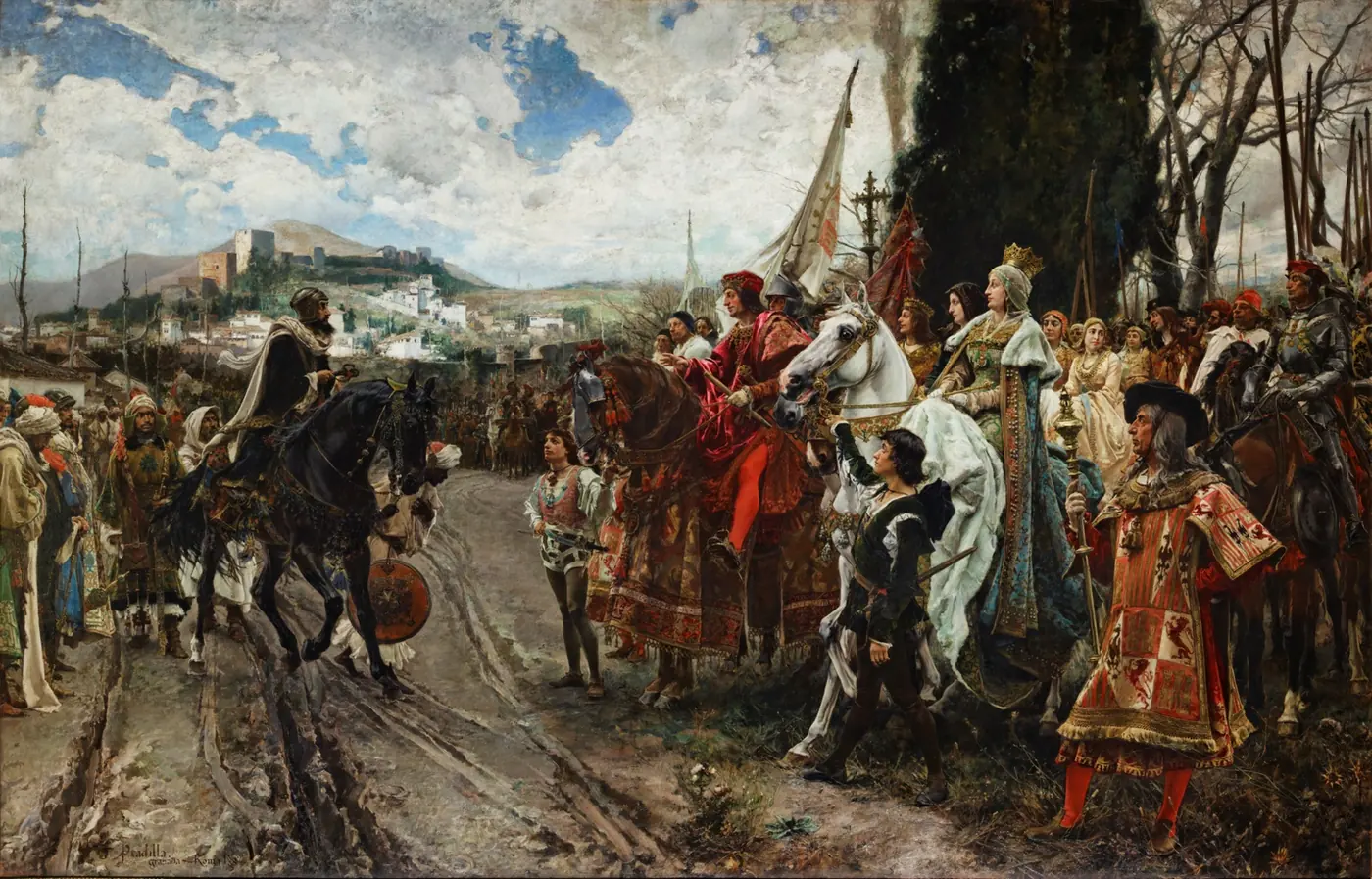
Ferdinand of Aragon and Isabella of Castile were the king and queen whose 1469 marriage joined Spain's two largest kingdoms. They are known as the Catholic Monarchs, a title the pope gave them in 1496. In a single year, 1492, they conquered the last Muslim state in Iberia, ordered the expulsion of Spain's Jews, and sent Christopher Columbus west across the Atlantic. They created something close to a modern state, centralizing royal power, curbing the nobility, and building institutions that lasted for centuries. They also made religious uniformity a condition of belonging, with consequences that outlasted everything else they did.
How Ferdinand and Isabella married and took power
Isabella was born in 1451, the half-sister of King Henry IV of Castile. Ferdinand was born in 1452, the son of King John II of Aragon. They married on October 19, 1469, in Valladolid. She was eighteen and he was seventeen. They had met only days before the wedding.
As second cousins, they needed a papal dispensation to marry under Church law. The archbishop of Toledo solved the problem by presenting a forged papal bull attributed to Pope Pius II, who had been dead for five years. The real dispensation did not come until 1471, when Pope Sixtus IV issued one.
Isabella's claim to the Castilian throne was not settled by the marriage. When Henry IV died in 1474, Isabella declared herself queen, and a civil war followed against a rival claimant. Isabella won. Ferdinand inherited the crown of Aragon in 1479 when his father died. From that year, the two largest kingdoms on the Iberian Peninsula shared the same rulers, but they were not merged. Each kingdom kept its own laws, coinage, and courts, and a full legal merger did not come for another two centuries.
Ferdinand's motto, "tanto monta, monta tanto," meaning roughly "one is equal to the other," became a symbol of their shared rule. In Seville in 1477, Isabella made herself available every Friday for ordinary people to come and bring complaints.
What Ferdinand and Isabella did in 1492
Almost everything Ferdinand and Isabella are remembered for happened in a single year.
On January 2, 1492, the Muslim ruler Boabdil surrendered the city of Granada to Ferdinand and Isabella. Granada was the last Muslim-ruled state in the Iberian Peninsula. Its fall ended the reconquista, the Christian campaign to retake the peninsula, which had lasted nearly eight centuries. Ferdinand and Isabella received the keys to the Alhambra in person.
On March 31, Ferdinand and Isabella issued the Alhambra Decree, ordering all Jews in their kingdoms to convert to Christianity or leave by the end of July. Modern historians estimate that between 40,000 and 100,000 Jews left Spain. Many others converted to stay. Spain lost a community that had lived on the peninsula for over a thousand years, along with much of its commercial and intellectual talent.
On April 17, Ferdinand and Isabella signed the Capitulations of Santa Fe, the contract that sent Columbus west across the Atlantic. The voyage was a long-odds venture. Columbus was looking for a sea route to Asia, and what he found instead opened the Americas to Castilian conquest.
Behind all three acts was a single policy: religious uniformity. Ferdinand and Isabella had established the Spanish Inquisition in 1478 to police the faith of converts. After 1492, they pressed Muslims in the former lands of Granada to convert or leave as well.
How did Ferdinand and Isabella unify Spain?
Ferdinand and Isabella did not formally unite Spain into one kingdom. Castile and Aragon remained separate, with separate laws, courts, and tax systems. What Ferdinand and Isabella created was a political union held together by shared rulers, a shared faith, and shared institutions.
They centralized royal power, above all in Castile. They brought the nobility under control, reduced the power of the military orders, and built a professional royal bureaucracy. The Inquisition was their one truly unified institution, operating across both kingdoms under royal authority. The legal merger did not come until the eighteenth century, but the political framework Ferdinand and Isabella created held Spain together until then.
Ferdinand and Isabella's children
Ferdinand and Isabella had five children who survived to adulthood, and they married every one of them into a ruling European dynasty.
Their eldest daughter, Isabella, married into the Portuguese royal house. Their only son, Juan, the heir to both thrones, married Margaret of Austria but died in 1497 at the age of nineteen. Their daughter Juana married Philip of the Habsburg dynasty. Their daughter Maria married the king of Portugal. Their youngest, Catherine, married King Henry VIII of England.
The marriage strategy worked beyond anything Ferdinand and Isabella could have planned, though not through their son. Juana and Philip's son Charles inherited Spain, the Netherlands, and Austria, and was elected Holy Roman Emperor. He became the most powerful ruler in Europe and presided over the largest Spanish conquests in the Americas. The dynasty Ferdinand and Isabella built through their children shaped European politics for the next two centuries.
Isabella died in 1504. Ferdinand ruled alone until his death in 1516. The Spain they left behind was one of the most powerful states in Europe, built on the institutions they created and the empire their children's marriages assembled.