
Armenian Genocide
The Armenian Genocide was the Ottoman government's systematic killing of its Armenian population from 1915 to 1917, in which up to 1.5 million people died.
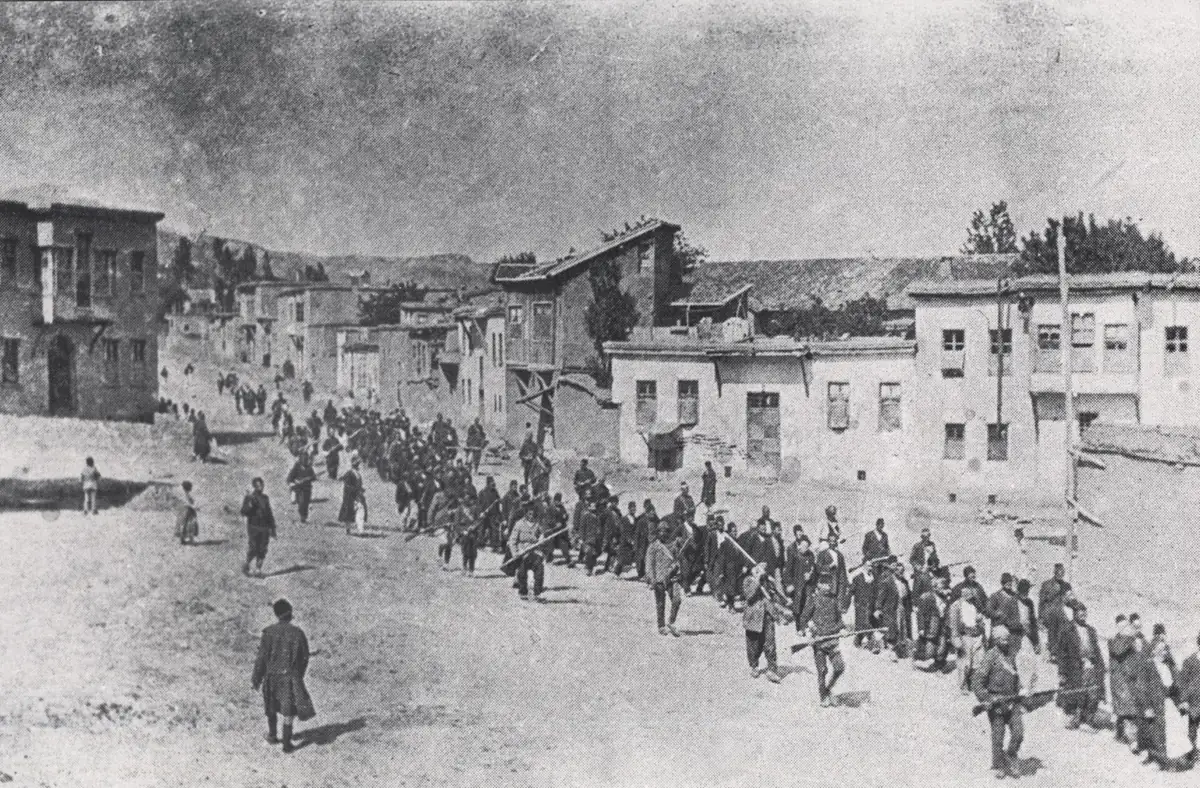
The Armenian genocide was the Ottoman government's systematic destruction of its Armenian population during the First World War. On April 24, 1915, Ottoman authorities rounded up hundreds of Armenian intellectuals, professionals, clergy, and community leaders across Constantinople. Most were killed. Over roughly two years, the government deported entire Armenian communities from Anatolia and forced them on death marches into the Syrian desert. Historians generally put the death toll between 600,000 and 1.5 million people. Turkey acknowledges that many Armenians lost their lives but disputes the use of the word genocide, a disagreement that still triggers diplomatic crises more than a century later.
How the Armenian genocide happened
Eastern Anatolia had been home to Armenians for more than two millennia. They adopted Christianity in the early fourth century. Before the war, roughly two million Armenians lived in the Ottoman Empire as a protected but subordinate community under the millet system. They paid different taxes from Muslims and were barred from testifying against Muslims in court.
As the Ottoman Empire shed its European territories through the nineteenth century, Muslim refugees moved east. Armenians were increasingly viewed as a community that might seek independence with support from Russia or another outside power. Sultan Abdul Hamid II ordered massacres between 1894 and 1896 that killed an estimated 80,000 to 300,000 people. Another mass killing took place at Adana in 1909.
The empire went to war alongside Germany and Austria-Hungary in late 1914. That December, Enver Pasha, the war minister, ordered the Ottoman Third Army into the Caucasus. Of the roughly 120,000 soldiers who set out, about 60,000 were dead, frozen, or captured within weeks after the Russians routed them at the Battle of Sarikamish. Enver blamed the defeat on Armenian disloyalty.
In April 1915, Armenians in the city of Van learned that people in nearby villages were being massacred and took up arms, holding their part of the city until a Russian force reached them. The Ottoman government used the Van uprising as proof that Armenians as a whole could not be trusted. On May 27, 1915, it passed a deportation law.
In the months that followed, the government emptied Armenian towns and villages across Anatolia. Families typically received only days of warning. Men and older boys were pulled from the groups first and executed. Women, children, and the elderly were forced to walk hundreds of kilometers toward the desert of northern Syria, given no food, water, or shelter. They were guarded by Ottoman gendarmes and by gangs of pardoned criminals recruited into a paramilitary force called the Special Organization. Most of those who survived the marches and reached the camps around Deir ez-Zor died from hunger, thirst, and disease, or were executed during 1916. The Ottoman government also carried out mass killings of Assyrian Christians and Pontic Greeks during the same period, using the same deportation methods.
Henry Morgenthau, the American ambassador to the Ottoman Empire, sent detailed reports of the killings to Washington. German officers allied with the Ottomans compiled their own accounts. Armin Wegner, a German medic serving with the Ottoman army, photographed the marching columns and smuggled his images out of the country. Those photographs are the main reason visual evidence of the genocide survives.
How many Armenians died in the Armenian genocide?
Historians generally estimate that between 600,000 and 1.5 million Armenians were killed from 1915 to 1917, with many figures clustering between 800,000 and 1.2 million. Turkey puts the toll at roughly 300,000 and says the deaths were a consequence of wartime displacement, hunger, epidemic disease, and intercommunal violence, not a deliberate campaign of extermination.
After the war, Ottoman military tribunals in 1919 and 1920 found several of the organizers guilty, but most had already left the country. Armenian assassins tracked them down in a campaign called Operation Nemesis. Soghomon Tehlirian shot Talat Pasha, the former interior minister and a chief architect of the genocide, on a street in Berlin on March 15, 1921. A German jury acquitted Tehlirian after hearing testimony about what Talat had planned and ordered. The Polish-Jewish lawyer Raphael Lemkin, who coined the word "genocide" in 1944, later said that it was the fate of the Armenians that first made him think about the need for such a term.
Which countries recognize the Armenian genocide?
More than thirty countries formally recognize the Armenian genocide, and Turkey has recalled its ambassador from several of them in protest. France recognized it in 2001, Germany in 2016, and the United States, where Congress passed recognition resolutions in 2019 and President Biden formally acknowledged it in 2021. Israel's government unanimously voted to recognize it in June 2026, after decades of avoiding the question because of its relationship with Turkey.
Turkey's position is that the word genocide does not apply. Turkish law, specifically Article 301 of the penal code, has been used to prosecute people who say otherwise. The Turkish-Armenian journalist Hrant Dink was tried under that law for writing about the genocide. He was shot dead outside his newspaper's office in Istanbul on January 19, 2007.
The Turkish-Armenian land border has been closed since 1993, when Turkey shut it during the war between Armenia and Azerbaijan over Nagorno-Karabakh. As of 2026, the two countries are negotiating to reopen it, but it remains shut. The Armenian genocide remains one of the few events in history that still produces a diplomatic crisis whenever a government takes a public position on it.