
Sublime Porte
The Sublime Porte was the Ottoman Empire's central government, named after the gate to the grand vizier's compound in Istanbul.
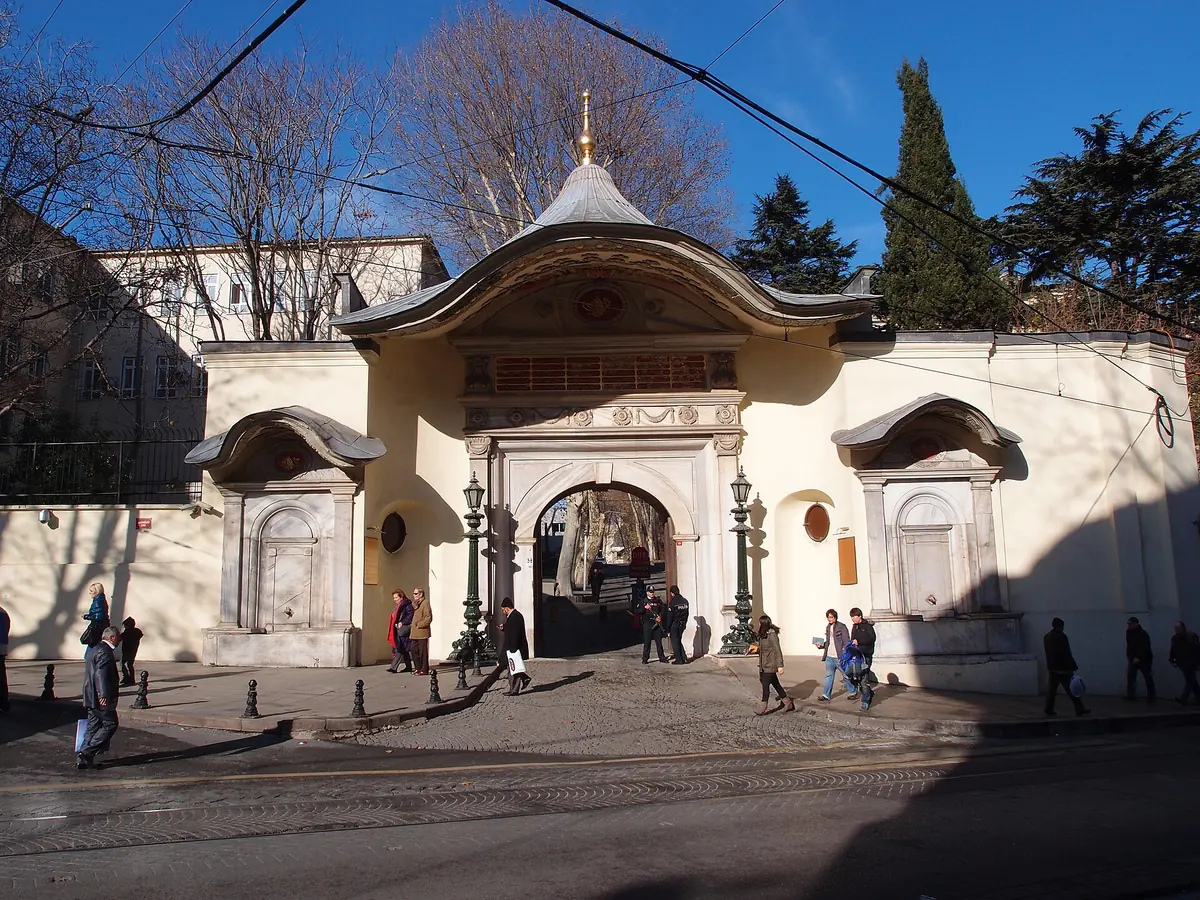
The Sublime Porte was the name Europeans used for the Ottoman government from roughly the seventeenth century until the empire fell in 1922. It came from a real gate, the Bab-i Ali ("high gate" in Turkish and Arabic), the main doorway of the grand vizier's government complex in Istanbul. The complex held the offices where the empire's business was done. Petitioners came to this gate to be heard, and foreign ambassadors were received there. Over centuries the name shifted from the doorway itself to the government offices within, and finally to the Ottoman state as a whole. When a nineteenth-century diplomat said they had sent a message to the Sublime Porte, they meant the Ottoman government, the same way someone today says "the White House" to mean the American presidency.
How the Porte became the seat of Ottoman government
In the early Ottoman Empire, the sultan governed from Topkapi Palace, overseeing the imperial council. After the sixteenth century, sultans gradually withdrew from daily administration. The real work of running the empire shifted to the grand vizier's compound, known as the Pasha Kapisi. By the eighteenth century the Pasha Kapisi had become the permanent seat of government. The palace still held sovereignty and legitimacy, but the Porte was where the actual work of governing happened, from diplomatic correspondence to tax collection, managed by trained officials who administered provinces from southeastern Europe to the Arabian Peninsula. Foreign ambassadors dealt with these officials, not with the sultan directly.
This arrangement produced an unusual division of power. Ottoman diplomacy had traditionally relied on the chief scribe and on Greek translators from the Phanar district of Istanbul. When the Greek uprising of 1821 made relying on those families for sensitive government work politically impossible, the empire created a bureau called the Translation Office, where Muslim civil servants learned French, the language of European diplomacy. The office became far more than a language school. It produced an entire generation of reforming statesmen who went on to establish a foreign ministry, open standing embassies across Europe, and drive the Tanzimat reforms of 1839 to 1876. The Tanzimat created secular courts alongside Islamic ones and guaranteed equal legal rights to non-Muslim subjects for the first time. For most of this period, the empire's real governing happened at the Porte rather than the palace, and so did its modernization.
The raid on the Sublime Porte
Sultan Abdulhamid II reversed this arrangement in 1878. He suspended the constitution, moved the center of power back to his own palace at Yildiz, and governed through his own secretariat and an extensive network of informants. Ministers at the Porte waited for orders instead of making policy. This lasted thirty years. The 1908 Young Turk revolution, which started as a military mutiny in Macedonia, forced the constitution back into effect. Abdulhamid, unable to contain the revolt, restored the parliament he had dissolved three decades earlier.
The most violent episode in the Porte's history came on January 23, 1913. The empire was being defeated in the First Balkan War. The grand vizier, Kamil Pasha, was preparing to surrender Edirne, the empire's former European capital. Enver Bey, Talat Bey, and a group of officers from the Committee of Union and Progress forced their way into the Sublime Porte while the cabinet was meeting. One of Enver's men, an officer named Yakup Cemil, shot the minister of war, Nazim Pasha, dead in the corridor. The officers then held Kamil Pasha at gunpoint and made him write out his resignation on the spot. The raid gave a triumvirate known as the Three Pashas, Enver, Talat, and Cemal, control of the empire. Twenty-one months later they brought it into the First World War as a German ally, and the war destroyed it.
Why was it called the Sublime Porte?
The name is a French translation of the Turkish Bab-i Ali. In both Turkish and Arabic, bab means "gate" and ali means "high" or "exalted." In Ottoman tradition, a ruler's gate was where he held court and dispensed justice, so the gate came to stand for the government itself. European diplomats adopted the French translation, and the term stuck in international usage for centuries. The same pattern appears across cultures. "The Kremlin," "Whitehall," and "the White House" all use a place to stand for a government. The Sublime Porte was one of the oldest and most widely recognized examples.
The Porte ceased to exist when the Ottoman sultanate ended in November 1922. Turkey became a republic the following year, after the Treaty of Lausanne, and the new government deliberately moved the capital inland to Ankara. Its ministries were built there, far from the old imperial center in Istanbul. The Bab-i Ali gate still stands. The building behind it, rebuilt in 1844 after a fire, now houses the governor's office of Istanbul province.