
Ashoka the Great
Ashoka was a third-century BC Indian emperor who ruled most of the subcontinent, then renounced war and governed by Buddhist moral law.
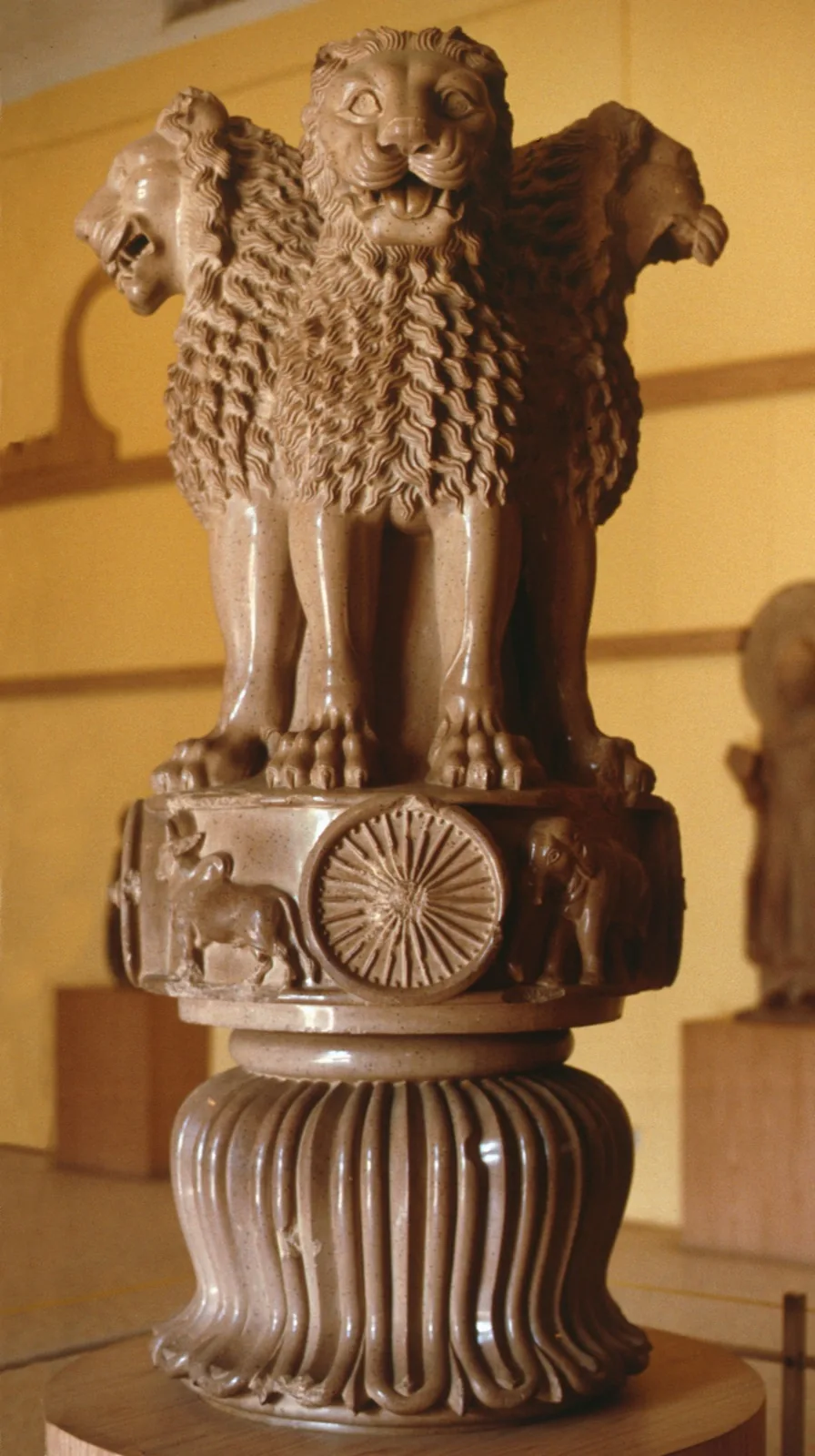
Ashoka was the third emperor of the Maurya dynasty, which ruled most of the Indian subcontinent in the third century BC. His empire stretched from what is now Afghanistan to India's east coast, the largest Indian empire until the Mughals nearly two thousand years later.
Around 261 BC, Ashoka conquered Kalinga, a kingdom in eastern India, in a war that killed and displaced hundreds of thousands of people. Afterward, he did something no known ruler before him had done: he had the cost of the war carved on rock for his subjects to read, and wrote that it caused him deep remorse. Kalinga was the last war Ashoka fought. He adopted Buddhism, reorganized his rule around a concept he called dhamma, or moral law, and spent the rest of his reign governing by persuasion instead of force. Today his symbols appear on India's national emblem and its flag.
How the Maurya empire was built
Ashoka's grandfather, Chandragupta Maurya, founded the empire around 322 BC. Chandragupta was a young soldier who overthrew the Nanda dynasty with the help of Kautilya, a Brahmin political strategist traditionally credited with the Arthashastra, one of the oldest surviving treatises on statecraft. Within about twenty years, Chandragupta controlled most of northern India and had pushed west into what is now Afghanistan, taking territory from the successors of Alexander the Great.
Chandragupta's son, Bindusara, expanded the empire further south. By the time Ashoka came to power around 268 BC, he inherited territory that covered nearly the entire subcontinent. Buddhist texts say he fought his way to the throne against his brothers, though the details vary and may be legend. What is clear is that Ashoka, like his father and grandfather, continued to expand the empire by war.
How the Kalinga war changed Ashoka
Around 261 BC, in the eighth year of his reign, Ashoka invaded Kalinga, a kingdom on India's east coast in what is now the state of Odisha. In edicts carved into rock years later, Ashoka recorded the cost: 100,000 people killed, 150,000 deported, and many more dead from other causes. He also wrote that the suffering caused him deep remorse.
After Kalinga, Ashoka adopted Buddhism and reorganized his government around dhamma. For Ashoka, dhamma meant tolerance between religious sects, welfare for his subjects, and ahimsa, the principle of not harming any living thing. His officials dug wells, planted shade trees along roads, and built rest houses and medical stations for both people and animals. He softened some of the harsher Mauryan punishments. He called this approach "conquest by dharma" and said it was better than conquest by force.
Ashoka was also the first ruler in Indian history to announce his policies directly to the public. He had edicts carved on tall sandstone pillars and large boulders placed across his territory. They were written in languages their audiences could read: Prakrit, in Brahmi and Kharosthi script, across most of India, and Greek and Aramaic for communities in the northwest that still used those languages from earlier Persian and Greek rule. A bilingual Greek-Aramaic edict was found in what is now Kandahar. More than thirty edicts survive today.
Ashoka sent Buddhist missions beyond his borders too. The most important went to Sri Lanka, where, according to tradition, Ashoka's own son Mahinda brought Buddhism to the island. It remains one of Sri Lanka's defining religions. Under Ashoka, Buddhism began its spread from a regional Indian sect into a religion that would eventually reach China, Japan, and Southeast Asia.
Nearly all the contemporary information we have about Ashoka's reign comes from these edicts. They are detailed and specific, but they are also Ashoka's own account of himself.
How did Ashoka die?
Ashoka died around 232 BC, probably of natural causes, after ruling for about 36 years. No reliable source records the circumstances of his death.
The Maurya dynasty weakened under his successors. In 185 BC, about fifty years after Ashoka's death, the last Maurya emperor, Brihadratha, was killed by his own general, Pushyamitra Shunga, during a military parade. The Maurya empire ended that day.
After his death, Ashoka was forgotten in India. He survived mainly in Buddhist texts, where monks preserved stories of the great king who had spread their faith. In India itself, no one could read his edicts anymore, and no one remembered who had put them there.
How Ashoka was rediscovered
In 1837, a British scholar named James Prinsep deciphered the Brahmi script, the writing system used on most of Ashoka's edicts. The inscriptions referred to their author as "Beloved of the Gods." Prinsep, working with colleagues who knew the Buddhist legends from Sri Lanka, realized that this title belonged to the same Ashoka the monks had written about. A king forgotten for more than a thousand years was suddenly real, and his own words were readable again.
Once rediscovered, Ashoka became a central symbol of modern India. When India became independent in 1947, its leaders chose Ashoka's symbols for the new nation. The Lion Capital from Ashoka's pillar at Sarnath, a polished sandstone sculpture of four lions standing back to back, became India's national emblem in 1950. The 24-spoke wheel from the same monument, called the Ashoka Chakra, appears at the center of India's flag. A king whose dynasty collapsed within fifty years of his death now represents the world's most populous country.