
Mughal Empire
The Mughal Empire ruled much of India between 1526 and 1857, built the Taj Mahal, and created a system of government the British kept.
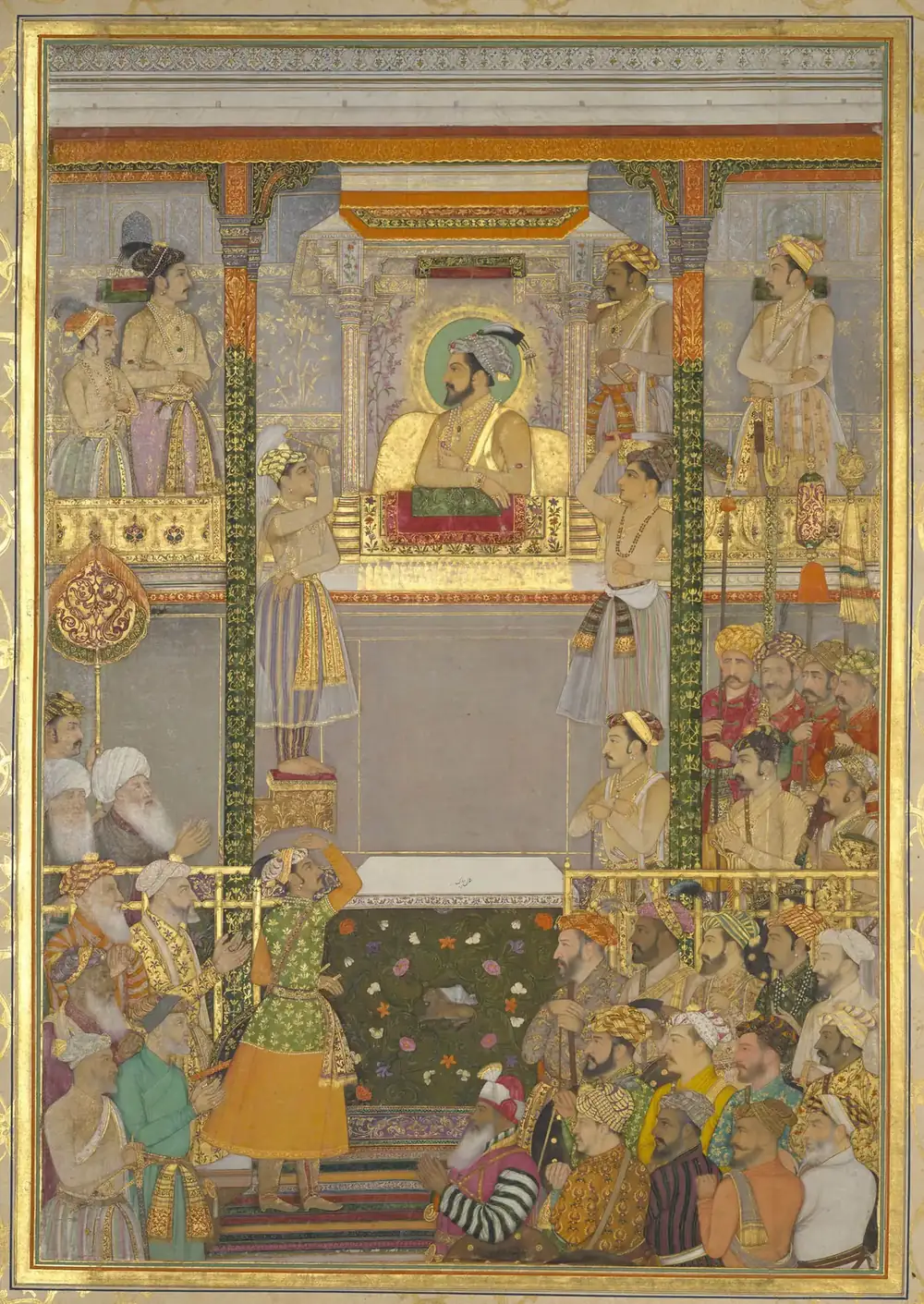
The Mughal Empire ruled much of the Indian subcontinent between 1526 and 1857. Its founder, Babur, was born in what is now Uzbekistan and lost his inherited territory twice before the age of twenty. He headed east in search of a kingdom he could hold, and the dynasty he established became one of the wealthiest states in history. By the late 1600s the empire governed roughly 150 million people and generated about a quarter of global economic output. The Mughals built the Taj Mahal, administered their lands in Persian, and set up a governing system so effective that the East India Company preserved most of it after taking control.
How Babur founded the Mughal Empire
Babur was born in 1483 in the Fergana Valley, in what is now Uzbekistan. Through his father he descended from Timur, the conqueror who had sacked Delhi in 1398. Through his mother he descended from Genghis Khan. He inherited a small kingdom at age eleven and lost it to rivals within a few years. After failing to hold Samarkand, Timur's old capital, he moved south, took Kabul in 1504, and spent the next two decades raising an army.
In April 1526 he brought that army to the plain of Panipat, north of Delhi, where it faced a Delhi Sultanate force several times its size. Babur had field cannons, matchlock guns, and disciplined cavalry. He lined up his cannons behind carts lashed together with ropes, forced the Delhi army into a frontal assault, and broke it. Sultan Ibrahim Lodi died on the field. Babur seized Delhi and established a dynasty that would govern India for the next two centuries. The word "Mughal" is a Persian form of "Mongol," a nod to his ancestry, though his family spoke Turkic and lived in a Persian cultural world.
How Akbar held the Mughal Empire together
Akbar, Babur's grandson, ruled from 1556 to 1605. He turned a military occupation into a durable state by solving the problem every Muslim ruler of India faced: a Muslim court of Central Asian origin governing a vast population that was mostly Hindu. Previous conquerors had kept apart from the Hindu majority and taxed it. Akbar chose inclusion.
In 1564 he scrapped the jizya, the special tax that non-Muslims paid. He took Rajput wives and appointed their brothers and fathers as imperial commanders, giving Hindu warriors a share of power rather than treating them as subjects. He created the mansabdari system, a numbered ladder of ranks that connected an officer's salary and military duties to his performance, not his family. Hindus rose through it alongside Muslims. At his court he gathered religious thinkers from every tradition he could find, including Muslim theologians, Hindu Brahmins, Jain monks, Zoroastrian priests, and Jesuit missionaries from Portuguese Goa. Few were persuaded, but the message was clear: the empire served all its people.
Akbar's revenue minister, Todar Mal, ordered a survey of the farmland in the empire's core provinces and graded each plot by what it could produce. The tax was set in cash at about one-third of normal output and held steady for several years, giving farmers enough certainty to plan ahead. The language of government was Persian, from Kabul to Bengal. That is why so much Persian vocabulary survives in Hindi and other northern Indian languages, and why Urdu itself grew out of the contact between Persian administrators and local populations.
How the Mughal Empire fell
Aurangzeb seized power in 1658. He imprisoned his father, Shah Jahan, the builder of the Taj Mahal, and had his brothers killed. Then he dismantled Akbar's inclusive system. In 1679 he brought back the jizya. He ordered Hindu temples pulled down in provinces where resistance was growing. In 1675 he had the ninth Sikh guru, Guru Tegh Bahadur, executed in Delhi. The empire grew to its largest size under Aurangzeb, but the price of that expansion destroyed it.
For twenty-six years, from 1681 until his death in 1707, Aurangzeb fought the Maratha confederacy in southern India. The campaigns drained the treasury and kept him hundreds of miles from Delhi for decades. Provincial governors, left on their own, learned to rule without him and eventually stopped obeying the capital. After Aurangzeb's death, his successors fought over the throne and never settled the question.
The decline was steep. In 1739, Nader Shah of Persia invaded and sacked Delhi, killing thousands and carrying off the Peacock Throne, the jeweled seat of Mughal power. Robert Clive defeated the Nawab of Bengal at the Battle of Plassey in 1757, and by 1765 the East India Company had taken over Bengal's tax collection. The Mughal emperor kept his title, but he lived on a Company pension and had no real authority.
The last emperor, Bahadur Shah Zafar, was an eighty-one-year-old poet when Indian soldiers rebelling against the Company in the uprising of 1857 named him their leader. The British convicted him and sent him to Rangoon, where he died in 1862.
What was the Mughal Empire known for?
The Mughal Empire is best remembered for its buildings. Shah Jahan built the Taj Mahal in Agra between 1632 and 1653 as a tomb for his wife, Mumtaz Mahal. The Mughals also built the Red Fort in Delhi and hundreds of gardens, tombs, and palaces across northern India.
The empire's economic weight was extraordinary. At its peak, Mughal India generated about a quarter of global economic output, roughly equal to all of Europe combined. Its textile industry, especially cotton and silk, supplied markets across Asia and Europe.
The Mughal system of government also outlived the dynasty. The East India Company did not tear down the existing administration. It adopted the Mughal tax system, continued using Persian for its records, and for a century maintained the pretense that it governed on the emperor's behalf. The question at the heart of Mughal history, whether a religiously diverse subcontinent should be governed through inclusion or through the dominance of one faith, did not end with the empire. The partition of India in 1947 was one answer to it.