
Alexander the Great
Alexander the Great was a Macedonian king who conquered the Persian Empire and spread Greek culture from Egypt to India before dying at 32.
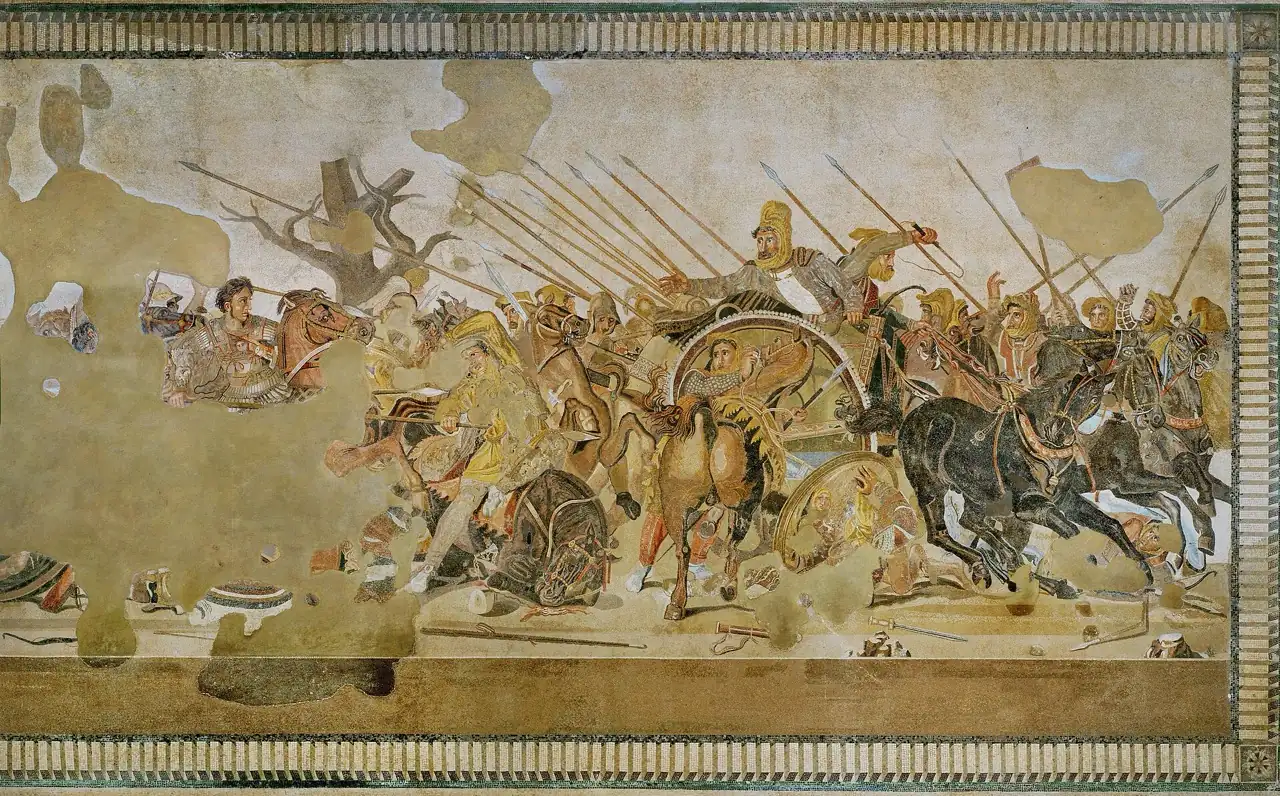
Alexander III of Macedon, known as Alexander the Great, was a Macedonian king who conquered the Persian Empire and led an army from Greece to India in eleven years. He was born in 356 BC in Pella, the Macedonian capital, and died in Babylon in 323 BC at the age of 32. He never lost a battle. His empire stretched from Egypt to modern Pakistan. It broke apart within a few years of his death, but Greek language and culture dominated the lands he had conquered for the next three hundred years. The Roman Republic later expanded into that Greek-speaking world and absorbed it.
How Philip II prepared Alexander for conquest
Alexander's father, Philip II, transformed Macedon from a minor kingdom into Greece's dominant military state. Philip created a professional army centered on the long-pike phalanx. He was planning to invade Persia when he was killed in 336 BC.
Alexander, then 20 years old, took the throne. He had spent about three years as a teenager studying under Aristotle. They worked through philosophy, science, and literature at a sanctuary near the town of Mieza. Alexander was also a natural horseman. At about 13, he tamed a horse named Bucephalus that no one else could ride, after noticing the animal was frightened by its own shadow and turning it to face the sun. Philip reportedly told him to find a kingdom worthy of himself, because Macedon was too small. Bucephalus carried Alexander through every major campaign until the horse died in India, roughly twenty years later.
Alexander spent two years putting down revolts in Greece and the Balkans. In 334 BC he crossed into Asia with about 40,000 soldiers and very little money.
How Alexander conquered the Persian Empire
Alexander's first major victory came at the Granicus River in 334 BC, near the coast of modern Turkey. The following year, at the Battle of Issus, he defeated the Persian king Darius III. Darius fled and left his family behind, including his mother, wife, and children. Instead of chasing the Persian king, Alexander turned south along the coast to deny the Persian fleet its ports. The city of Tyre held out under siege for seven months before he destroyed it. Egypt submitted without resistance, and Alexander founded the city of Alexandria there in 331 BC.
The decisive battle came at Gaugamela in October 331 BC. Darius had assembled a much larger army on a wide plain that his engineers had cleared and flattened to give his chariots room to charge. Alexander spotted a gap forming in the Persian formation and led his cavalry straight through it toward Darius. The Persian king fled the field once more. Babylon, Susa, and Persepolis, the Persian ceremonial capital, all fell in quick succession after that. Persepolis was burned. In 330 BC, one of Darius's own governors murdered him, leaving Alexander as the leading claimant to the Persian throne.
Alexander then spent three years in guerrilla fighting across Bactria and Sogdiana, in modern Afghanistan and Central Asia. During this campaign he took a local noblewoman named Roxana as his wife. In 326 BC he crossed into India and defeated the Indian king Porus, who fielded war elephants, at the Battle of the Hydaspes. At the Hyphasis River, his soldiers refused to go farther. They had been marching for eight years. Alexander turned back.
The return nearly destroyed what remained of the army. Alexander led much of it across the Gedrosian Desert, in what is now southern Pakistan and Iran. Ancient sources say more soldiers died of thirst and heat on that crossing than in any battle he had fought. The column that entered the desert may have numbered around 60,000 people, including soldiers, families, and camp followers. Modern estimates of how many of them perished vary widely.
Throughout the campaign, Alexander tried to merge the Macedonian and Persian ruling classes. He kept Persian officials in their posts and began wearing elements of Persian royal clothing. He expected his court to perform proskynesis, a formal bow that Persians gave their ruler, but his Macedonian officers resisted. Greeks bowed only to gods. In a drunken rage, Alexander stabbed his companion Cleitus to death over a quarrel about these Persian customs. Alexander's official historian, Callisthenes, a nephew of Aristotle, was arrested after opposing the bowing requirement and died in custody. At a mass ceremony in Susa in 324 BC, Alexander wed one of Darius's daughters, and roughly eighty of his officers took Persian wives in the same event. He also enrolled 30,000 young Persians in Macedonian-style military training.
How did Alexander the Great die?
Alexander died in Babylon on June 10 or 11, 323 BC, after roughly two weeks of fever. He was 32 years old. The cause has never been settled. Ancient writers suspected poisoning, and some named Antipater, his governor in Macedon, as the person behind it. Modern historians have proposed typhoid fever, malaria, and other infections common in ancient Babylon. He had named no successor. According to the ancient historian Diodorus, when asked who should inherit the empire, Alexander answered "the strongest."
What happened after Alexander the Great died?
His generals began fighting each other within two years. Four decades of warfare left three successor dynasties in control: the Ptolemies ruled Egypt, the Seleucids held western Asia, and the Antigonids governed Macedon. Cleopatra, the last Ptolemaic queen, did not die until 30 BC, nearly three centuries later.
Greek became the tongue of administration and commerce across the eastern Mediterranean and Central Asia. The city of Alexandria became the Mediterranean's largest port and housed its most celebrated library. For two hundred years, Greek-speaking kings governed parts of Afghanistan, and the coins they minted had Greek lettering on one face and local Indian scripts on the reverse.
The Roman Republic expanded into a world that already spoke Greek, not Persian. Educated Romans learned Greek as a second language, and Roman generals compared themselves to Alexander for centuries. Julius Caesar reportedly groaned before a statue of Alexander in Spain, dismayed that at the same age he had accomplished so little. More than two thousand years after Alexander's death, Napoleon brought a corps of scholars with him to Egypt, deliberately following Alexander's example.