
Avicenna (Ibn Sina)
Avicenna was a Persian physician and philosopher whose Canon of Medicine was used as a textbook in Europe and the Islamic world for centuries.
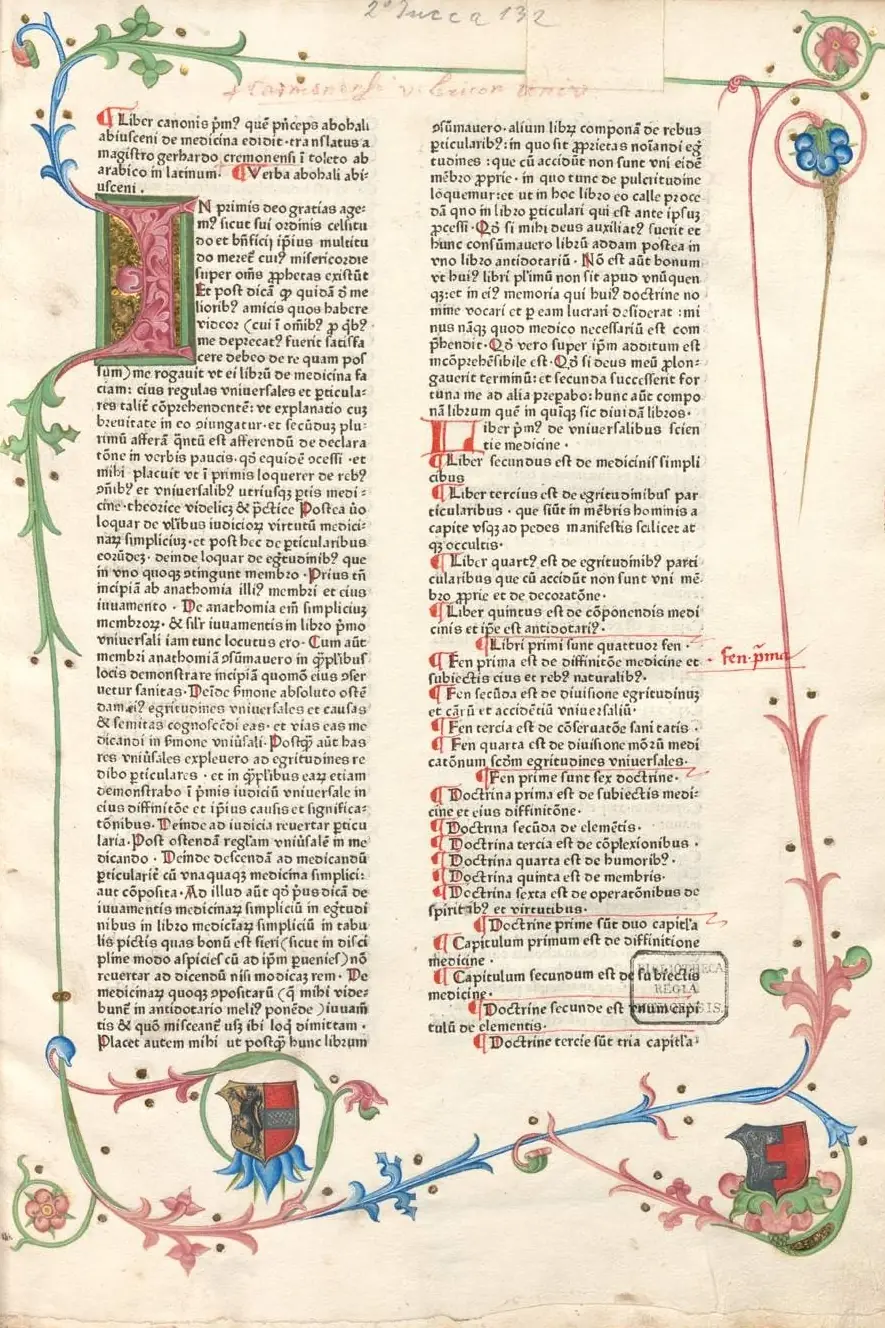
Avicenna, known in the Islamic world as Ibn Sina, was a Persian physician and philosopher born around 980 near Bukhara, in what is now Uzbekistan. He produced roughly 450 works on subjects from medicine to metaphysics. Around 240 survive. His most important book, the Canon of Medicine, brought together medical knowledge from Greek, Persian, and Indian sources in five volumes and roughly a million words. After it was translated into Latin in the twelfth century, European universities used it as a standard medical textbook for the next five hundred years. When the Canon was finished around 1025, neither Oxford nor Bologna yet had a medical faculty.
How Avicenna wrote the Canon of Medicine
Avicenna's father was a government official in the Samanid dynasty, and their home in Bukhara attracted visiting scholars. By the age of ten, Avicenna had memorized the Quran. He began studying medicine at thirteen and was treating patients by eighteen. Around that age, he cured the Samanid ruler Nuh II of an illness that other physicians had given up on. As a reward, the ruler gave him access to the royal library, one of the finest collections in the Islamic world.
His life after Bukhara was never settled. The Samanid dynasty collapsed, and Avicenna spent decades moving from one Persian court to the next as rulers gained and lost power. He served as a court physician and government administrator, and at one point was briefly imprisoned after a political reversal. Despite the instability, he was extraordinarily productive. He reportedly worked through the night and dictated long passages from memory. He began writing the Canon in Gorgan and completed it around 1025 in Hamadan.
Gerard of Cremona translated the Canon into Latin in twelfth-century Toledo, and from there it spread through European universities. Bologna, Montpellier, and Paris assigned it as a core text. Some medical schools were still teaching from it in the 1600s, more than five centuries after Avicenna wrote it.
Avicenna's contributions to medicine
The Canon did more than collect existing knowledge. It organized medicine into a system that could be taught and used. Avicenna defined diseases by their causes and symptoms, mapped anatomy, cataloged hundreds of drugs, and laid out treatments.
He also went beyond what Greek and Persian physicians before him had written. He proposed that some diseases passed between people through the air or water, centuries before anyone could see a pathogen under a microscope. He recommended isolating sick patients to prevent the spread of illness. He also wrote rules for determining whether a treatment was effective. A drug had to be tested on a simple disease, not a complex one. Its effect had to appear consistently across multiple patients. And results from animals might not apply to humans. These rules are often called the earliest written framework for clinical drug trials.
The Canon's five books covered general medical principles, simple drugs, diseases of specific organs, conditions affecting the whole body, and compound medicines.
Avicenna's philosophy and the floating man
Avicenna's other major work, the Book of Healing (Kitab al-Shifa), was not about medicine at all. The "healing" in the title referred to curing ignorance. It was an encyclopedia covering logic, natural science, mathematics, and metaphysics, written as a systematic engagement with Aristotle's ideas.
One of Avicenna's most famous arguments is the "floating man" thought experiment. He asked the reader to imagine a person created fully formed in midair, with no sensory input at all: no sight, no sound, no touch, not even the feeling of his own body. Avicenna argued that this person would still be aware of his own existence. The point was that self-awareness does not depend on the body or the senses. It belongs to the soul alone. The argument raised questions about consciousness and the relationship between mind and body that European philosophers would take up centuries later.
Avicenna also drew a sharp distinction between what a thing is (its essence) and the fact that it exists (its existence). This idea influenced both Islamic and Christian philosophy. Thomas Aquinas, writing more than two hundred years later, engaged directly with Avicenna's arguments when building his own theological system.
How did Avicenna die?
Avicenna fell ill with severe colic while traveling with his patron, the ruler Ala al-Dawla. He tried to treat himself, but an attendant administered the wrong dosage of a preparation, causing intestinal damage. His condition improved for a time, then worsened again. He died in June 1037 in Hamadan, in western Iran, at about fifty-seven years old.
His mausoleum still stands in Hamadan. The current structure, a tower blending Persian and Islamic architectural styles, was built in the early 1950s to replace an older monument. It includes a small museum and a library, and the square around it is named after him.