
Aristotle
Aristotle was a Greek philosopher who founded formal logic and studied everything from biology to politics by observing the world directly.
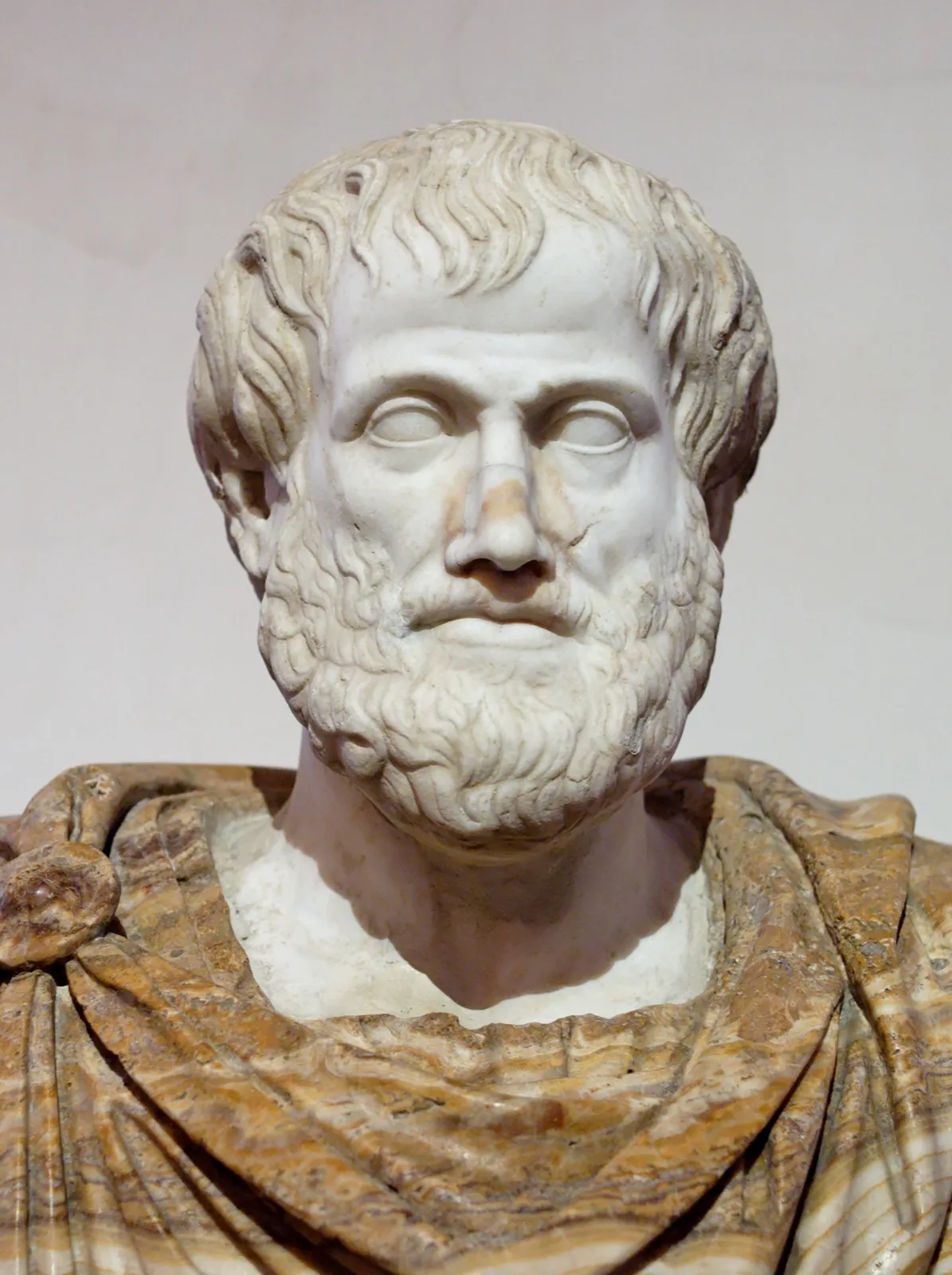
Aristotle was a Greek philosopher who lived from 384 to 322 BC. He wrote on logic, physics, biology, ethics, politics, rhetoric, and poetry. For centuries, scholars in Christian Europe called him simply "the Philosopher," with no other name needed. His teacher, Plato, built philosophy by reasoning toward ideal forms. Aristotle reversed the method. He looked at the world directly, collected specimens and observations, organized them by type, and developed his explanations from what he found. He founded formal logic, dissected and classified hundreds of animal species, examined how dozens of Greek city-states governed themselves, and asked what a good human life consists of. He wrote as many as 200 works. About 31 survive, and none of them is in finished form.
How Aristotle went from Stagira to the Lyceum
Aristotle was born in Stagira, a small town on the coast of northern Greece. His father, Nicomachus, was the personal physician to King Amyntas of Macedon, which gave Aristotle a connection to the Macedonian royal court from birth. Both of his parents died when he was young, and a guardian raised him.
At about seventeen, Aristotle traveled to Athens and entered Plato's Academy, the leading school of philosophy in Greece. He stayed for roughly twenty years, first as a student and then as a teacher. Over that time he absorbed Plato's ideas and gradually broke from them. Plato reasoned from abstract ideals downward. Aristotle preferred to start with what he could see and count, and reason upward.
After Plato died in 347 BC, Aristotle left Athens. Around 343 BC, King Philip II of Macedon hired him to tutor his thirteen-year-old son, Alexander. Aristotle taught the prince and a small group of Macedonian nobles at a sanctuary in Mieza for about three years. The subjects included literature, rhetoric, philosophy, and natural science. Alexander reportedly developed a lasting interest in zoology and botany from Aristotle's teaching, and when he later invaded Asia he brought teams of naturalists along with his army.
Around 335 BC, Aristotle returned to Athens and founded his own school, the Lyceum, in a grove sacred to Apollo Lyceus. His students were called Peripatetics, a name that probably comes from the covered walkway, or peripatos, where Aristotle liked to teach while walking. His wife Pythias died around the time the school opened. Aristotle later had a son, Nicomachus, with a woman named Herpyllis, who may have come from his hometown of Stagira.
Aristotle ran the Lyceum for about twelve years. When Alexander died in 323 BC, anti-Macedonian anger in Athens turned on Aristotle because of his ties to the royal court. He was charged with impiety. Rather than stand trial, Aristotle left for Chalcis on the island of Euboea, where he died the following year at the age of 62.
What Aristotle studied and wrote
The range of Aristotle's surviving work has no real parallel. He developed the syllogism, the basic structure of logical argument, and with it founded formal logic as a discipline. He cut open animals and grouped hundreds of species by their physical features. In the Nicomachean Ethics, he argued that the good life comes from practicing virtue and moderation. He and his students gathered the governing systems of more than 150 Greek city-states, and in the Politics he analyzed how they actually functioned, rather than only designing an ideal one. He coined the phrase that a human being is "by nature a political animal," meaning that people can only live fully within a community.
Most of what survives reads like lecture notes rather than polished prose. Ancient sources say Aristotle also wrote finished dialogues for the public, praised in antiquity for their style. Nearly all of those dialogues are lost. What remains is dense, technical, and clearly meant for students, not general readers.
Aristotle was wrong about some things. He believed the Earth sat at the center of the universe and built his physics around a theory of four elements. But the ambition to observe, catalog, and explain the entire natural and human world in a single system was new. The method he used to do it, building theory from collected evidence, outlasted his specific conclusions.
What is Aristotle's full name?
Aristotle did not have a full name in the modern sense. Ancient Greeks typically used a single given name. He is sometimes called "Aristotle of Stagira" or "the Stagirite" after his birthplace. His father's name was Nicomachus, so in the Greek convention he could be identified as "Aristotle, son of Nicomachus," but this was not a formal surname. Medieval scholars called him simply "the Philosopher," and that title stuck for centuries.
How Aristotle's ideas were lost and found again
After the fall of Rome, most of Aristotle's works disappeared from Western Europe. They survived in part because scholars in the Islamic world translated them into Arabic, studied them, and wrote on them extensively. Avicenna, the Persian physician and philosopher, built his own philosophical system on Aristotle's foundations. Averroes, a twelfth-century scholar from Córdoba in Muslim Spain, wrote such thorough line-by-line commentaries that later European scholars called him simply "the Commentator."
Aristotle's texts came back into Europe from Arabic and Greek sources during the twelfth and thirteenth centuries. Thomas Aquinas, a Dominican friar, combined Aristotle's philosophy with Christian theology in a synthesis so influential that it became the foundation of Catholic intellectual life. For centuries after that, Aristotle's authority dominated European universities. Professors taught his physics, his logic, and his biology as settled truth.
That dominance eventually became a problem. The scientific revolution of the 1600s partly defined itself in opposition to Aristotelian ideas that had become dogma. But the scientists who overturned Aristotle's specific answers kept using something close to his method: observing the world, collecting evidence, and building theory from it. Political scientists who compare real governments, biologists who build taxonomies, and philosophers who ask what a flourishing life consists of are all working in a tradition that Aristotle started.