
Camp David Accords
The Camp David Accords were the 1978 agreements between Egypt and Israel that produced the first Arab-Israeli peace treaty.
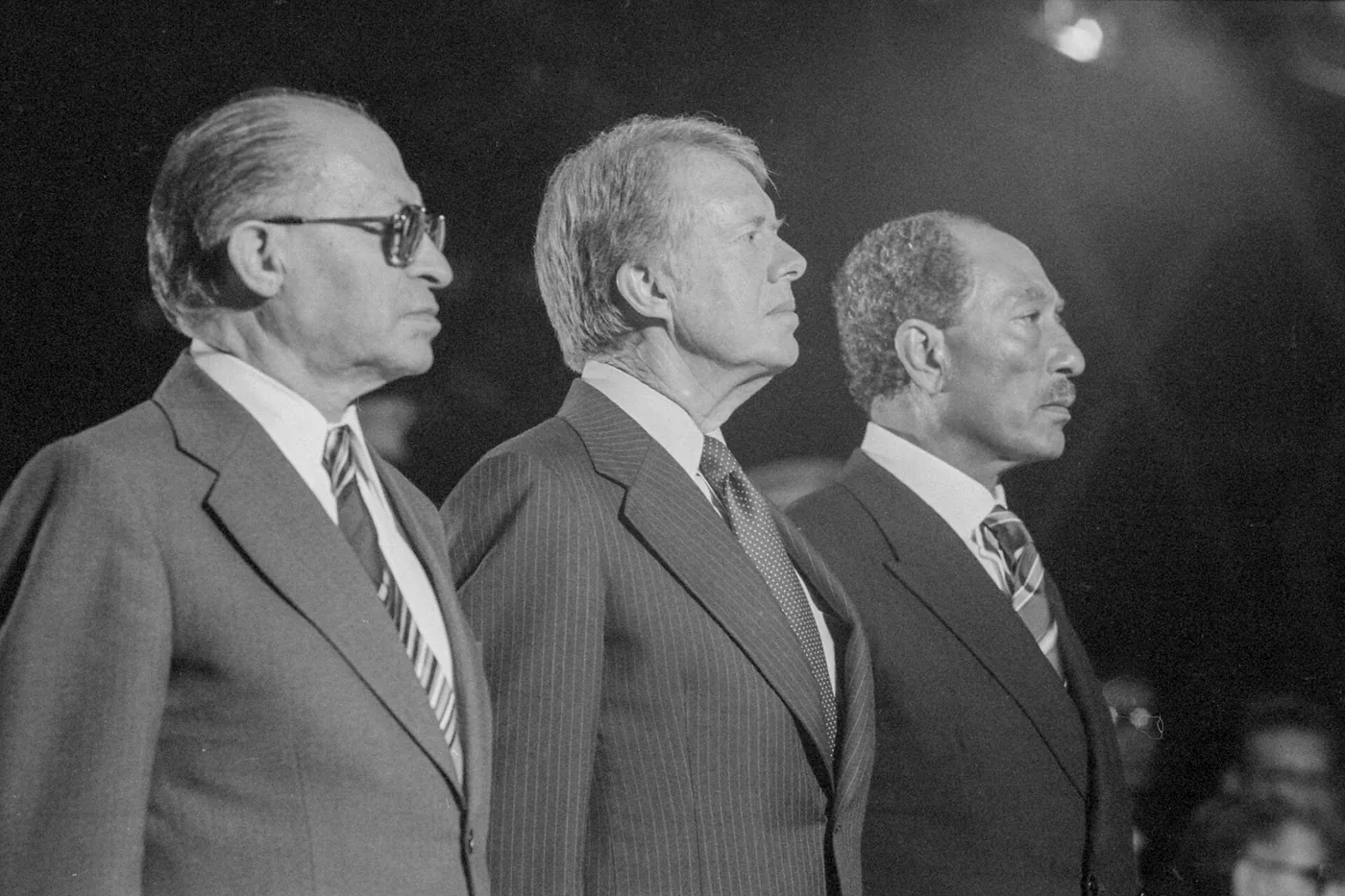
The Camp David Accords were two agreements signed on September 17, 1978, after thirteen days of negotiations at Camp David, the presidential retreat in Maryland. US President Jimmy Carter brought together Egyptian President Anwar Sadat and Israeli Prime Minister Menachem Begin to negotiate directly. The first agreement led to a peace treaty between Egypt and Israel, signed in March 1979, the first peace between Israel and any Arab state. The second agreement promised self-government for the Palestinian population of the West Bank and Gaza Strip. That part was never carried out. Both leaders received the Nobel Peace Prize in 1978. Three years later, Sadat was assassinated by soldiers from his own army, in part for making peace with Israel.
How Sadat came to make peace with Israel
Egypt fought four wars against Israel between 1948 and 1973. In the 1967 war, Israel seized the entire Sinai Peninsula, including Egypt's oil fields and the east bank of the Suez Canal. Egypt's president, Gamal Abdel Nasser, died in 1970, and Sadat succeeded him.
Sadat launched a surprise attack across the Suez Canal on October 6, 1973. Egypt did not defeat Israel, but the crossing restored its military credibility and gave Sadat something to negotiate from. Then he made a calculation that no Arab leader had made before. Egypt was pouring much of its budget into a military standoff it had no way of winning, and the broader question of Palestine belonged to the whole Arab world, not to Egypt alone. He had already expelled his Soviet military advisers in 1972, and now he turned to Washington for support.
In November 1977, Sadat traveled to Jerusalem and spoke before the Israeli Knesset. He was the first Arab leader to visit Israel. His own foreign minister, Ismail Fahmi, resigned in protest before the trip. Much of the Arab world never forgave it. But the visit led to direct talks with Israel.
Thirteen days at Camp David
Carter invited Sadat and Begin to Camp David in September 1978 because direct negotiations between Egypt and Israel had stalled. The two leaders disliked each other intensely. After the first few days they refused to sit in the same room, so Carter shuttled between their cabins with drafts, revising the text through twenty-three versions.
The two men had very different backgrounds. Sadat was born in 1918 in Mit Abul Kom, a small village north of Cairo, the son of a military hospital clerk. He was one of the Free Officers who overthrew the Egyptian monarchy in 1952 and had spent time in prison for plotting against the British during World War II. Begin was born in 1913 in Brest-Litovsk, in what is now Belarus. He studied law at the University of Warsaw, led the Zionist militant group Irgun in British Palestine, and lost both parents and his brother to the Holocaust. Only he and his sister survived.
On the thirteenth day, Begin was packing to leave. Before that, he had asked Carter to sign photographs of the three leaders for his grandchildren. Carter found out each grandchild's name and wrote it on a photograph with a message about peace. When Carter brought them to Begin's cabin, Begin read the names aloud, one by one, and his eyes filled with tears. He put his bags down and agreed to try once more. On September 17, all three signed the accords at the White House.
What did the Camp David Accords achieve?
The accords had two parts. The first dealt with Egypt and Israel and produced a formal peace treaty, which the two countries signed in Washington on March 26, 1979. Israel completed its withdrawal from all of the Sinai by 1982, removing every settlement and air base it had built there. For the first time, an Arab state recognized Israel. Egypt established full diplomatic relations. A Multinational Force and Observers was stationed in the Sinai to monitor the border, and it remains there in 2026. Egypt and Israel have been among the largest recipients of US foreign aid since 1979. The United States provides Israel about $3.8 billion per year in military aid and Egypt about $1.3 billion.
The second part promised transitional self-government for the Palestinian population of the occupied territories, with negotiations on a permanent arrangement to follow within five years. The talks included no Palestinian representatives. Begin read the word "autonomy" as narrowly as the agreement permitted, and Israeli settlement construction in the West Bank continued. The framework produced no result. Palestinian self-government was the issue the Oslo Accords tried to resolve in 1993. It remains unresolved.
What the Camp David Accords cost
The Arab League suspended Egypt in March 1979 and moved its seat to Tunis. Nearly every Arab government severed diplomatic ties with Cairo. Sadat's critics in the Arab world said he had traded the Palestinians for the Sinai. Egypt was not readmitted to the Arab League until 1989.
On October 6, 1981, during a military review commemorating the 1973 war, an Egyptian army lieutenant named Khalid Islambouli jumped from a passing truck and opened fire on the reviewing stand. Sadat was killed. Islambouli declared that he had killed Pharaoh. At his trial, he named the peace with Israel as one of his reasons. Three former American presidents, Richard Nixon, Gerald Ford, and Jimmy Carter, flew to Cairo for Sadat's funeral. Almost no Arab leaders came.
Begin resigned as prime minister in 1983 after the 1982 Lebanon War and the death of his wife. He spent the last nine years of his life in near-total seclusion and died in 1992.
The Camp David Accords today
No coalition of Arab states has fought Israel since Camp David. The peace between Egypt and Israel is cold and unpopular with the Egyptian public. It has survived a revolution, a military coup, and several wars in Gaza. It persists because the arrangement serves both governments. The treaty gives Egypt American aid and limits military forces in the Sinai. It gives Israel a secure southern border.
The Palestinian question that Camp David left open is still open. Every negotiation since, from Oslo in 1993 to the present, has tried to close it. None has succeeded.