
Suez Canal
The Suez Canal is a 120-mile waterway across Egypt that connects the Mediterranean to the Red Sea and normally carries about 12 percent of world trade.
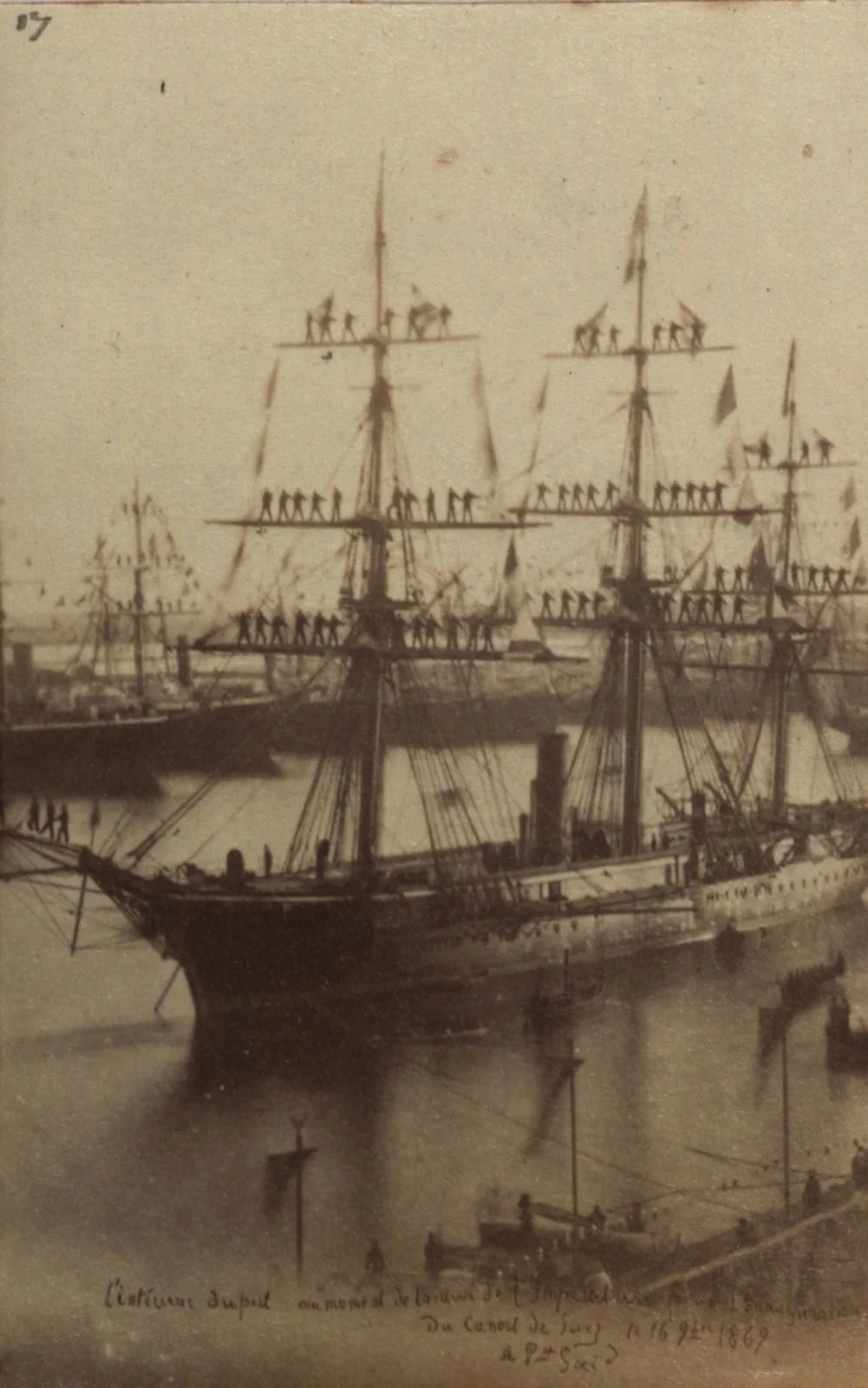
The Suez Canal is a 120-mile waterway cut through the Egyptian desert that connects the Mediterranean Sea to the Red Sea. It runs from Port Said on the Mediterranean coast to the city of Suez on the Red Sea. The canal opened on November 17, 1869. Before it existed, the only sea route from Europe to Asia went around the southern tip of Africa. The canal cut roughly 4,500 miles from the voyage between London and Bombay. It has no locks, because the Mediterranean and the Red Sea sit at nearly the same level, so ships pass straight through. The canal was built by a French company, Egypt has owned and operated it since 1956, and in normal years about 12 percent of global trade moves through it.
How the Suez Canal was built
The idea of a canal across Egypt goes back to antiquity, but the modern canal was the work of one Frenchman. Ferdinand de Lesseps was a former diplomat with a talent for promotion and no engineering training. He had served as consul in Egypt and used a personal friendship with Egypt's ruler to win a concession for building the canal. He raised the capital, mostly from French investors, and oversaw ten years of construction. In the early years, the work relied on forced Egyptian labor, with thousands of peasants conscripted to dig by hand across the desert.
The canal opened on November 17, 1869, with a ceremony meant to announce Egypt as a modern state. French Empress Eugenie sailed at the head of a procession of decorated ships. London had called the whole scheme unrealistic and refused to invest. But the British were the first to benefit from it. By the 1870s, most of the ships passing through the canal were British. The canal had become the quickest way for Britain to reach India, the most valuable territory in its empire.
How Britain took control of the Suez Canal
In 1875, Egypt's ruler, Khedive Ismail, ran out of money. He had borrowed heavily from European banks to modernize Egypt, building new railroads and reshaping Cairo, and by the mid-1870s he could not keep up with the payments. Britain's prime minister, Benjamin Disraeli, acted fast. He borrowed £4 million from the Rothschild banking family and bought Egypt's 44 percent stake in the canal company before Parliament could debate the purchase. Britain, which had once dismissed the canal as unrealistic, now owned nearly half of it.
Owning shares did not give Britain control of the territory around the canal. In 1882, a nationalist revolt in Egypt threatened the canal zone, and Britain responded by invading and occupying the country. The occupation lasted, in some form, for over seventy years. The canal became what the British called "the lifeline of empire." Troops, mail, and trade between London and India, Australia, and East Asia all passed through it. For the Royal Navy and merchant ships, using the canal cut the voyage to India from about two months to three weeks. During World War I, the Ottoman Empire attacked the canal zone but failed to take it. During World War II, defending the canal was a central goal of the Allied campaign in North Africa.
Who owns the Suez Canal today?
Egypt owns the Suez Canal. In 1956, Egypt's president, Gamal Abdel Nasser, nationalized the canal, ending decades of shared French and British ownership. Britain, France, and Israel launched a joint invasion to take it back, but the Suez Crisis ended in their retreat under American pressure. Egypt kept the canal, and the Suez Canal Authority, a state-owned Egyptian agency, has operated it since then. The canal is one of Egypt's largest sources of foreign currency. In 2015, Egypt completed a major expansion, adding a second channel along part of the canal's length to allow two-way traffic.
The canal has been closed or disrupted several times since nationalization. It was shut for eight years after the 1967 Arab-Israeli war, when the canal sat on the front line between Egyptian and Israeli forces. In March 2021, a container ship called the Ever Given ran aground and blocked the canal for six days, stopping billions of dollars in goods from moving. Starting in late 2023, missile and drone strikes on Red Sea shipping by Yemen's Houthis have driven much of the traffic back to the old route around the southern tip of Africa. The canal's portion of Asia-to-Europe shipping has not recovered.
The Suez Canal remains one of the world's key maritime chokepoints. When it is open and safe to use, it saves time and money for nearly every country that trades by sea.