
Chaebol
The chaebol are South Korea's family-controlled conglomerates, including Samsung, Hyundai, and LG, that drove the country's rapid industrialization.
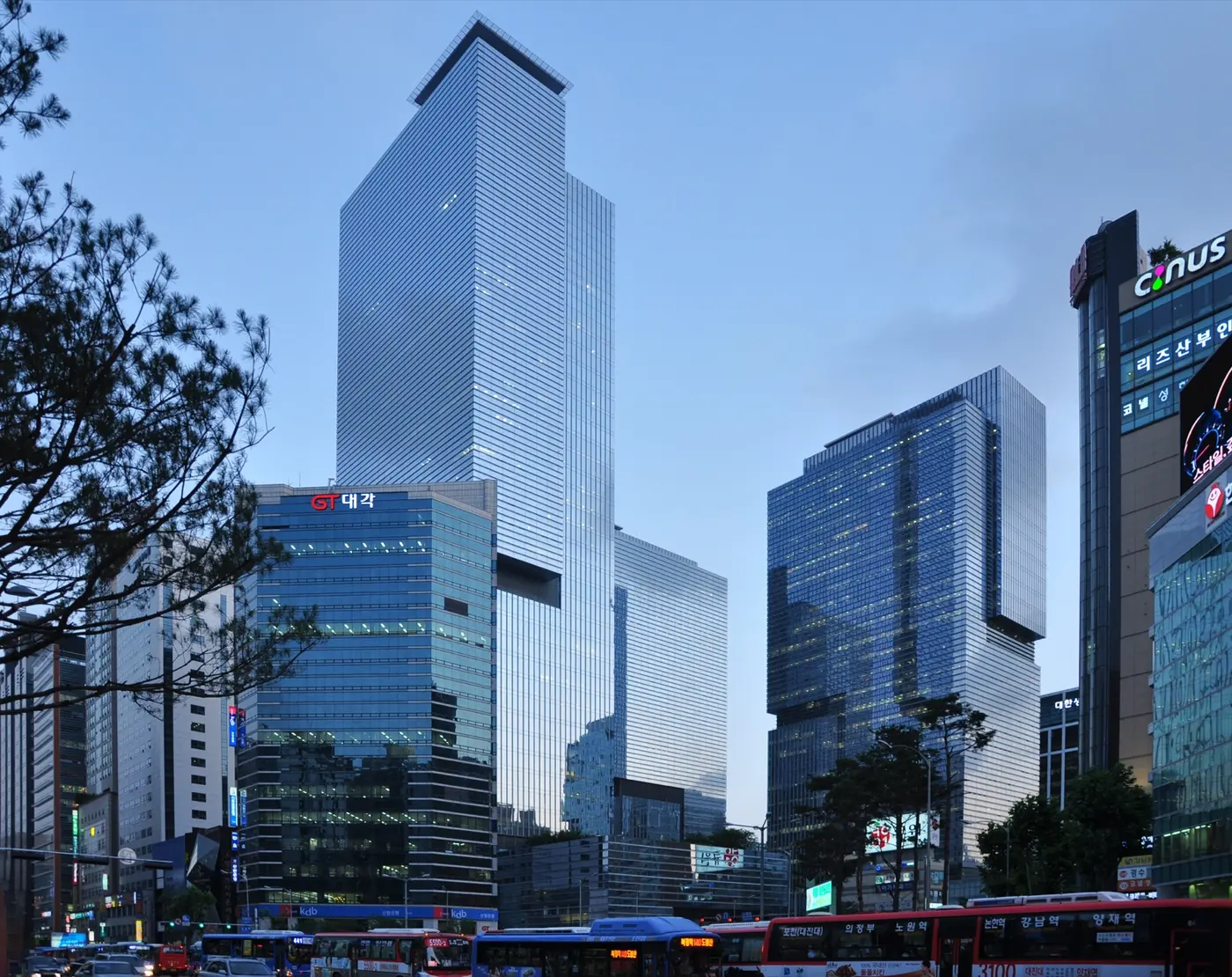
The chaebol are South Korea's giant family-controlled conglomerates. The word means "wealth clan" in Korean. Samsung, Hyundai, SK, LG, and Lotte are among the best known. They were built up in the 1960s when the South Korean government set out to industrialize a country that, in 1960, was poorer per person than Ghana and had barely any factories. In roughly twenty years, South Korea was building ships, cars, and semiconductors, and the chaebol drove that transformation. In 2024, Samsung's group revenue alone equaled about 13% of South Korea's GDP. The five largest chaebol groups together account for more than half the value of the country's stock market. The founding families still control these conglomerates through networks of cross-shareholdings, and successive governments have tried and failed to reduce their influence.
How Park Chung-hee built the chaebol
In May 1961, Major General Park Chung-hee led a military coup and took control of South Korea's government. The country was impoverished, dependent on American aid, and had almost no industrial base. Park's plan was straightforward: the state would choose which companies to grow. Because the government ran the banks, it controlled who got credit, and it directed low-interest loans, import barriers, and operating licenses toward a handful of favored business owners. The price was strict export quotas. Owners who met their targets kept receiving support. Those who fell short could lose everything.
The system resembled Japan's prewar zaibatsu, and it produced a similar kind of company: a family-run conglomerate spanning dozens of unrelated industries, deeply tied to the government.
Chung Ju-yung was the eldest son of a poor farming family from what is now North Korea. He had come to Seoul as a teenager, worked as a laborer and a rice-store owner, and founded a construction company called Hyundai in 1947. Under Park's system, Hyundai won contracts to build the largest share of the 428-kilometer Gyeongbu Expressway from Seoul to Busan, and the whole road was finished in about two and a half years, starting in 1968. Chung then pushed into shipbuilding with no experience in it. In 1972 he broke ground on a shipyard at Ulsan and signed an order for two supertankers from a Greek shipping magnate before the yard was even built. The ships and the shipyard were finished at the same time.
Lee Byung-chul, the son of a wealthy landowning family, had founded Samsung in 1938 as a small trading company in Daegu. He studied economics at Waseda University in Tokyo before returning to Korea. By the time Park took power, Samsung had already moved into sugar refining and textiles. Under Park's system, the group expanded into electronics and over the following decades became the largest company in South Korea.
This period of rapid growth is called the Miracle on the Han River. Few countries have ever industrialized so fast.
How chaebol families keep control
A single chaebol group can include dozens of companies in unrelated industries. Samsung, for example, makes semiconductors, phones, and appliances, but also runs a construction arm, a life insurance company, and a hospital chain. What holds these companies together is ownership: the companies own shares in each other, sometimes forming a closed loop of cross-shareholdings. Company A owns part of Company B, B owns part of Company C, and C owns part of A. This structure lets the founding family control the entire group while owning only a small percentage of its shares. The Lee family holds roughly 5% of Samsung's shares but effectively controls the company.
That concentration of power has led to repeated corruption scandals. In 2016, South Korea's president, Park Geun-hye, the daughter of Park Chung-hee, was impeached after it emerged that she and a close confidante had pressured Samsung and other conglomerates to donate tens of millions of dollars to private foundations. Lee Jae-yong, the Samsung founder's grandson and the group's current leader, was found guilty of bribery, jailed, released on parole in 2021, and pardoned by the next president in 2022. The government justified the pardon on economic grounds: it said the country needed Lee Jae-yong running Samsung.
Why no government has reformed the chaebol
South Korean presidents have been promising to rein in the chaebol for decades. The difficulty is that the companies are too important to the economy to punish severely.
The closest thing to a reckoning came during the 1997 Asian financial crisis. Daewoo, at the time among the biggest of the conglomerates, went under in 1999 carrying roughly $50 billion in debt (about $97 billion in 2025 dollars). It ranked as one of the largest corporate collapses ever recorded. Its founder, Kim Woo-choong, fled the country. But the crisis did not break the chaebol system. The surviving groups grew even larger as they absorbed Daewoo's remains and expanded into new industries.
Critics say the chaebol crowd out smaller firms and startups, keeping South Korea dependent on a handful of family-controlled companies for its jobs, exports, and growth. The chaebol are the reason South Korea is rich, but the economy depends so heavily on them that any serious crackdown carries real risk. Taking power away from the families whose companies dominate the country's economy is something every president has talked about and none has managed to do.