
Congo Free State
The Congo Free State was a territory in central Africa personally owned by King Leopold II of Belgium from 1885 to 1908.
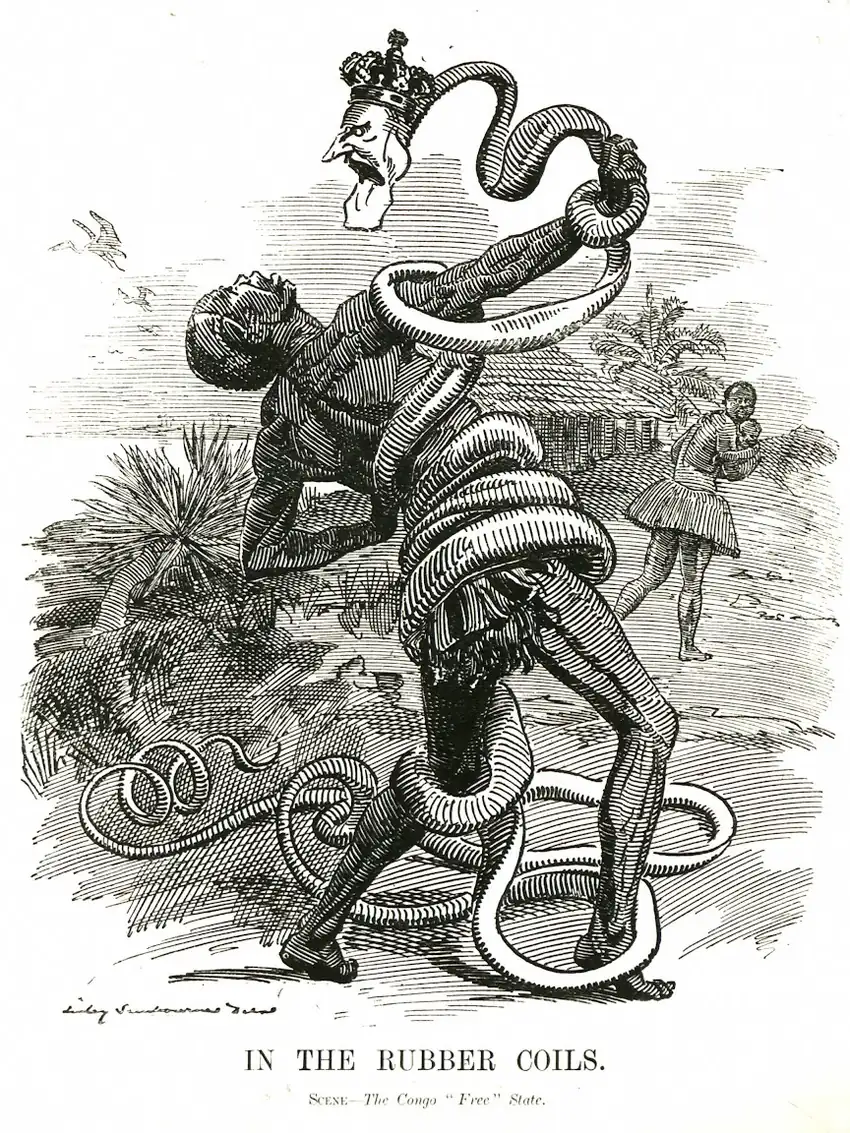
The Congo Free State was a territory in central Africa that King Leopold II of Belgium personally owned from 1885 to 1908. It was not a Belgian colony. It was one man's private property, covering nearly a million square miles, 76 times the size of Belgium. Leopold never visited it. He ran it from Brussels through a private army called the Force Publique. Its soldiers held families hostage, burned villages, and cut off people's hands to enforce rubber quotas. The system killed millions of people. No one knows the exact death toll because there was never a census, and Leopold ordered the state records destroyed before the handover.
How Leopold took the Congo
Leopold was king of Belgium, a country whose constitution left the monarch with almost no authority. He spent years trying to persuade Belgium's parliament to buy a colony. When parliament said no, he decided to acquire one on his own. In the early 1880s he sent Henry Morton Stanley, the famous explorer, up the Congo River to make agreements with local chiefs. Stanley got hundreds of chiefs to sign. Nearly all of them were illiterate and had no way of knowing the papers gave their land to a European king.
Leopold then lobbied European capitals, presenting himself as a philanthropist working to open central Africa to free trade and end the Arab traffic in enslaved people. In 1884 and 1885 the European powers met at the Berlin Conference and recognized Leopold's International Association of the Congo as the governing authority over the territory. The United States was the first country to give its recognition. Leopold, a monarch with almost no power in his own country, now personally owned a territory larger than western Europe.
How rubber made the Congo a forced labor system
For its first decade, the Congo Free State lost money on ivory. Then in the 1890s, John Boyd Dunlop's pneumatic tire set off a bicycle and automobile boom, and world rubber prices soared. The Congo basin had abundant wild rubber vines, and Leopold saw his opportunity. He declared all "vacant" land, which meant nearly all of the territory, to be state property. He imposed rubber quotas on villages and sent the Force Publique to collect.
The Force Publique was officered by Europeans and staffed by conscripted Africans. When a village fell short of its quota, soldiers seized women and children and held them captive until the village's men delivered enough rubber sap. Villages that still fell short were burned. Ammunition was costly, and European officers worried that African soldiers were spending rounds on game instead of enforcement. To account for every bullet, soldiers had to produce a severed right hand for every cartridge they fired. This created a trade in severed hands, some cut from people who were still alive. Missionaries photographed mutilated children, and those images were among the earliest photographs of mass atrocity to reach a global audience.
How the world found out about the Congo Free State
The exposure began with E. D. Morel, a clerk at the Liverpool shipping company Elder Dempster. Morel handled the paperwork for ships running between Antwerp and the Congo. He noticed that outbound ships held firearms, chains, and bullets, but no trade goods. The returning ships were full of rubber and ivory. Nothing was being bought. Everything was being taken.
Morel quit his job and started a newspaper to report on what was happening. In 1903, Roger Casement, a British consul, traveled through the territory and wrote a report for the Foreign Office that documented the labor system village by village. Together, Morel and Casement started the Congo Reform Association. It became one of the first modern human rights campaigns: mass public meetings, projected photographs of atrocities, and endorsements from well-known writers. Mark Twain contributed a satire, "King Leopold's Soliloquy." Arthur Conan Doyle wrote a book in support. Joseph Conrad had traveled the Congo River as a steamboat pilot in 1890, and his novel "Heart of Darkness" appeared years before the campaign began.
The campaign worked. In 1908, facing pressure from governments and public opinion across Europe, Belgium's parliament took the territory away from Leopold and made it a state-run colony, the Belgian Congo. Before the transfer, Leopold had the Congo's official records destroyed. He died the following year.
How many people died in the Congo Free State?
Nobody knows. The territory never had a census, and Leopold destroyed much of the evidence. The British consul Roger Casement estimated around three million dead in his 1904 report. The historian Adam Hochschild, in "King Leopold's Ghost," estimated that the population fell by roughly ten million, about half the total, between 1880 and 1920. That figure counts deaths from murder, starvation, exhaustion, disease, and a collapse in birth rates. Other scholars put the number lower, with the lowest serious estimates starting around one million. The range is so wide because the baseline population is uncertain, and much of the death came not from direct killing but from famine, disease, and the destruction of communities that could no longer sustain themselves.
The Congo after Leopold
The Belgian Congo was a conventional colony, not a private estate, but Belgium governed it with tight control and almost no preparation for self-rule. Congo gained independence on June 30, 1960. Within weeks the country fractured. The first elected prime minister, Patrice Lumumba, was overthrown in 1960 and murdered in 1961. Mobutu Sese Seko then ruled for three decades. Then came two wars, sometimes called Africa's world wars, that killed millions more.
Today the Democratic Republic of the Congo mines about three-quarters of the world's cobalt, a metal essential to batteries and electronics. The country's borders still enclose more than 200 language groups, drawn not around any existing society but around the territory one man claimed in the 1880s.