
Berlin Conference
The Berlin Conference was a meeting of fourteen nations in 1884-1885 that set the rules European powers used to claim territory in Africa.
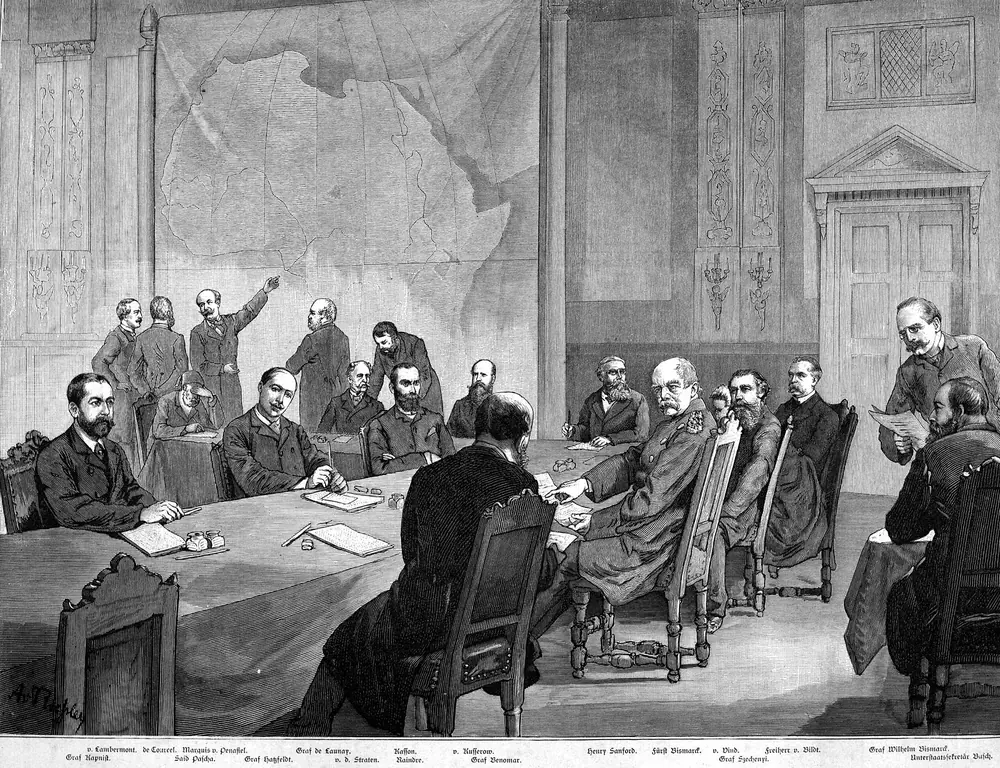
The Berlin Conference was a gathering of fourteen nations in Berlin between November 1884 and February 1885 that established the rules European powers would follow when claiming territory in Africa. Germany's chancellor, Otto von Bismarck, organized it. The attendees were twelve European states, the Ottoman Empire, and the United States. None of the fourteen was African, and no African had any role at the table. The conference did not draw borders on a map of Africa. Instead it created a framework under which borders could later be drawn, and that framework made the Scramble for Africa faster and more systematic.
Why Bismarck called the Berlin Conference
The immediate problem was the Congo basin. King Leopold II of Belgium had been signing treaties with local rulers through a front organization he described as a charitable and scientific body. By 1884, Leopold was claiming an enormous stretch of central Africa. France, Portugal, and Britain were each pursuing their own interests in the same area, and the situation was heading toward a confrontation among the great powers.
For ten years Bismarck had dismissed colonies as expensive and pointless, and he had no particular interest in African territory. But he had spent his career building a balance of power in Europe, and he judged that colonial disputes could disturb it. Settling the question in a conference room was cheaper than letting officials on the ground pull their governments into a fight. In November 1884 he hosted delegates from fourteen nations at the German chancellery. A large map of Africa hung on the wall behind them. The nations present were Germany, Austria-Hungary, Belgium, Denmark, France, Great Britain, Italy, the Netherlands, Portugal, Russia, Spain, Sweden-Norway, the Ottoman Empire, and the United States.
What the Berlin Conference decided
The conference produced a document called the General Act, signed on February 26, 1885. Three main things came out of it.
The first and most important was a rule called "effective occupation." A European power could only have a claim on the African coast recognized if it maintained a working government in the territory: a functioning administration and notification to the other signatory powers. Paper claims based on earlier discovery no longer held. The delegates intended the rule to limit how much territory any single power could grab. The result was the reverse. Each European power saw that any territory without a European administration was open for the taking. A rush to raise flags, make agreements with local chiefs, and station garrisons spread across the continent. Many of the chiefs who signed these agreements had no understanding of what they were giving away.
Second, the General Act declared free navigation along the Congo and Niger rivers and open commerce in the Congo basin. This was mainly intended to prevent any single power from locking other nations' merchants out of the region.
Third, the signatories recognized King Leopold II's private claim over the Congo Free State. Leopold had presented himself as committed to ending slavery and bringing progress to central Africa. In practice, the Congo Free State became among the most lethal colonial regimes in history. Leopold's agents enforced a rubber extraction system through mutilation and hostage-taking. Historians estimate that as many as ten million Congolese died under his rule, from violence, forced labor, starvation, and disease. Leopold, a European monarch, held a territory seventy-six times the size of Belgium as his personal possession. Public outrage in Europe and the United States eventually compelled Belgium to annex the territory in 1908.
Did the Berlin Conference divide Africa?
The Berlin Conference is often called the meeting where Europeans divided Africa among themselves. That is not entirely accurate. The conference itself drew almost no borders. The actual boundaries resulted from bilateral treaties negotiated over the following fifteen years, worked out in European capitals by officials using inaccurate maps.
What the conference did was create the rules that made those treaties possible, and those rules sped up the process. The Scramble for Africa was already under way before the Berlin Conference began. In 1870, European powers controlled about ten percent of Africa, mostly along the coasts. By 1914 that figure was over ninety percent. The Berlin Conference did not start the scramble, but by making effective occupation the standard, it turned an unruly competition into a faster one. The deeper charge against the conference, that it treated African territory and political authority as things European powers assigned to one another with no regard for the people who lived there, holds entirely.
Africa's borders after the Berlin Conference
The boundaries produced by the post-conference treaties are, with few exceptions, still Africa's borders. Officials working from inaccurate maps in London, Paris, and Berlin separated peoples who shared a language and a political system, and grouped together others who did not. Some borders split ethnic groups in half. Others locked together peoples with no shared history inside states none of them had designed.
When African states gained independence in the 1950s and 1960s, they inherited these lines. The Organization of African Unity, founded in 1963, voted to keep them, reasoning that redrawing them would lead to conflict without end. The choice has stood, but at great cost. Many of Africa's civil conflicts, including the cycle of coups across the Sahel, trace back to boundaries drawn by European officials who had never been to the places they were dividing.