
Transatlantic Slave Trade
The Atlantic slave trade was the forced transport of roughly 12.5 million Africans to the Americas between the early 1500s and 1866.
The Atlantic slave trade was the forced transport of an estimated 12.5 million Africans to the Americas from the early 1500s to 1866. No forced migration in history was larger. About 10.7 million people survived the crossing. The rest, around 1.8 million, died at sea. Most were sold into slavery on plantations in Brazil and the Caribbean, where they grew sugar, tobacco, coffee and cotton. Only about 4 percent were brought to what is now the United States. The trade lasted more than three centuries and transformed the economies and populations of Africa, Europe and the Americas.
How the Atlantic slave trade worked
The trade followed a triangular route across the Atlantic. Ships sailed from ports like Liverpool, Nantes and Lisbon carrying textiles, firearms, iron and alcohol. Along the West African coast, European traders exchanged these manufactured goods for captive people. Most of the captives had been taken from the interior through wars, raids and debt bondage. African rulers and traders who controlled the coast sold them to Europeans. The ships then carried the captives west to the Americas, where they were sold to plantation owners, often branded, and put to work in the fields. The ships returned to Europe carrying sugar, tobacco, cotton and rum, all produced by enslaved labor. This cycle was a central part of mercantilism, the economic system that treated colonies as sources of raw materials for European markets.
Portugal and Brazil handled the largest share, transporting close to half of everyone who made the crossing. Britain was the second-largest carrier, followed by France, Spain and the Netherlands. Brazil and the Caribbean received the great majority of enslaved people, in part because sugar plantations had such harsh working conditions that the enslaved population could not sustain itself and planters needed constant new arrivals from Africa. Each leg of the voyage was profitable, and the trade fed capital into banks, insurance companies and shipyards across the Atlantic world. Historians disagree about how much of that wealth helped start the Industrial Revolution, but it built cities and made families rich for generations.
What was the Middle Passage?
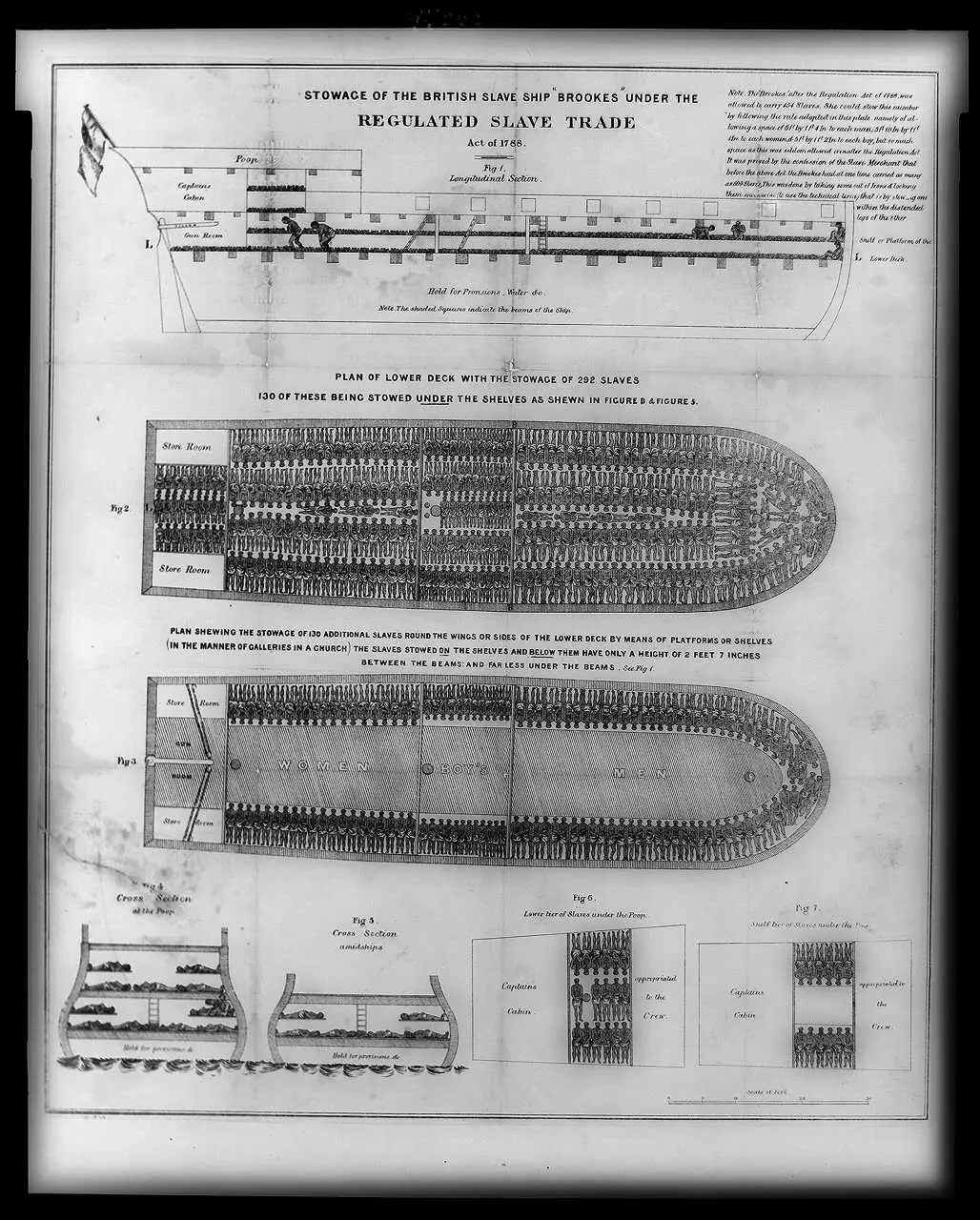
The Middle Passage was the Atlantic crossing from Africa to the Americas. Enslaved people were chained below decks in holds where the ceiling was sometimes less than two feet above them, with no light and little air, for crossings that lasted six to ten weeks. Dysentery, smallpox and dehydration killed many. Some captives took their own lives rather than endure the voyage. Others revolted, though few revolts succeeded.
In the 1500s, roughly 30 percent of captives died during the crossing. By the late 1700s, that rate had fallen below 15 percent. The decline happened because slavers learned to keep more of their cargo alive. It had nothing to do with concern for the people they carried.
In 1788, abolitionists in Plymouth published a diagram of the British slave ship Brookes. It showed hundreds of human figures packed side by side in rigid rows, with measurements of the space each person was given. The image spread across Britain and became one of the most effective pieces of abolitionist propaganda ever produced. A year later, Olaudah Equiano, a formerly enslaved man from what is now southeastern Nigeria, published his autobiography describing his own crossing as a child. Equiano had bought his freedom around the age of 20 and settled in London, where he became a leading voice in the movement to end the trade. His book gave British readers a firsthand account of what the Brookes diagram showed in lines and numbers.
How the Atlantic slave trade ended
Portuguese and Spanish traders began shipping enslaved Africans to the Americas in the early 1500s. By the 1600s, Britain, France and the Netherlands had entered the trade. It reached its peak in the 1700s, when ships carried more Africans across the Atlantic than in any other century.
Abolition came in stages. Britain banned the slave trade in 1807 and then spent decades enforcing the ban, using the Royal Navy to patrol the West African coast and intercept slave ships. Britain abolished slavery in its colonies in 1833. The United States outlawed the importation of enslaved people in 1808 but kept slavery itself until the Emancipation Proclamation and the end of the Civil War in 1865. Brazil, which had received more enslaved Africans than any other country, was the last nation in the Western Hemisphere to abolish slavery, in 1888. The last recorded slave voyage crossed the Atlantic in 1866.
The trade's effects lasted far longer than the trade itself. It took millions of working-age people from West and Central Africa over three centuries. Many states in the region built their power around capturing and selling people, and the population loss left societies weakened when European powers carved up the continent during the Scramble for Africa. In the Americas, slavery created racial divisions that persisted for generations after abolition. The Atlantic slave trade ended more than 150 years ago, but the racial and economic inequalities it built into societies on both sides of the Atlantic have not disappeared.