
Cuneiform
Cuneiform is the oldest known writing system, developed by Sumerian temple administrators around 3400 BC to track grain and debts.
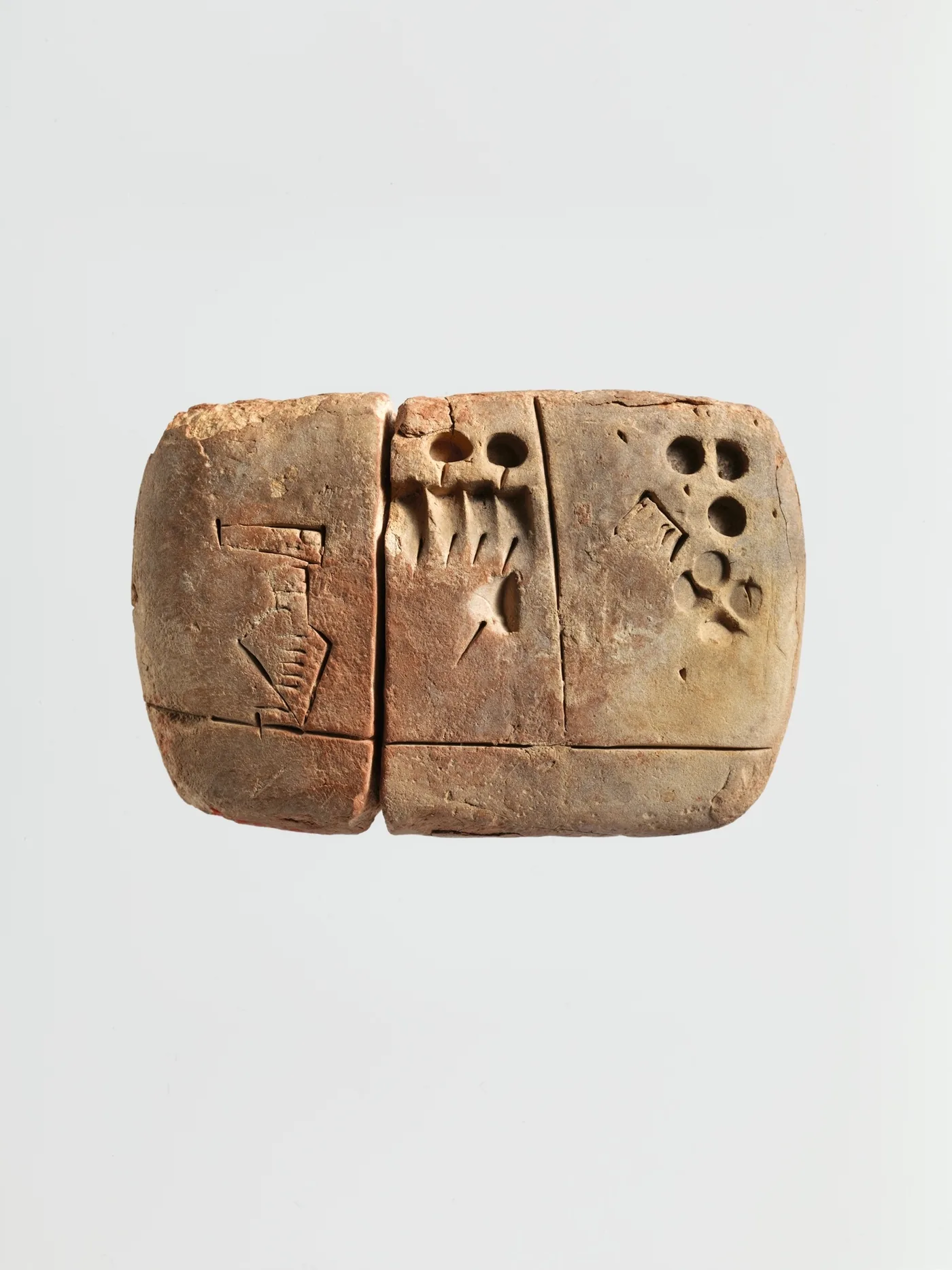
Cuneiform is the oldest known writing system. It was developed around 3400 BC in Uruk, a Sumerian city in what is now southern Iraq, by temple administrators who needed to track grain, livestock, and debts. A scribe would trim a reed to a wedge-shaped tip and press it into wet clay, leaving short angular marks. The name comes from the Latin word cuneus, meaning wedge. Cuneiform stayed in use for about 3,500 years and was adapted to write several languages across the ancient Near East. It carried everything from tax receipts to the Epic of Gilgamesh. About half a million clay tablets have survived in museums around the world, and most of them are accounting records.
How Sumerian accountants invented writing
Before there were tablets, Mesopotamians kept count with small shaped tokens made of clay. A temple that lent ten jars of beer would seal ten jar-shaped tokens inside a hollow clay ball. When the borrower came to settle the debt, someone broke the ball open and counted the tokens. Scribes found they could do away with the tokens and mark the shapes directly onto a flat slab of clay.
The earliest tablets from Uruk, dating to around 3400 to 3200 BC, are not language. A typical one shows a commodity, a number, and a name, drawn as simple pictures. Over time the pictures lost their detail. Pressing a reed into clay is better suited to straight lines than curves, so scribes replaced drawn images with combinations of short wedge strokes. A picture of a head became an arrangement of wedges that no longer looked like a head. At its peak the system used between 600 and 1,000 signs, depending on the period and the language being written.
Tablets were left to dry in sunlight or hardened in a kiln. Paper and papyrus rot, but a clay tablet can sit in the ground for five thousand years and come out readable. Writing gave a state a memory that outlasted any individual official. Temples could track debts across seasons. Palaces could tax by record instead of guesswork. Strangers could sign contracts that an outside party could hold them to. For the first time, human organization could grow beyond the village, where everyone knew everyone.
What was cuneiform used for?
Cuneiform started as bookkeeping and stayed that way for centuries. The oldest tablets are inventories of grain, beer, and livestock, recorded by temple administrators who needed to know who owed what.
As the system matured, its uses expanded. Around 1750 BC, the Babylonian king Hammurabi had his legal code carved in cuneiform on a stone stele, one of the oldest surviving sets of written laws. The Epic of Gilgamesh, one of the oldest surviving works of literature, was written on cuneiform tablets. Scribes recorded medical treatments, astronomical observations, and mathematical tables. Kings sent diplomatic letters to one another in cuneiform Akkadian, which served as the common written language of Near Eastern diplomacy for centuries. A collection of about 350 such letters, found at Tell el-Amarna in Egypt, shows pharaohs corresponding with the kings of Babylon, Assyria, and the Hittites in the fourteenth century BC.
Cuneiform was invented for Sumerian, but it proved adaptable. Over the centuries it was used to write Akkadian and its Babylonian and Assyrian forms, along with Hittite, Elamite, and Old Persian. It served as the standard script of the ancient Near East for a longer span than the Latin alphabet has been in use.
How was cuneiform deciphered?
Cuneiform died out slowly. Simpler alphabets, which needed a few dozen letters instead of hundreds of signs, spread across the Near East with Aramaic-speaking merchants and officials. The last dated cuneiform tablet, an astronomical text from Uruk, was written around AD 80. Within about two centuries, no one alive could read the script. Until the mid-1800s, the tablets buried in the ruins of Mesopotamian cities sat illegible, and some European scholars took the marks for decoration.
The key to reading them again was the Behistun Inscription, a monumental carving on a limestone cliff in western Iran. Around 520 BC, the Persian king Darius the Great ordered an account of his victories carved into the rock face in three scripts: Old Persian, Elamite, and Babylonian.
Starting in the 1830s, a British army officer named Henry Rawlinson, then 25 and stationed in Persia as a military adviser, began climbing the cliff to copy the inscriptions by hand. He scaled the rock repeatedly over the next decade, sometimes without ropes, and later hired a local Kurdish boy to rig ropes across the most dangerous sections so that paper casts could be made of the Babylonian text. Rawlinson used the Old Persian inscription, the simplest of the three, to work out the cuneiform signs of the other two. He announced his decipherment of the Old Persian text in 1846 and the Babylonian in 1851. The Behistun Inscription played the same role for cuneiform that the Rosetta Stone played for Egyptian hieroglyphs.
When scholars began reading the tablets that archaeologists were pulling from sites across Iraq, they found mostly receipts, inventories, debts, and contracts. Writing began as a way to track what was owed, and clay preserved that record for five thousand years.