
Egyptian Hieroglyphs
Egyptian hieroglyphs are the writing system of ancient Egypt, used for 3,500 years, lost for 1,400 years, and decoded through the Rosetta Stone in 1822.
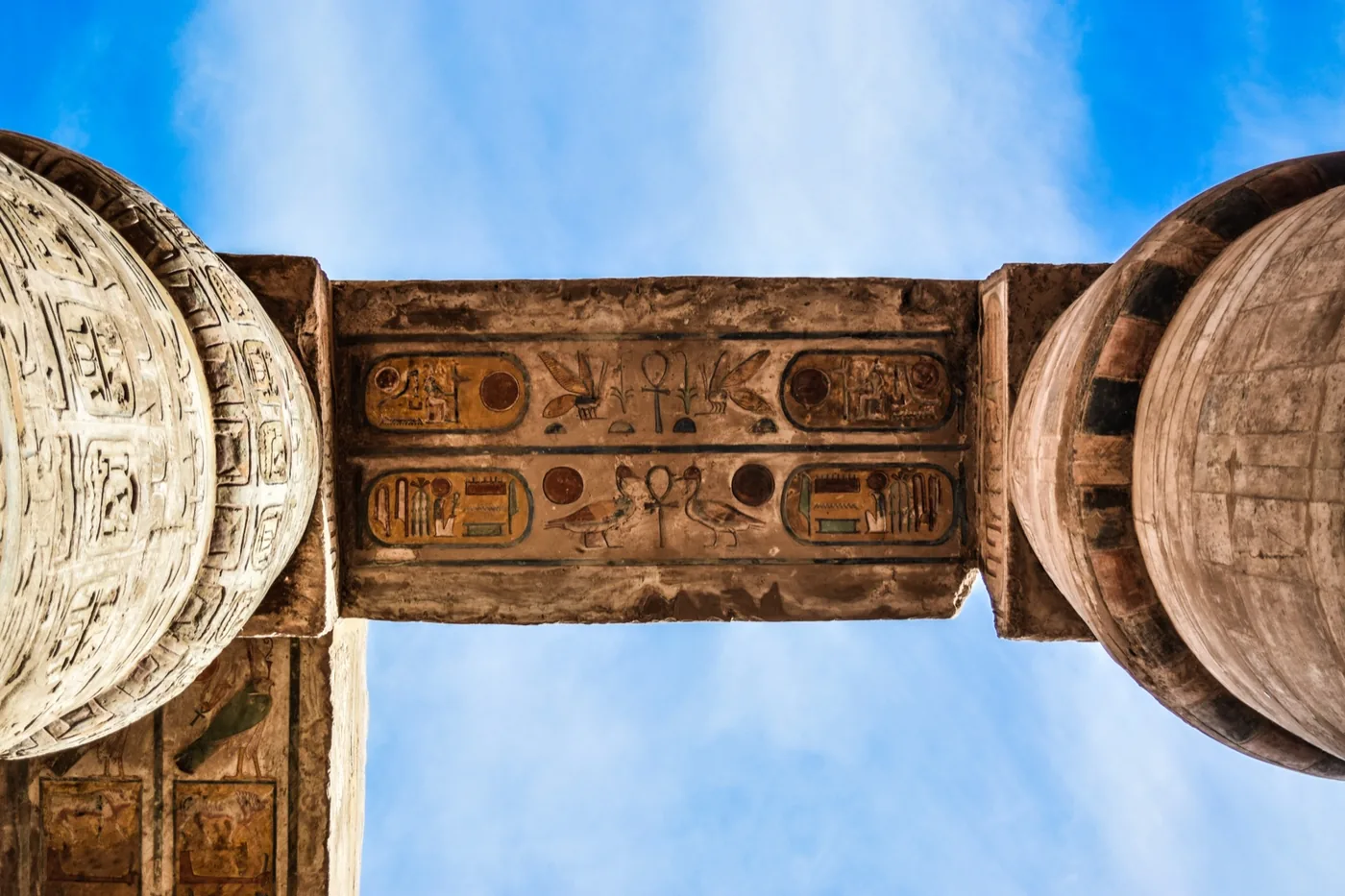
Egyptian hieroglyphs are the writing system that ancient Egypt used from around 3200 BC to the late 300s AD, a span of more than 3,500 years. The Egyptians called the script "medu netjer," meaning "words of the gods." The signs look like small pictures of birds, eyes, reeds, and human figures, but the system is not purely pictorial. Many signs represent sounds, much like letters in an alphabet. Egyptians carved hieroglyphs on the walls of temples and tombs and on royal monuments, and used them to record everything from tax records and royal decrees to religious spells. After most Egyptian temples closed under Christian Roman rule around 400 AD, the people trained to read hieroglyphs died out, and the script went unread for nearly 1,400 years. A French scholar named Jean-Francois Champollion decoded them in 1822, reopening 3,000 years of recorded history.
How Egyptian hieroglyphs worked
Hieroglyphs are a hybrid system that mixes pictures, sounds, and silent markers. Some signs are logograms: a picture of a sun disk means "sun." But many of the approximately 700 signs that scribes used day to day are phonograms, standing for sounds rather than objects. A sign shaped like an owl represents the consonant "m," no matter what the picture shows. A third kind of sign, called a determinative, is placed after a word to mark its category. A word spelled with the same consonants might mean "scribe" or "scroll," and the determinative tells the reader which one.
The script had no fixed reading direction. Text could run left to right, right to left, or top to bottom. The birds and human figures in the signs always face the beginning of the line, so a reader can tell which direction to start.
Unlike cuneiform, Mesopotamia's wedge-shaped script that turned abstract after only a few centuries, Egyptian hieroglyphs kept their pictorial form for more than 3,000 years. Carving them was slow and expensive, so Egyptians reserved the full pictorial script for stone surfaces meant to last: temples, tombs, and the faces of royal monuments. For everyday work, they used faster cursive scripts written with a brush on papyrus. Hieratic, the older cursive, was used by priests and clerks. Demotic, which came later, was the script of daily business.
Only a small scribal class could read and write. The people who controlled the writing controlled the records: how much grain was owed, what the pharaoh had decreed, and what rituals had to be performed to maintain order.
How hieroglyphs were decoded
After the old temples closed around 400 AD, the last generation of hieroglyph readers died out. The last known hieroglyphic inscription, a short text at the Temple of Isis at Philae in southern Egypt, dates to 394 AD. For the next fourteen centuries, the temples still stood with walls covered in carved signs, but no living person knew what they meant. European travelers assumed each sign was a mystical symbol. Nearly all of them were wrong.
The breakthrough came in 1799. Soldiers in Napoleon's army, digging fortifications near Rashid, an Egyptian town known in Europe as Rosetta, found a broken slab of dark stone. It carried a single priestly decree from 196 BC, written in three scripts: hieroglyphic, demotic, and Greek. Scholars could read the Greek, so for the first time they had a translation sitting next to the lost script. The British captured the stone from the French in 1801, and it has been in the British Museum in London since 1802.
An English physician and physicist named Thomas Young made early progress. Young was already known for his work on the wave nature of light, but he spent years studying the stone. By 1819 he had figured out that the oval outlines on it, called cartouches, contained the phonetic spelling of a royal name: Ptolemy. He identified several signs correctly. But Young believed the phonetic principle applied only to foreign names written in Egyptian, and that the rest of the script was symbolic.
Jean-Francois Champollion proved otherwise. Champollion was born in 1790 in Figeac, a small town in southwestern France, and he was a language prodigy. By his mid-teens he had learned Latin, Greek, Hebrew, Arabic, Coptic, and several other languages. Coptic turned out to be the crucial one. Coptic is the final stage of the ancient Egyptian language, still used in the liturgy of Egypt's Coptic Christian church, and knowing it let Champollion hear how ancient Egyptian words sounded.
Champollion started with two royal names. From the Rosetta Stone he had Ptolemy. From an obelisk brought to England from Philae, he had a cartouche that another scholar had guessed spelled Cleopatra. The two names shared several letters, and Champollion used the overlap to confirm his readings sign by sign. Then, in September 1822, working with copies of inscriptions from the temple at Abu Simbel, he recognized the name of the pharaoh Ramesses spelled out phonetically. Ramesses was a native Egyptian name, not a foreign one. The phonetic principle applied to the entire script. Champollion announced the discovery in a letter to the French Royal Academy on September 27, 1822. He was 31 years old. He spent the rest of his short life building the new field of Egyptology, and died in 1832 at 41.
How many hieroglyphs are there?
About 700 signs were in regular use during most of ancient Egyptian history. But the total number grew over time. In the Ptolemaic and Roman periods, roughly 300 BC to 400 AD, temple scribes added new signs and new values for old ones, expanding the full catalog to more than 5,000. Most of those late additions appeared in specialized religious texts. The working set that a trained scribe needed was much smaller.
Hieroglyphs are not an alphabet in the modern sense. The system includes signs for one consonant, signs for two or three consonants, signs for whole words, and determinatives that carry no sound at all. Within the system there is a set of about 24 single-consonant signs that could, in theory, have spelled any word on their own. The Egyptians never simplified their writing that way. They used the full hybrid system for more than 3,000 years. When Champollion decoded it in 1822, scholars could finally read one of the longest recorded civilizations in history, carved on monuments that had been standing in plain sight the entire time.