
Albert Einstein
Albert Einstein was a German-born physicist whose theories of relativity and equation E=mc² reshaped the modern understanding of space, time, and energy.
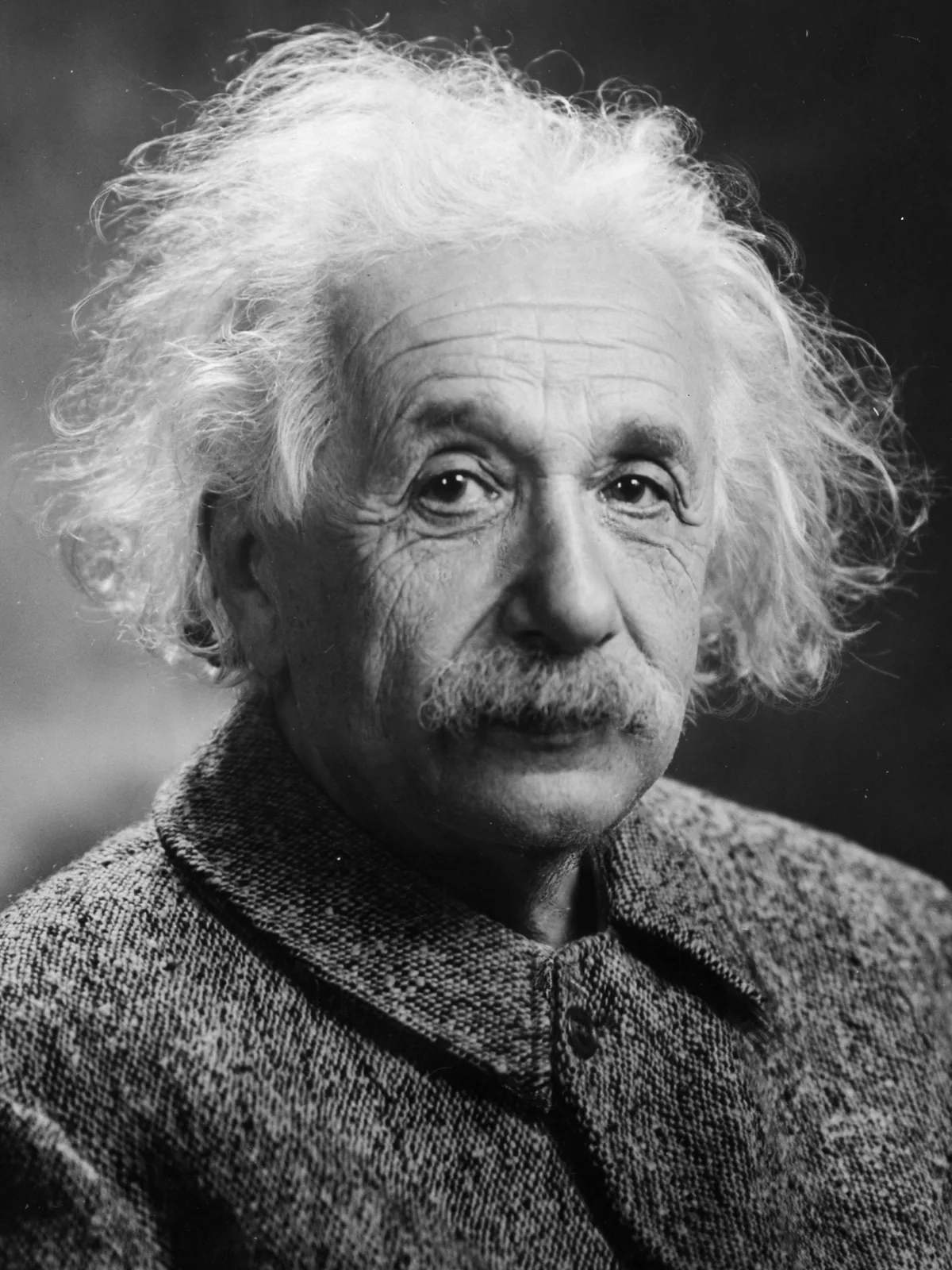
Albert Einstein (1879–1955) was a German-born physicist who changed the understanding of space, time, and energy. In 1905, while working as a clerk at a Swiss patent office, he published four papers that transformed physics. One introduced special relativity. One explained why tiny particles suspended in a liquid jiggle at random, providing evidence that atoms are real. One showed that light comes in discrete packets, a finding that helped launch quantum theory. And one contained the equation E=mc², showing that mass and energy are two forms of the same thing. A decade later he published general relativity, which described gravity as the bending of spacetime. He won the 1921 Nobel Prize in Physics, fled Nazi Germany in 1933, and signed a letter that helped start the American atomic bomb program. He spent his final years trying to stop the weapons that letter set in motion.
How a patent clerk reshaped physics
In 1905, Einstein was twenty-six years old and working at the Swiss Patent Office in Bern. He had earned a degree from the Swiss Federal Polytechnic in Zurich but could not find a university position. His job reviewing patent applications left him time to think, and in that single year he produced four papers, any one of which could have anchored a career.
Special relativity showed that space and time are not fixed. They stretch and compress depending on how fast an observer moves. The Brownian motion paper provided strong evidence that atoms are real by explaining why particles suspended in a liquid move at random. The photoelectric effect paper argued that light comes in discrete packets of energy, now called photons. It was this paper, not relativity, that won Einstein the 1921 Nobel Prize. And the mass-energy equivalence paper introduced E=mc²: even a small amount of mass holds an enormous amount of energy, because the speed of light squared is a very large number.
In 1915, Einstein published his general theory of relativity. It described gravity not as a force pulling objects together but as a curvature in spacetime caused by mass. In 1919, the British astronomer Arthur Eddington traveled to the island of Príncipe off West Africa to photograph a solar eclipse. His measurements showed that starlight bent around the sun as Einstein's equations predicted. The results made headlines worldwide, and Einstein became the most famous scientist alive. He had completed all of this work before he turned forty.
Einstein's letter to President Roosevelt
When Adolf Hitler came to power in January 1933, Einstein was visiting the United States. He never went back to Germany. He gave up his German citizenship, left the Prussian Academy of Sciences, and joined the Institute for Advanced Study in Princeton, New Jersey, where he lived for the rest of his life. He became an American citizen in 1940.
Einstein was a lifelong pacifist, which made what happened next difficult. Leo Szilard, a fellow physicist, approached Einstein during the summer of 1939 with urgent news. Recent discoveries in nuclear fission meant an atomic bomb was now theoretically possible, and Szilard feared Nazi Germany would try to build one. He drafted a letter to President Franklin Roosevelt warning that uranium could be used to build powerful new bombs. Einstein signed it. The letter was delivered in October 1939 and helped launch the research effort that grew into the Manhattan Project.
Einstein never worked on the bomb. The government considered him a security risk because of his political views, and the government never granted him access to the project his letter had helped start.
Did Einstein work on the atomic bomb?
No. Einstein's main connection to the development of nuclear weapons was signing the 1939 letter to Roosevelt. He was not part of the Manhattan Project and had no role in designing or building the bomb. His equation E=mc² explained why nuclear fission releases so much energy, because splitting an atom converts a small fraction of its mass into energy. But understanding the physics and engineering a weapon are different things.
The bombs were used against Japan in August 1945, not against Germany. Germany's nuclear program never came close to building a weapon. Einstein spent the last decade of his life campaigning against the weapons his letter had helped create. He called for world government as the only way to prevent nuclear war. He told a colleague that signing the letter was "one great mistake in my life." He added that there had been justification: the fear that Germany would build the bomb first.
In 1952, Israel offered Einstein its presidency after its first president, Chaim Weizmann, died. He turned it down, saying he lacked the natural ability to deal with people in an official role. Einstein died on April 18, 1955, in Princeton. An aortic aneurysm had ruptured, and he refused surgery, saying he wanted to go on his own terms. He was seventy-six. He was still doing physics, and he was still putting his name to appeals against nuclear weapons. His theories of relativity remain among the most tested and confirmed ideas in all of science.