
Franklin D. Roosevelt
Franklin D. Roosevelt was the 32nd president of the United States, serving from 1933 until his death in 1945.
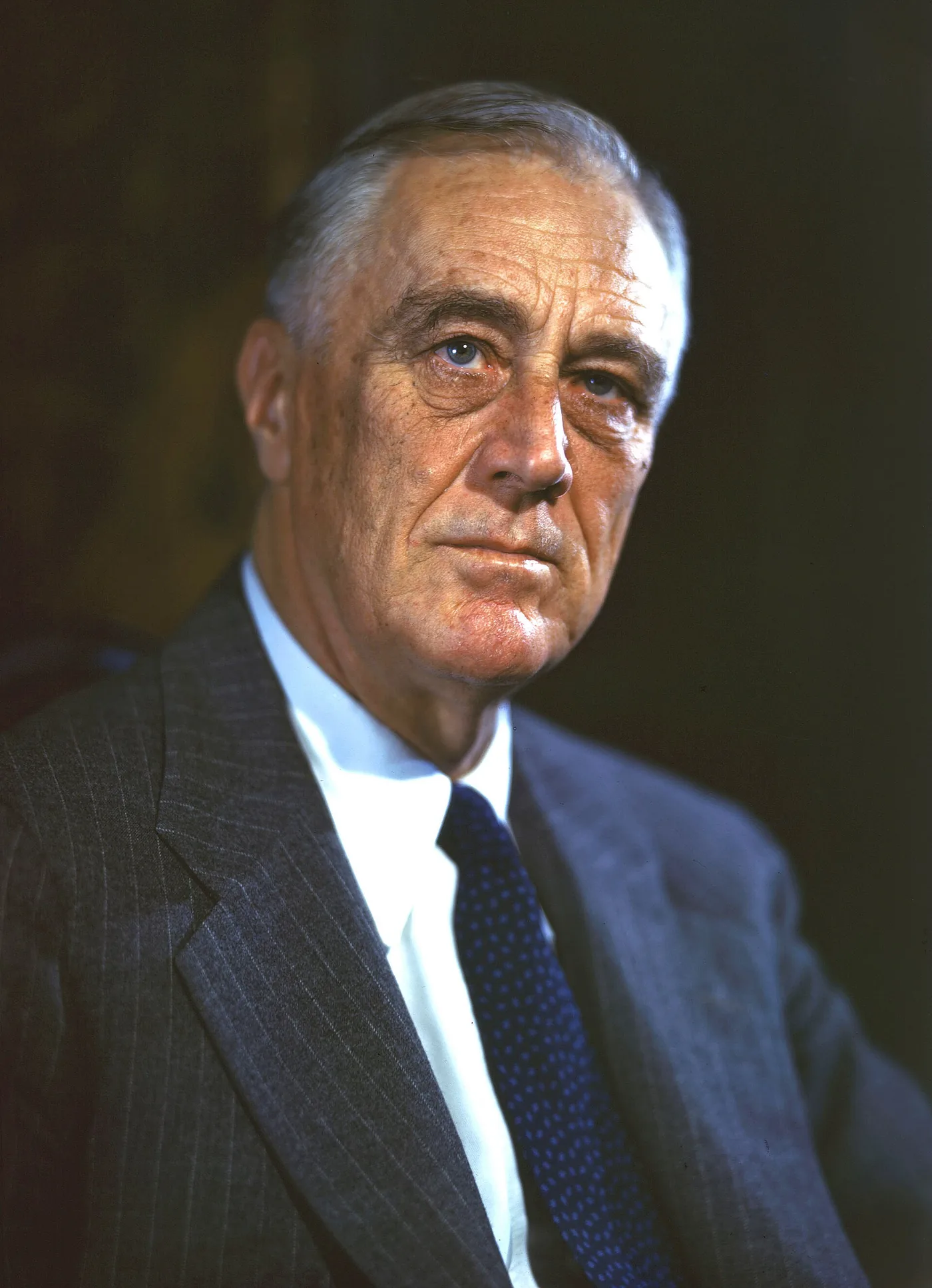
Franklin Delano Roosevelt was the 32nd president of the United States and the only person elected to the office four times. He served from 1933 until his death in 1945. Roosevelt took office at the bottom of the Great Depression. One in four workers had no job, and the banking system had collapsed. Over the next twelve years, he created Social Security, guaranteed bank deposits, and led the country through the Second World War. He died less than a month before Germany surrendered. For his entire presidency, Roosevelt could not walk. He governed from a wheelchair that most Americans never saw.
How Roosevelt reached the presidency
Roosevelt was born in 1882 into a wealthy family in Hyde Park, New York. He was a fifth cousin of Theodore Roosevelt, the 26th president, and in 1905 he married Eleanor Roosevelt, Theodore's niece. Theodore Roosevelt, then the sitting president, gave the bride away. Franklin's early political career was conventional: state senator, assistant secretary of the Navy, and an unsuccessful run for vice president in 1920.
In 1921, at age 39, an illness diagnosed as polio paralyzed Roosevelt from the waist down. He never walked unaided again. He wore heavy steel leg braces and used a wheelchair, but he struck an agreement with reporters covering the White House: they would not photograph him in it. The reporters honored the agreement almost without exception. Only a handful of photographs of Roosevelt in his wheelchair are known to exist, and most of the people who elected him never fully understood that their president could not stand on his own.
Roosevelt spent years rebuilding his public career. He was elected governor of New York in 1928 and won the presidency in 1932.
Roosevelt and the New Deal
Roosevelt's first inaugural address, on March 4, 1933, contained the famous line "the only thing we have to fear is fear itself." In his first hundred days, Congress passed fifteen major laws. These included a bank holiday and federal deposit insurance, farm price supports, the Tennessee Valley Authority, and large public works programs.
Roosevelt's program was not a single plan. It was a series of experiments, some of them contradictory. The Depression did not end until war spending began. But the New Deal permanently changed what the federal government did. After the Social Security Act of 1935, the government paid old-age pensions. It guaranteed bank deposits, protected workers' right to organize unions, and regulated the stock market. Every later administration, Republican and Democratic, kept them.
Roosevelt's reach had limits. When the Supreme Court overturned several of Roosevelt's laws, Roosevelt proposed in 1937 to add new justices to the Court. Congress rejected the plan, and the fight cost him political support. Roosevelt also built his majority by working with southern segregationists, and because of that alliance, Congress wrote Social Security and labor law to leave out farmworkers and household workers. In practice, that left out about 65 percent of Black workers nationwide.
Roosevelt and World War II
Roosevelt saw the threat from Nazi Germany earlier than most Americans did, but he could move only as fast as voters would accept. In a fireside chat on December 29, 1940, he called the United States the "arsenal of democracy." In March 1941, the Lend-Lease Act let him supply Britain with weapons and equipment without a declaration of war.
After Japan attacked Pearl Harbor on December 7, 1941, Roosevelt made the decision to defeat Germany first, even though the attack had come from Japan. He also signed Executive Order 9066 in February 1942, authorizing the internment of about 120,000 Japanese Americans. Roughly two-thirds of them were United States citizens. The internment had no serious military justification, and the United States formally apologized for it in 1988.
By early 1945, Roosevelt was visibly dying. At the Yalta Conference in February, he negotiated the postwar order with British prime minister Winston Churchill and Soviet leader Joseph Stalin. On April 12, 1945, Roosevelt died of a cerebral hemorrhage at his retreat in Warm Springs, Georgia, while sitting for a portrait. Germany surrendered less than a month later. His vice president, Harry Truman, took over knowing nothing about the atomic bomb.
Why did Roosevelt serve four terms?
When Roosevelt first ran in 1932, nothing in the Constitution limited how many terms a president could serve. The two-term limit was a tradition set by George Washington, not a law. Roosevelt broke it in 1940 by running for a third term, and again in 1944 by running for a fourth. He won all four elections.
The 22nd Amendment, ratified in 1951, was a direct response. It says no person can be elected president more than twice. No one since Roosevelt has served longer than eight years.
Roosevelt held the presidency for twelve years. He entered office with the banking system closed and a quarter of the country out of work. He left behind a federal government that guaranteed economic security for ordinary citizens, and he helped build the international institutions created at the Bretton Woods conference. Roosevelt coined the name "United Nations" himself.