
Los Alamos
Los Alamos is the secret New Mexico town where scientists built the first atomic bombs during World War II.
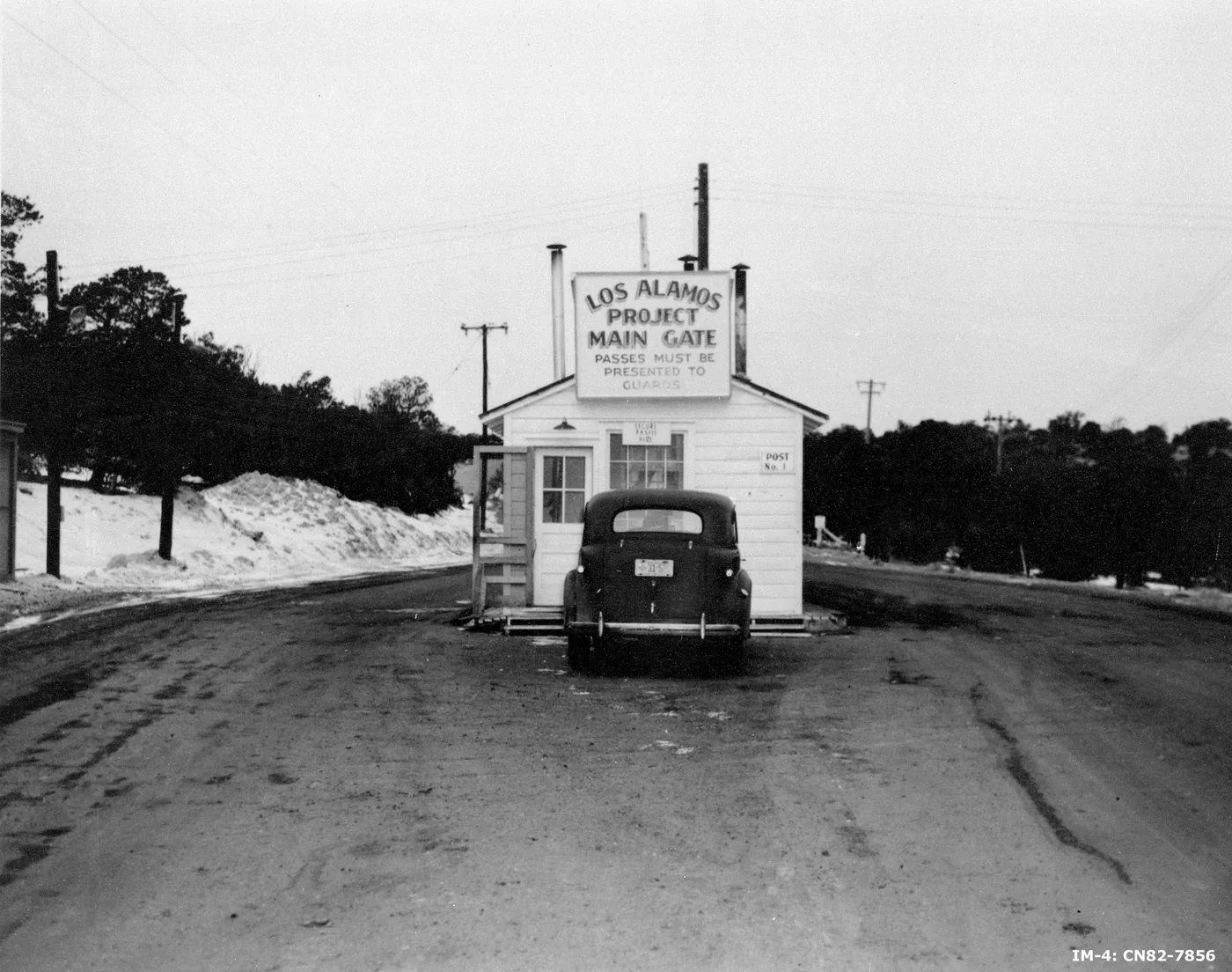
Los Alamos is a town and national laboratory in northern New Mexico where the first atomic bombs were designed and built during World War II. The name means "the cottonwoods" in Spanish, after the trees that line the canyons of the Pajarito Plateau. From 1943 to 1945, as part of the Manhattan Project, Los Alamos was a secret military site that appeared on no map. Everyone who lived there sent and received mail through a single address, P.O. Box 1663 in Santa Fe. Children born on the mesa had that box number recorded as their birthplace. The laboratory produced both of the atomic bombs dropped on Japan in August 1945, and the site that was supposed to shut down after the war never did.
How Oppenheimer and Groves chose the site
In late 1942, the physicist J. Robert Oppenheimer and General Leslie Groves needed somewhere to bring together the scientists working on a nuclear weapon. Oppenheimer wanted them gathered together so they could collaborate without barriers. Groves wanted them behind a fence so nothing could leak. They found their answer on a remote plateau in New Mexico, at an elevation of 7,300 feet, where a boys' ranch school occupied land that was isolated enough to lock down completely. Oppenheimer knew the landscape well. He had first visited New Mexico in 1922, as an eighteen-year-old sent west to recover from illness, and had spent later summers on horseback in its mountains. He proposed the site himself.
The Army took over the ranch school's property and shut it down in January 1943. Within months, scientists were showing up at a site with no place on any public map, designated Project Y but known to everyone who worked there as "the Hill." Daily life was improvised. Nobel Prize winners lived with taps that sometimes ran dry. Spouses were told nothing about what their partners did at work. By 1945, the population had climbed from several hundred to roughly 8,000, a makeshift settlement of unpaved roads and poker games. The birth rate rose high enough that Groves complained about it.
The two bombs Los Alamos built
The scientists were trying to take the theory of nuclear fission and turn it into a weapon that could be dropped from a plane. They produced two designs.
The first was a uranium gun-type bomb. It worked by shooting one piece of enriched uranium into another to trigger a chain reaction. The design was simple enough that the team felt confident using it without a test. That weapon, called Little Boy, was dropped on Hiroshima on August 6, 1945.
The second design was far more difficult. A plutonium implosion bomb required arranging explosive charges around a plutonium core with such precision that the detonation compressed the core evenly from every direction. This one had to be tested. On July 16, 1945, at 5:29 in the morning, the team set off the device in the desert 210 miles south of the laboratory, near Alamogordo, New Mexico. The blast, known as the Trinity test, was the world's first nuclear detonation. It released energy equal to roughly 21,000 tons of TNT, and the flash could be seen as far away as Amarillo, Texas, nearly 300 miles to the northeast. Oppenheimer later said the explosion reminded him of a passage from the Bhagavad Gita about becoming the destroyer of worlds. Just over three weeks after Trinity, a second plutonium bomb, called Fat Man, was dropped on Nagasaki on August 9.
How the Soviet Union got the bomb design
While the bombs were being built, at least two people working at Los Alamos were sending information to the Soviet Union. Klaus Fuchs, a German-born physicist assigned to the implosion program, passed detailed technical reports to Soviet intelligence beginning in 1941. David Greenglass, an Army machinist who built molds for the explosive lenses used in the implosion bomb, handed sketches and written descriptions to his brother-in-law Julius Rosenberg. Both Rosenberg and his wife Ethel were later convicted of espionage and executed in 1953.
The stolen plans shortened the Soviet timeline considerably. On August 29, 1949, the Soviet Union tested its first nuclear weapon at a site in Kazakhstan. American analysts had not expected a Soviet bomb for years. The device was a near-copy of the Fat Man design, built partly from technical drawings that had been smuggled out of Los Alamos.
Los Alamos today
Los Alamos was supposed to last only as long as the war, a crash program that would shut down once the weapons were finished. It never shut down. The site was renamed Los Alamos National Laboratory and became a lasting institution in the American nuclear weapons program. As of 2024, it employs about 16,500 people, about twice the population of the wartime settlement. The United States has not tested a nuclear weapon since 1992, so the laboratory relies on computer simulations to confirm that the country's warheads still function. It continues to design new ones. The town sits on the same plateau where the first physicists arrived in 1943, and the work that began there has continued without interruption.