
Enigma and Bletchley Park
The Enigma was Germany's military cipher machine, considered unbreakable but broken by Polish and British codebreakers in World War II.
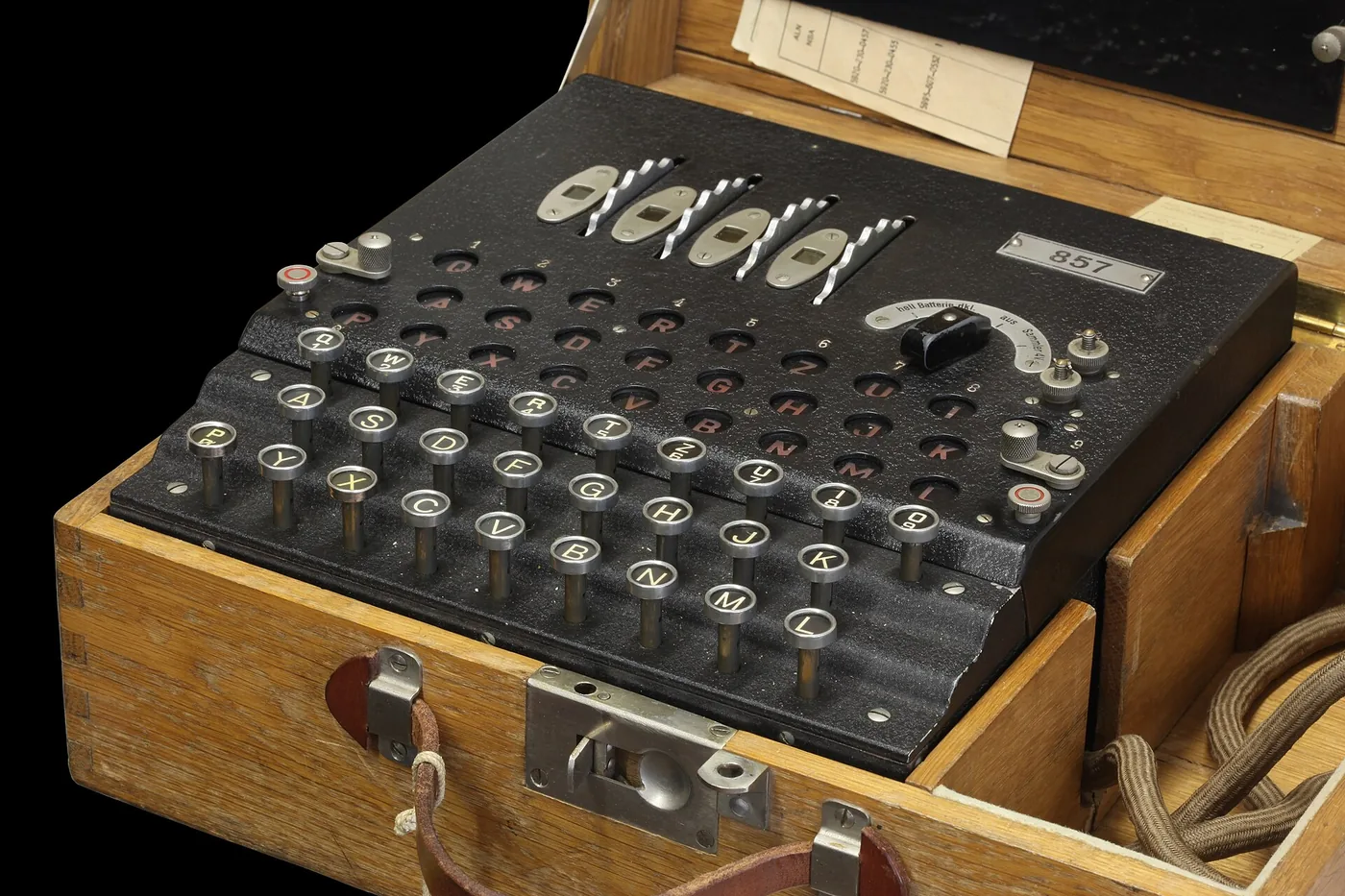
The Enigma was a cipher machine powered by electrical circuits and mechanical rotors that the German military used to encrypt much of its communications during the Second World War. A German engineer named Arthur Scherbius patented the design in 1918 and sold it commercially under the name Enigma beginning in 1923. The German navy adopted it in 1926, and the army and air force followed. The military modified the machine and changed its settings daily, producing roughly 158 million million million possible configurations. German military officials looked at that number and declared the cipher unbreakable, but they were wrong. Polish mathematicians broke the Enigma in the early 1930s, and a British team at Bletchley Park built on their work to read German messages for most of the war. The intelligence they produced, codenamed Ultra, is widely credited with shortening the war by at least two years.
How the Enigma machine worked
Pressing a key on the Enigma sent an electrical signal through a plugboard, then through three rotating wheels called rotors. Each rotor scrambled the signal by substituting one letter for another. The current bounced off a reflector at the end and passed back through the rotors, then lit up a different letter on the lampboard. That letter was the encrypted output. Each keystroke turned the rotors forward, so pressing the same key twice usually produced two different letters. Operators changed the rotor order, starting positions, ring settings, and plugboard pairings every day according to printed key sheets. One design feature of the machine meant that no letter could ever encrypt as itself, a property that the Germans considered a strength but that codebreakers later turned against them.
How Poland broke the Enigma
The first people to break the military Enigma were not British. They were three Polish mathematicians working for Poland's Cipher Bureau in Warsaw: Marian Rejewski, Jerzy Różycki, and Henryk Zygalski. Rejewski was the son of a cigar merchant from Bydgoszcz, trained in mathematics at Poznań University. In late 1932, he worked out the internal wiring of the German military Enigma from scratch, without ever examining a machine, using mathematical group theory and documents that French intelligence had obtained from a paid German source. The Poles built devices they called bomby to find the daily key settings and could read German military traffic years before the war started.
In 1938, Germany changed its Enigma procedures and the techniques the Poles had developed stopped working. With a German invasion clearly coming, Poland's Cipher Bureau handed everything to Britain and France in July 1939, just five weeks before Germany invaded Poland: the techniques, the devices, and the recovered wiring. Britain's codebreaking effort started from the Polish solution, not from zero.
Bletchley Park and Alan Turing's Bombe
The British codebreaking operation was based at Bletchley Park, a country estate in Buckinghamshire. It started with around 150 staff and grew to roughly 10,000 people by the end of the war. About three quarters of them were women, many serving in the Women's Royal Naval Service.
Alan Turing, a 27-year-old Cambridge mathematician, designed a machine called the Bombe to break the daily Enigma settings. The Bombe did not try every possible key. Instead, it tested assumptions about the encrypted message and threw out every option that produced a logical impossibility. Cryptanalysts fed it "cribs," which were guessed portions of the original message matched against the ciphertext. Cribs were possible because German radio operators followed rigid habits: they transmitted weather updates at fixed times each morning, used formulaic sign-offs, and one station that had nothing to report sent "nothing to report," encrypted, every day. The fact that no Enigma letter could encrypt as itself let the codebreakers rule out wrong crib positions instantly. By the war's end, 211 Bombe machines were running across several sites, operated mostly by about 1,700 women from the Women's Royal Naval Service.
Did breaking Enigma shorten the war?
The intelligence from Bletchley Park was codenamed Ultra. Protecting the secret that Ultra existed was as important as producing the intelligence itself. Commanders could only act on a decrypt if they had a believable alternative explanation for how they knew, such as a reconnaissance flight or an agent report, to explain where the information came from.
The clearest case of Ultra's value was the Battle of the Atlantic. Knowing where German U-boat wolfpacks were positioned let the Royal Navy route convoys around them, keeping Britain supplied with food, fuel, and weapons. In February 1942, the German navy added a fourth rotor to its submarine Enigma machines. Bletchley Park could not read U-boat traffic for ten months, and Allied shipping losses climbed steeply. The gap in coverage closed after British sailors recovered key materials from a sinking submarine, U-559, in October 1942.
Sir Harry Hinsley wrote the official history of British wartime intelligence. He estimated that Ultra shortened the war by "not less than two years and probably by four years." The exact figure is uncertain, but no serious historian disputes that it shortened the war.
What happened to Alan Turing?
The entire Bletchley Park operation was kept secret for nearly 30 years. The first public account in English came in 1974, when F.W. Winterbotham, who had overseen Ultra's distribution during the war, published The Ultra Secret. The people who worked at Bletchley could not tell anyone, including their families, what they had done.
Alan Turing was never publicly credited for his codebreaking work during his lifetime. In 1952, he was prosecuted for homosexuality under British law and sentenced to chemical castration. He died on June 7, 1954, at the age of 41, from cyanide poisoning. An inquest ruled it suicide. In 2013, Queen Elizabeth II granted Turing a posthumous royal pardon.
Bletchley Park's legacy went well beyond the war. The Colossus machines used there to crack a separate German cipher system were the first programmable electronic digital computers, and the people and ideas that came out of Bletchley went directly into postwar computing. The wartime cooperation between British and American intelligence agencies became the Five Eyes alliance, which still shapes how the English-speaking world's spy services work together.