
FIM-92 Stinger
The FIM-92 Stinger is an American shoulder-fired missile that lets one soldier shoot down a helicopter or jet using the heat of its engine.
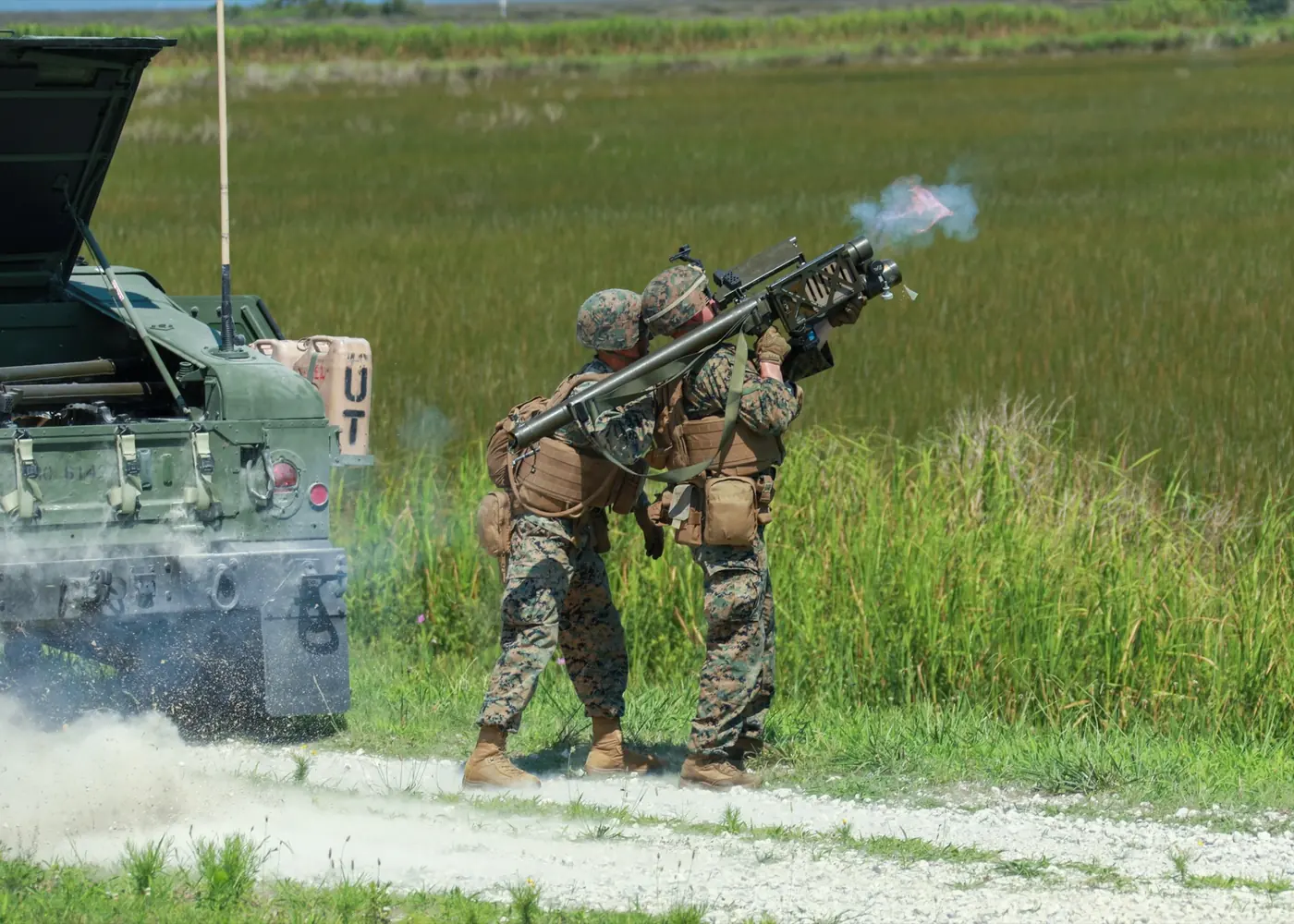
The FIM-92 Stinger is an American shoulder-fired anti-aircraft missile, classified as a man-portable air-defense system (MANPADS). A single soldier carries the launch tube, which weighs about 35 pounds fully loaded, locks onto a helicopter or low-flying jet by the heat of its engine exhaust, and fires. Once the seeker locks on and the soldier pulls the trigger, the missile guides itself to the target without further input. The military calls this "fire and forget." The operator can drop the launcher and move to cover while the missile is still in the air. The Stinger has an effective range of about five miles. The United States Army has used it since 1981, and more than 20 countries have bought it. Each missile costs a few hundred thousand dollars. The aircraft it can destroy is worth tens of millions of dollars. That cost gap is the reason the Stinger has shaped wars from Afghanistan to Ukraine.
When was the Stinger missile invented?
The Stinger replaced the FIM-43 Redeye, the American military's first shoulder-fired anti-aircraft missile. The Redeye entered service in 1968, but it had a serious limitation: its infrared seeker could only lock onto an aircraft from behind, after the target had already flown past. A soldier who saw a helicopter coming had to wait for it to pass, then fire at its exhaust. In 1967 General Dynamics began work on a missile that could engage targets from any angle, including head-on.
The project took longer than expected. The design was originally called Redeye II and was renamed Stinger in 1972. Technical problems delayed the first shoulder launch until 1975, and the Army did not award a production contract until 1978. The first Stinger units reached American troops in 1981, fourteen years after development began.
How the Stinger changed the war in Afghanistan
By the mid-1980s, the Soviet Union's Mi-24 Hind gunship dominated the battlefield in the Soviet-Afghan War. The Hind was heavily armored, carried rockets and machine guns, and flew fast enough to chase vehicles on the ground. Afghan fighters had no reliable way to bring one down.
In 1986, the CIA began sending Stinger missiles to the Afghan mujahideen, ending years of argument within the US government about whether to escalate the conflict. Pakistan's ISI intelligence service handled delivery on the ground, and the supply effort fell under Operation Cyclone, the largest covert program the CIA had ever run. Estimates of how many Stingers the CIA sent into Afghanistan over the course of the war range from about 500 to 2,300.
On September 25, 1986, the Stinger got its first confirmed kill near Jalalabad. A mujahideen commander known as Engineer Ghaffar led a team that fired on a formation of Mi-24 Hinds approaching the airport. Three helicopters went down. The effect on the air war was immediate. Soviet pilots who had spent years flying low and aggressively were forced to stay at higher altitudes and approach targets more cautiously. Flying higher kept the pilots safer, but it reduced the accuracy of their weapons and made close air support far less effective for ground troops.
The Stinger did not by itself drive the Soviet Union out of Afghanistan. Moscow had its own political and economic reasons for wanting to end the war. But within a year of the Stinger's introduction, the fighting had changed. Afghan fighters could defend territory that had been impossible to hold before, and the sense in Moscow that the war was unwinnable deepened.
The CIA's failed Stinger buyback
When Soviet forces withdrew in 1989, hundreds of Stingers were unaccounted for. The missiles had scattered among warlords, smugglers, and arms dealers across Afghanistan and Pakistan. Washington feared that one would be used to shoot down a civilian airliner.
In 1990 the CIA launched a recovery effort called Operation MIAS. Congress eventually authorized more than $65 million for the program, roughly twice what the United States had originally paid for the first 1,000 Stingers it sent. CIA officers offered bounties that reportedly reached six figures for each missile returned. The program reportedly recovered only about 70. Worse, the buyback drove up the black-market price, making the remaining Stingers more valuable and harder to get back. Intelligence officers have a word for this kind of outcome, where a country's own weapons circle back to threaten it: blowback.
The Stinger in Ukraine
The Stinger returned to the headlines in February 2022, when Russia invaded Ukraine. The United States and its allies shipped more than 2,000 Stingers to Ukrainian forces to defend against Russian helicopters and low-flying attack aircraft. The missiles helped blunt Russia's early air assault and forced Russian pilots to change their tactics, much as Soviet pilots had been forced to do in Afghanistan 36 years earlier.
Raytheon, which took over Stinger production from General Dynamics, still manufactures the missile. In September 2025 the U.S. Army awarded Raytheon a $579 million contract to keep production running through 2031. The Stinger has been in service for more than four decades. A missile that costs a few hundred thousand dollars can still destroy an aircraft worth tens of millions, and that makes low-altitude flight dangerous for any air force in the world.