
Soviet-Afghan War
The Soviet-Afghan War (1979-1989) was the Soviet Union's failed ten-year war to defend a communist government in Afghanistan against guerrilla fighters.
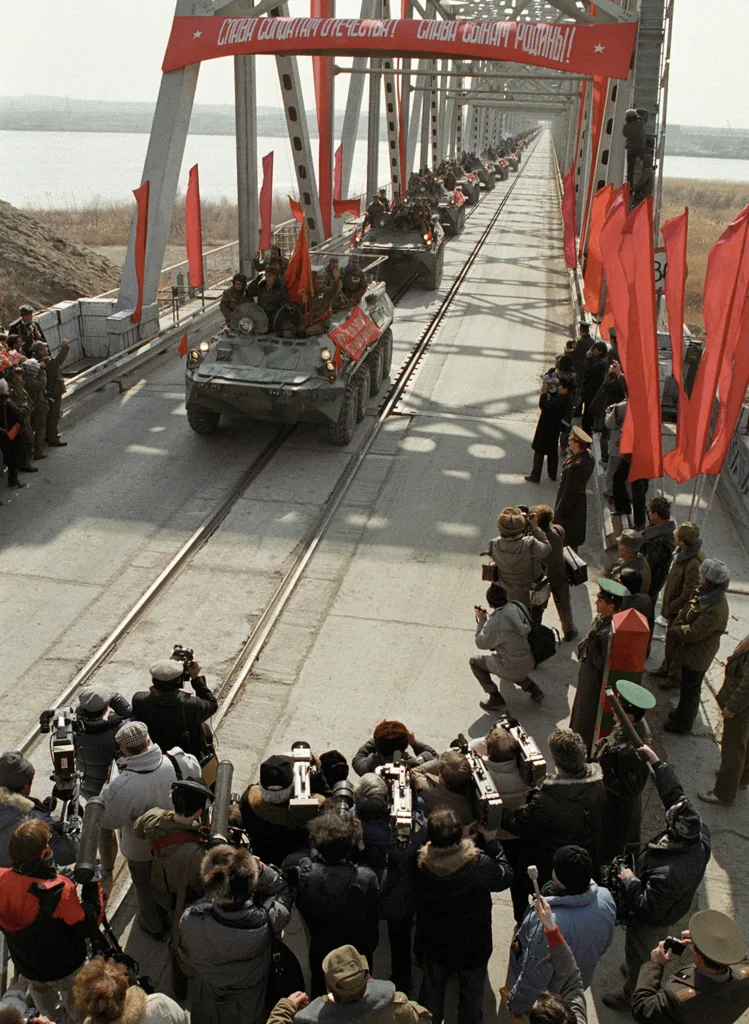
The Soviet-Afghan War was a ten-year conflict in Afghanistan between the Soviet Union and Afghan resistance fighters called the mujahideen, fought from December 1979 to February 1989. The Soviet Union invaded Afghanistan to keep a communist government in power after it began losing control of the country. About 100,000 Soviet troops held the cities and main roads. The mujahideen, armed and funded by the United States, Pakistan, and Saudi Arabia, controlled most of the countryside. The war killed around 15,000 Soviet soldiers and between one and two million Afghans. More than five million Afghans fled to Pakistan and Iran, roughly a third of the country's population. It was the last war the Soviet Union ever fought.
How the Soviet Union went to war in Afghanistan
In April 1978, a military coup called the Saur Revolution overthrew Afghanistan's government and brought the People's Democratic Party of Afghanistan (PDPA), the country's communist party, to power. The new government launched a program of forced land redistribution, aggressive secularization, and mass arrests. In a deeply religious rural country, these policies set off armed rebellions across the provinces.
The PDPA quickly fractured. Its first leader, Nur Muhammad Taraki, was killed in a power struggle with his deputy, Hafizullah Amin, in October 1979. Moscow had watched the government it backed lose control of one province after another and feared that Afghanistan might fall to Islamist or Western-aligned forces. On the night of December 27, 1979, Soviet commandos attacked the Tajbeg Palace in Kabul and killed Amin. Moscow replaced him with Babrak Karmal, a more cooperative figure, while the Soviet 40th Army crossed the border. Soviet leaders believed the operation would be brief. Instead it turned into a ten-year war.
How the mujahideen fought the Soviet army
The Soviet 40th Army, about 100,000 strong, held Afghanistan's cities, main roads, and airspace. The mujahideen were a loose collection of Islamic guerrilla groups that controlled almost everything else. Unable to hold the countryside, Soviet forces tried to empty it. They bombed villages, mined fields, and destroyed crops to cut off the guerrillas' food and shelter. These tactics drove millions of civilians from their homes but did not break the resistance.
The mujahideen survived because of outside help. Pakistan's intelligence agency, the ISI, ran the supply pipeline into Afghanistan. The CIA funded the mujahideen through a covert program called Operation Cyclone. The program grew from about $20 million a year in 1980 to $630 million by 1987, making it one of the most expensive covert operations in the agency's history. Saudi Arabia roughly matched American funding. In 1986, the United States began supplying FIM-92 Stinger shoulder-fired anti-aircraft missiles. The Stingers shot down Soviet helicopters and forced pilots to fly at higher altitudes, where they were far less effective against targets on the ground. By the mid-1980s the war had become a stalemate that the Soviet economy could not sustain.
How the Soviet-Afghan War ended
In February 1986, Soviet leader Mikhail Gorbachev told the Communist Party Congress that Afghanistan had become a "bleeding wound." He was determined to cut Soviet losses. The Geneva Accords, signed in April 1988, set the terms for withdrawal. Soviet troops left over the following months, and on February 15, 1989, General Boris Gromov crossed the Friendship Bridge from Afghanistan into Soviet Uzbekistan as the last Soviet soldier to leave. His fourteen-year-old son, Maksim, ran across the bridge to meet him with a bouquet of carnations.
The Soviet-backed government in Kabul, now led by Mohammad Najibullah, held on without Soviet troops for three more years before falling to the mujahideen in April 1992.
Who won the Soviet-Afghan War?
The mujahideen won on the battlefield. The Soviet Union withdrew after a decade without defeating the insurgency, and the communist government it had fought to protect collapsed three years later. The defeat damaged the Soviet military's reputation and deepened the political and economic crisis that ended the Soviet Union itself in December 1991.
But the mujahideen did not win a stable country. After the communist government fell, the guerrilla factions turned on each other in a civil war that destroyed much of Kabul. Out of that civil war came the Taliban, a movement of religious students backed by Pakistan, which took Kabul in 1996.
The Soviet-Afghan War and al-Qaeda
The war's longest-lasting consequence was the network of fighters it created. During the 1980s, thousands of Arab volunteers traveled to Afghanistan to join the jihad against the Soviet Union. Among them was Osama bin Laden, a young Saudi who helped fund and organize the Arab fighters. As the Soviets withdrew, bin Laden used that network to build al-Qaeda.
On September 11, 2001, twelve years after the last Soviet soldier crossed the Friendship Bridge, al-Qaeda attacked the United States. The United States responded by invading Afghanistan in October 2001, beginning a war that lasted twenty years. It ended in August 2021 when the Taliban returned to power in Kabul.