
Haber-Bosch Process
An industrial process that turns nitrogen from the air into ammonia, the basis of synthetic fertilizer that feeds roughly half the world's population.
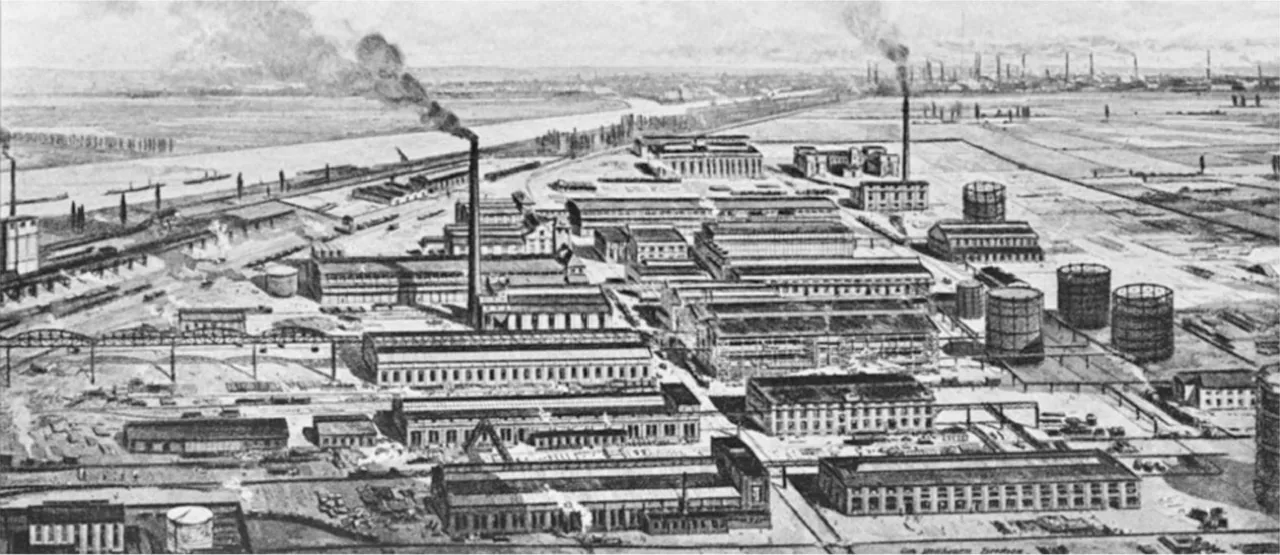
The Haber-Bosch process is an industrial chemical reaction that forces nitrogen and hydrogen together at extreme pressure and temperature to produce ammonia. That ammonia becomes synthetic fertilizer, and roughly half the people on Earth eat because of it. About half of all nitrogen atoms in a human body trace back to this reaction. The German chemist Fritz Haber proved the reaction in a laboratory in 1909. The engineer Carl Bosch figured out how to run it in a factory. By September 1913 it was producing ammonia at industrial scale, and no other single invention has done more to increase how many people the planet can feed.
How Fritz Haber and Carl Bosch made it work
The atmosphere is 78 percent nitrogen, but plants cannot pull it from the air directly. They need nitrogen in a reactive compound they can absorb through their roots. For most of history, farmers supplied it through animal dung, crop rotation with legumes, and mined deposits of guano or Chilean saltpeter. In 1898, the British chemist William Crookes gave a speech to the British Association for the Advancement of Science. He warned that wheat harvests would fail to keep pace with population growth within decades if no one found a way to manufacture usable nitrogen.
Fritz Haber, a professor at the University of Karlsruhe, cracked the chemistry. In 1909 he passed nitrogen and hydrogen across a metal catalyst at about 200 atmospheres of pressure and temperatures near 500 degrees Celsius. The apparatus produced only a trickle of ammonia each hour, but it showed the reaction was possible.
Building a working factory was a separate challenge, and a larger one. Carl Bosch, an engineer at the chemical company BASF, took it on. The combination of pressure and temperature destroyed every container available at the time. Pressurized hydrogen seeped into conventional steel walls and turned them brittle from within, and several of Bosch's prototype reactors cracked open. His solution was a double-walled vessel: a lining of soft iron, surrounded by a reinforced steel shell. Meanwhile his colleague Alwin Mittasch ran more than 6,500 experiments across some 2,500 different compositions to find an affordable catalyst, eventually landing on one based on iron to replace the scarce osmium Haber had relied on. BASF brought the first full-scale plant online at Oppau, Germany, on September 9, 1913. The Nobel committee awarded Haber its Chemistry prize for 1918, and gave Bosch the same honor in 1931.
How the process kept Germany fighting in World War I
The Oppau factory had been operating for roughly a year when the First World War began in August 1914. Making artillery shells requires nitric acid, and Germany had been importing the nitrates to make it from Chile. Once the Royal Navy blockade sealed the sea lanes, those imports stopped. Germany's remaining stockpile would have lasted only a few months. Its armies would have gone quiet by 1915.
The Haber-Bosch process offered a way out: ammonia could be oxidized into nitric acid without any Chilean nitrate at all. BASF expanded on wartime government contracts, and German guns kept firing for four more years. The reaction that would go on to feed half the world began its career by prolonging a war that destroyed millions of lives.
Fritz Haber and poison gas
Fritz Haber also led Germany's chemical weapons program during the war. He organized and personally oversaw the first large-scale release of chlorine gas at the Belgian town of Ypres in April 1915.
Clara Immerwahr, Haber's wife and a trained chemist in her own right, reportedly opposed his weapons work. On May 2, 1915, days after Haber returned from the front, she took his military pistol and killed herself.
Haber was born Jewish. After the Nazis took power in 1933, he resigned his post as director of the Kaiser Wilhelm Institute rather than fire his Jewish staff. He left Germany and died in Basel, Switzerland, on January 29, 1934, at age 65, while on his way to Palestine. In the 1920s, his institute had developed a cyanide-based insecticide. A modified version of it, Zyklon B, was used to murder people in the gas chambers at Auschwitz. Members of Haber's own extended family died in Nazi concentration camps.
Why does ammonia production use so much energy?
Making ammonia through the Haber-Bosch process takes roughly 1 to 2 percent of all the energy the world uses and produces a comparable share of global CO2 emissions. Most of that energy comes from natural gas, which supplies both the hydrogen feedstock and the heat. Fertilizer prices therefore rise and fall with gas prices. In 2022, when European natural gas prices surged, ammonia plants across the continent shut down because production costs exceeded what the market would pay.
This energy link ties fertilizer to geopolitics. Russia and Belarus rank among the largest fertilizer exporters in the world, and Western governments carved out exemptions for fertilizer when they sanctioned Russia after its invasion of Ukraine. The logic was blunt: if a country loses access to fertilizer, a food shortage follows within a single growing season.
There is an environmental cost as well. Excess nitrogen that plants leave behind runs off into waterways and fuels algal blooms that strip oxygen from coastal waters, creating dead zones at river mouths. Some of the surplus also enters the atmosphere as nitrous oxide, which traps heat hundreds of times more effectively than CO2 over a twenty-year span.
What is green ammonia?
The leading proposal for cleaning up ammonia production is called green ammonia. Instead of cracking natural gas to get hydrogen, the green approach would split water using renewable electricity. The Haber-Bosch reaction itself would not change. The high-pressure, high-temperature synthesis Fritz Haber demonstrated in 1909 would remain the same.
As of 2026, several large green ammonia plants are under construction or just beginning production, but they represent only a small fraction of global capacity. The world manufactures roughly 190 million metric tons of ammonia each year, about 80 percent of it for fertilizer, and nearly all of it still depends on fossil fuel. More than a century after Haber's laboratory demonstration, his reaction still underpins the global food supply.