
Napoleon Bonaparte
Napoleon Bonaparte was a French military commander who became emperor, conquered most of Europe, and reshaped its laws and borders.
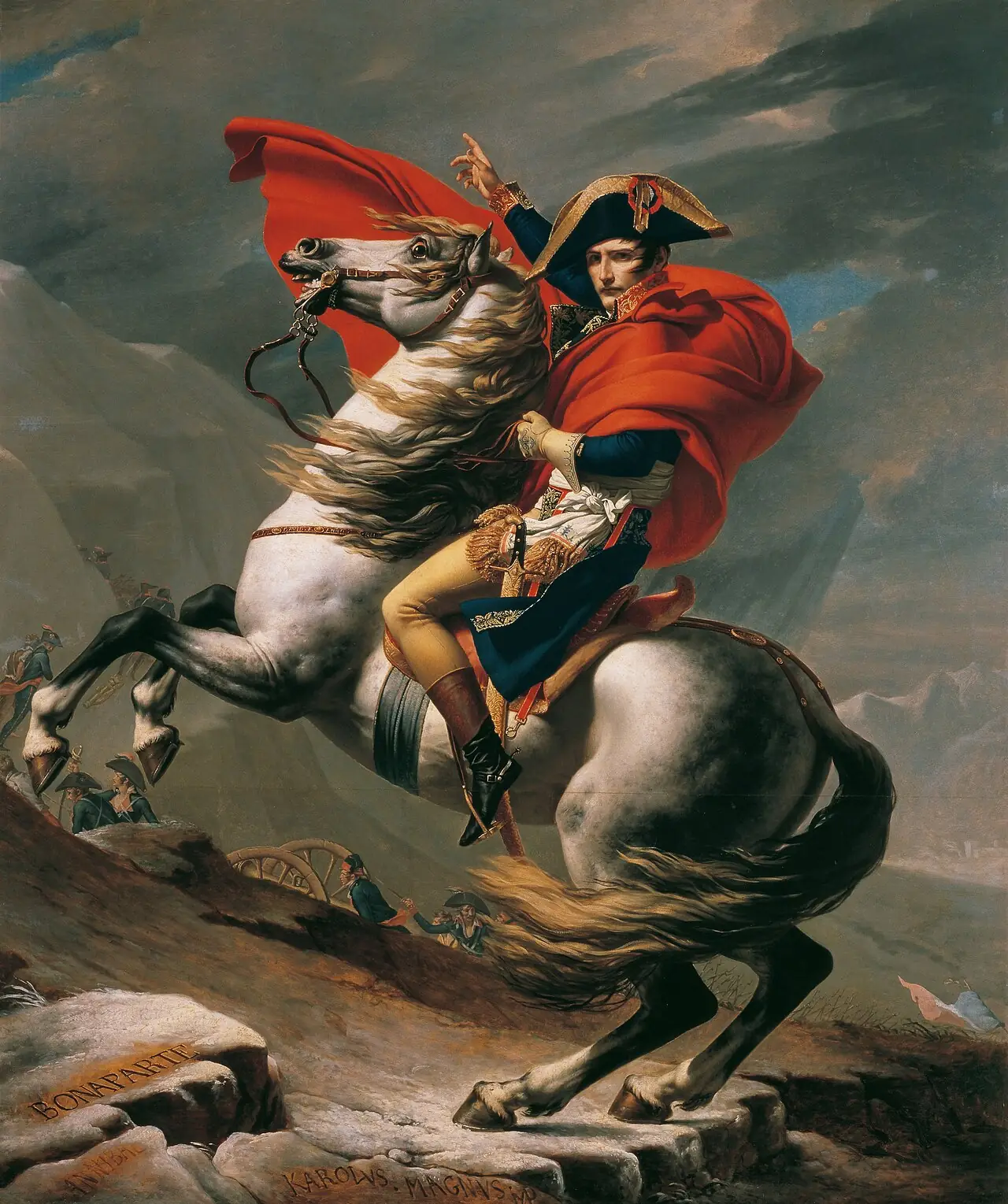
Napoleon Bonaparte was a French military commander who became emperor and conquered most of continental Europe in the early 1800s. He was born in 1769 on the island of Corsica, which France had purchased from Genoa the previous year. He rose through the army's artillery branch, seized power in a coup at age 30, and crowned himself emperor at 35. He fought in roughly sixty major battles and lost fewer than ten. His Civil Code swept away centuries of feudal law and replaced it with a single legal system that still serves as the foundation of law across much of Europe, Latin America, and Japan. His wars cost an estimated three to six million lives. He died a prisoner on a remote island in the South Atlantic, at the age of 51.
How Napoleon came to power
Napoleon was born Napoleone di Buonaparte into a family of minor Italian nobility that had settled in Corsica more than two centuries earlier. He spoke French with a Corsican accent his entire life and changed his name to the French spelling in his twenties. His father secured him a place at a military school on the mainland, where he trained in artillery. It was the most mathematical branch of the French army and drew fewer aristocrats than the cavalry or infantry.
The French Revolution made his rise possible. As the Revolution executed or exiled the officers above him, Napoleon moved up fast. He first proved himself in 1793 by retaking the port of Toulon from the British, and in 1795 he defended the government against a royalist crowd storming through Paris. At 26 he took command of France's army in Italy and beat the Austrians in a string of battles through 1796 and 1797. He then signed a peace agreement without permission from Paris, presenting the government with a finished deal. The French government was left with a commander who answered to no one but himself.
In 1798 he led an expedition to Egypt. It was a military failure: Admiral Nelson destroyed the French fleet at the Battle of the Nile, and Napoleon left his army behind and sailed home. But his own dispatches had described the campaign as a triumph, and he used that fame to take power. He overthrew the government in November 1799, took the title of First Consul, then made himself Consul for life, and finally had himself crowned emperor in December 1804. At the ceremony he took the crown from the altar and placed it on his own head.
Napoleon's wars and defeat
In October 1805, the Royal Navy destroyed the French fleet at Trafalgar, ending any chance that Napoleon could cross the Channel and invade Britain. Six weeks later, at Austerlitz, Napoleon defeated a larger force of Austrians and Russians. He drew their main attack toward his right side by thinning it on purpose, then struck their exposed center. In 1806 he defeated Prussia in a single day at the battles of Jena and Auerstedt.
Unable to reach Britain by sea, Napoleon tried to ruin it economically by closing the continent to British goods. That choice led to two disasters. In 1808 he invaded Spain, where a popular uprising combined with a British army killed roughly 250,000 French soldiers over six years. In 1812 he crossed into Russia with about 600,000 men. Most were killed by starvation, freezing temperatures, and illness, not by Russian soldiers. Only a fraction returned.
After Russia, the remaining European powers joined together against him. At Leipzig in 1813, they defeated him in what was then the biggest battle in European history, a distinction it kept until 1914. He gave up the throne in April 1814, and the allies sent him to the island of Elba. He escaped the following year and returned to power for a hundred days, but the Duke of Wellington and the Prussian commander Blücher defeated him at Waterloo in June 1815. The British exiled him to Saint Helena, a volcanic island sitting 1,200 miles off the west coast of Africa.
How did Napoleon die?
Napoleon spent his last six years on Saint Helena under British guard. He died on May 5, 1821. An autopsy found stomach cancer, the same disease that had killed his father. Later tests found high levels of arsenic in his hair, which led to theories of poisoning, but modern studies have confirmed that stomach cancer was the cause of death.
Was Napoleon short?
Napoleon was about 5 feet 7 inches tall, which was average or slightly above average for a Frenchman of his time. The myth that he was tiny comes from a confusion between French and English measurements. His height was recorded as 5 feet 2 inches in old French units, which used a longer inch than the English system. British cartoonist James Gillray spread the idea further by drawing Napoleon as a childish figure called "Little Boney" in popular caricatures during the early 1800s.
What Napoleon changed
Napoleon's conquests did not last, but many of his reforms did. The Civil Code he signed in 1804 swept away hundreds of local and feudal laws and replaced them with one framework grounded in equal treatment before the law, the right to own property, and civil marriage. He applied it to every territory he took, and it still forms the basis of legal systems in much of Europe, Latin America, and Japan. He established the Bank of France, overhauled tax collection, created state secondary schools, and set up the Legion of Honor. Napoleon also settled France's conflict with the Catholic Church through a concordat in 1801 that gave the state the upper hand.
He restored slavery across France's colonies in 1802 and censored the press. He ran a police state under his minister Joseph Fouché.
The wars themselves reshaped Europe in ways Napoleon did not intend. His invasions gave Germany, Spain, and Russia their first real experience of nationalism, the idea that a people sharing a language and culture should govern themselves. When Napoleon overthrew the Spanish king in 1808, he opened the way for Simón Bolívar and the independence movements across Latin America. The Congress of Vienna, convened as Napoleon fell, redesigned the map of Europe with one purpose: making sure no one could do what Napoleon had done again.