
Indus Valley Civilization
The Indus Valley Civilization built grid-planned cities with advanced drainage across what is now Pakistan and northwest India.
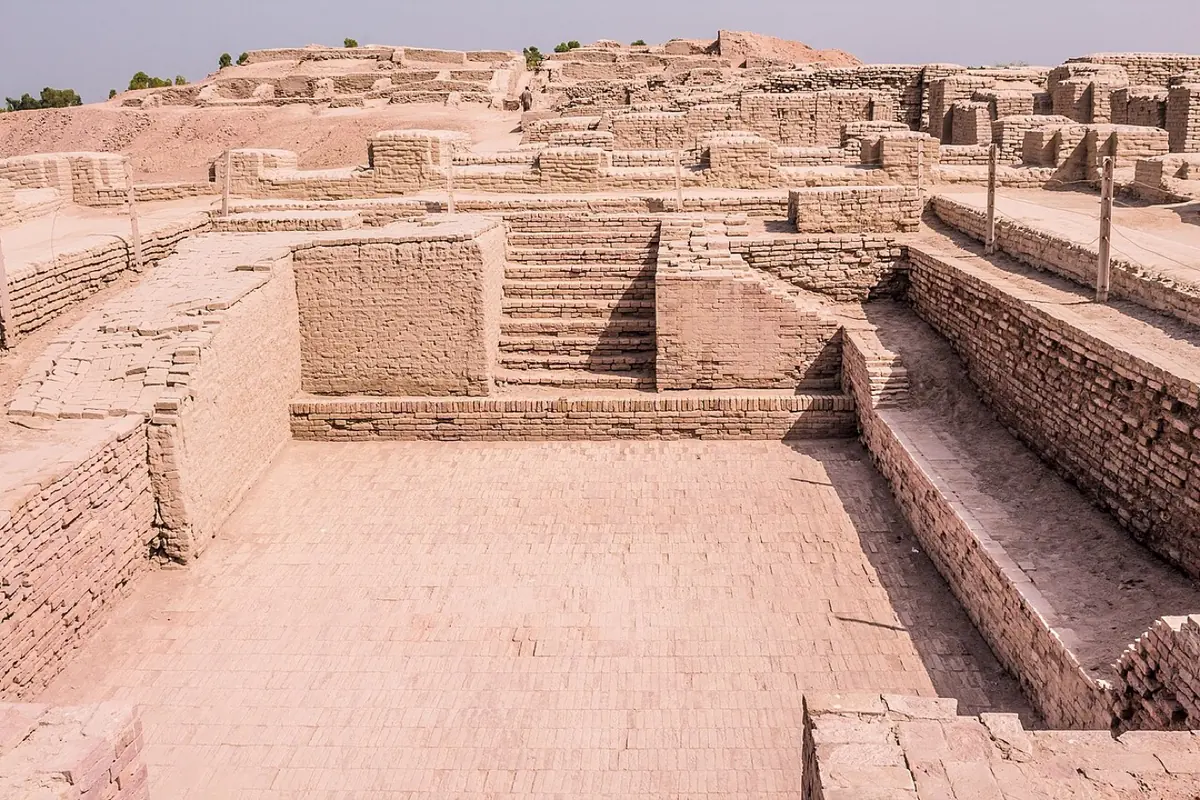
The Indus Valley Civilization was one of the three earliest urban societies in the world, alongside ancient Egypt and Mesopotamia. It lasted from roughly 3300 to 1300 BC, with its peak between about 2600 and 1900 BC. Its cities and settlements spread across today's Pakistan and northwestern India, covering about 1.3 million square kilometers, an area larger than either Egypt or Sumer at the time. Archaeologists have found more than a thousand sites. The two best-known cities, Harappa and Mohenjo-daro, may each have held 30,000 to 60,000 people. The civilization built grid-planned streets, used standardized bricks, and ran covered drains through its neighborhoods. Its writing has never been deciphered, and no one knows what its people called themselves.
How the Indus cities were discovered
In the early 1860s, British engineers in British India were laying the railway line between Lahore and Multan. Near the village of Harappa, their crew found enormous quantities of well-fired bricks and used them as track ballast. The bricks ended up paving roughly 150 kilometers of rail bed. The engineers had no idea they were dismantling a city more than four thousand years old.
The site's true significance only became clear in the 1920s, when the Archaeological Survey of India excavated Harappa and then Mohenjo-daro, far to the southwest. What they found was a civilization that had been entirely forgotten for more than three thousand years.
How the Indus cities were built
The cities of the Indus Valley were planned with unusual precision. Roads followed a grid pattern. Houses were built from kiln-fired bricks made to a fixed ratio of 1:2:4 (height to width to length), and the same proportions turned up in cities hundreds of kilometers apart. The most common brick measured 7 by 14 by 28 centimeters.
Brick-covered channels lined the roads and carried waste water out of the city. Individual houses had their own wells and raised washing platforms. Mohenjo-daro's Great Bath, a tank roughly 12 meters long, 7 meters wide, and 2.4 meters deep, was lined with bricks and sealed with bitumen to hold water. It is still intact more than four thousand years later.
The civilization traded over long distances. Sumerian cuneiform tablets refer to a land called Meluhha, which scholars identify as the Indus region. Ships from Meluhha brought lapis lazuli, carnelian, ivory, and timber to Mesopotamian ports. Sargon of Akkad, who ruled around 2334 to 2279 BC, recorded in an inscription that Meluhhan vessels tied up at his docks.
The Indus cities also stand out for what they lacked. Archaeologists have found no royal tombs, no clearly identified palaces or temples, and no victory monuments. There is no sign of a standing army. A small statue from Mohenjo-daro was nicknamed the "Priest-King," though nothing found so far suggests that priests or kings actually governed the civilization. Nearly every house was connected to the water and sewage system. That level of public infrastructure suggests organized planning, but without the kind of visible central authority found in Egypt or Mesopotamia.
Why can't we read the Indus script?
The Indus script appears on small stone seals and on pottery, usually in strings of just a few signs. Scholars have cataloged several hundred distinct signs, but no one has read them. The inscriptions are too short to give pattern-recognition methods enough to work with, and the language behind them is unknown. Without a bilingual text, like the Rosetta Stone that unlocked Egyptian hieroglyphs, decipherment has stalled for more than a century.
Researchers have tried cryptographic analysis, AI models, and statistical methods. In 2025, the Tamil Nadu state government in India offered a one-million-dollar prize for a successful reading. As of 2026, no attempt has been accepted by the scholarly mainstream. Because the script is unread, we do not know what the Indus people called their cities, their rulers (if they had any), or their gods.
What happened to the Indus Valley Civilization?
An older theory held that invading Aryans destroyed the Indus cities. That theory has been discarded. The evidence now points to climate change. Around 1900 BC, the monsoon that watered the region weakened. Rivers shifted course. The Ghaggar-Hakra river system, which had fed many settlements, dried up. Recent research has identified a series of severe droughts, each lasting more than 85 years, between roughly 2400 and 1400 BC.
Without reliable water, the large cities could not sustain themselves. Farming yields fell, and trade with Mesopotamia declined. The people did not vanish. They moved into smaller villages and scattered across a wider area. The urban way of life that had lasted seven centuries gradually ended. By about 1700 BC, most of the great cities stood empty.
The Indus Valley Civilization was unlike the other great societies of its era. Egypt had pharaohs. Mesopotamia had kings and armies. The Indus cities had grid streets, standardized bricks, and clean water in nearly every home, but no visible ruling class and no military. It was one of the largest and most organized societies of its time, and its writing remains unread.