
British Raj
The British Raj was direct British Crown rule over the Indian subcontinent, lasting from 1858 to 1947.
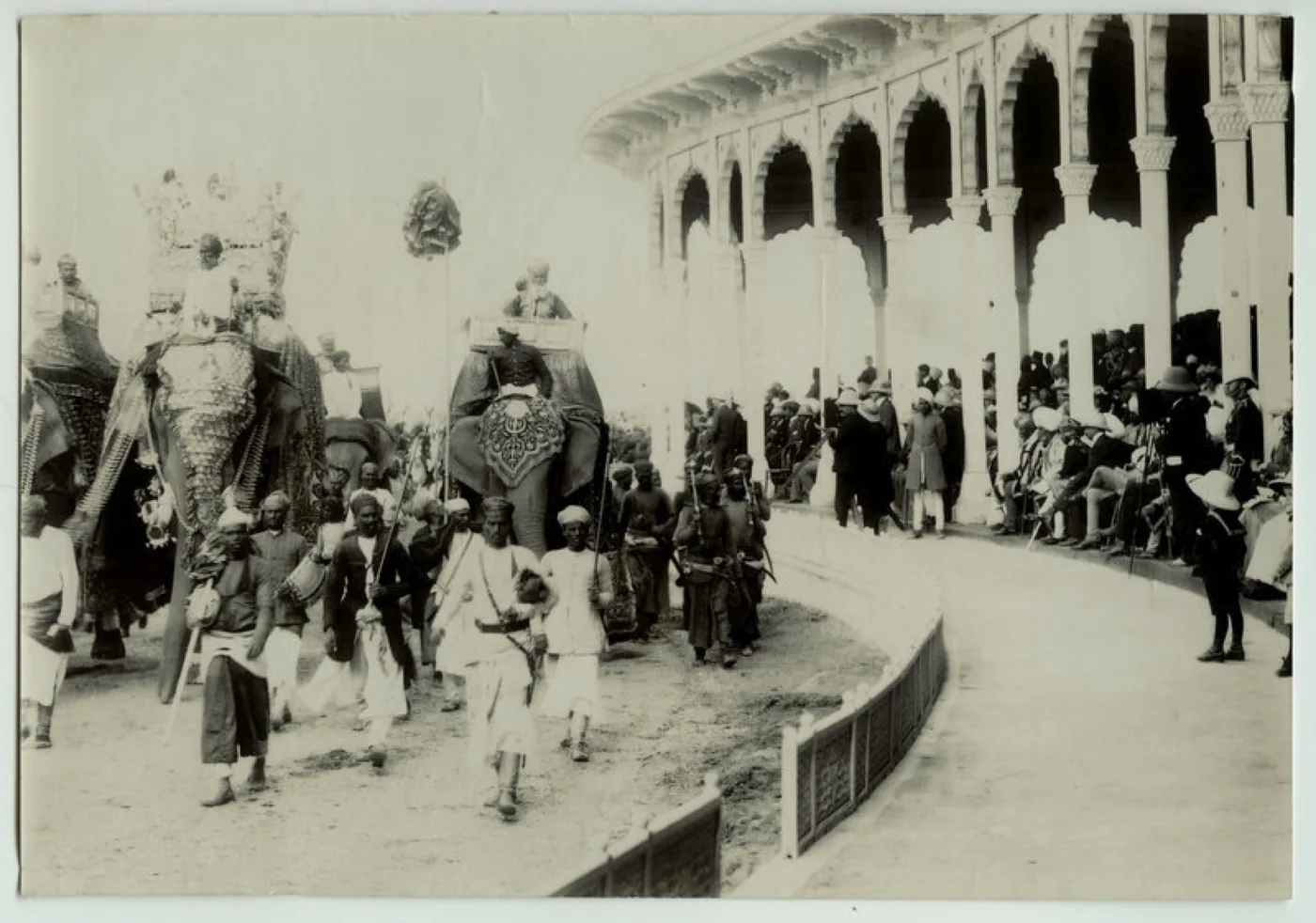
The British Raj was the period of direct British Crown rule over the Indian subcontinent, from 1858 to 1947. "Raj" is a Hindi word meaning "rule." For eighty-nine years, several thousand British officials administered roughly 300 million people, about one in five of all people alive at the time. India was the most valuable part of the British Empire. It supplied raw materials, bought British manufactured goods, and provided the soldiers who fought Britain's wars across Asia and Africa. The Raj ended in August 1947, when Britain partitioned the subcontinent into India and Pakistan, a division that killed up to two million people and displaced as many as 15 million.
How Britain took direct control of India
For two centuries before the Raj, the East India Company had been expanding British power across India through trade, treaties, and war. By the 1850s the Company governed most of the subcontinent with its own army and its own civil servants. In 1857, Indian soldiers in the Company's army rose in rebellion. The uprising spread across northern India before being put down with extreme violence. Parliament blamed the Company for the crisis, and in 1858 it passed the Government of India Act, which stripped the Company of its power and transferred its territories to the British Crown.
The new system placed a Viceroy at the top, appointed by London. Below him, about a thousand members of the Indian Civil Service ran the upper administration. Until the 1920s, they were selected through a competitive exam in London and were almost entirely British. They were nicknamed the "heaven-born" for their status, but the actual work of governing fell to a much larger Indian bureaucracy, Indian police forces, and the Indian Army, which by 1945 was the world's largest all-volunteer military force.
Alongside the directly ruled provinces, about 565 princely states kept their own rulers. They ranged from Hyderabad, which covered more land than England and Scotland combined, to estates barely larger than a town. Each stayed nominally independent as long as it accepted British authority, an arrangement the British called "paramountcy."
How the independence movement ended the British Raj
The tools Britain built to control India helped create the movement that ended British rule. The British laid roughly 40,000 miles of railway, strung telegraph lines across the subcontinent, established a common legal system, and opened English-language schools. Those schools produced a generation of Indian lawyers and activists who used the skills they had learned to organize against the government that taught them.
In 1885, a retired British civil servant named Allan Octavian Hume helped start the Indian National Congress alongside a group of Indian leaders. It began as a polite debating society for educated professionals. It grew into a mass movement after Mohandas Gandhi returned to India in 1915 from South Africa, where he had spent two decades developing his method of nonviolent resistance. Gandhi, a London-trained lawyer who gave up Western suits for hand-spun Indian cloth, transformed Congress from an organization of elites into one that could mobilize millions of ordinary Indians.
The Amritsar massacre of April 1919 hardened opposition across the country. General Reginald Dyer ordered his troops to fire without warning on an unarmed crowd packed into Jallianwala Bagh, an enclosed garden in Amritsar with few exits. At least 379 people were killed. Dyer later told a British inquiry that his goal was to produce "a sufficient moral effect" on the population of Punjab. The massacre radicalized Indian opinion and made it far harder for the British to claim they were governing in India's interest.
Two world wars drained Britain's ability to hold India. Millions of Indian soldiers served in both conflicts, and their sacrifices strengthened the case for independence. By 1947, Britain was financially exhausted from the Second World War and could no longer sustain its empire. Lord Mountbatten, the last Viceroy, oversaw a rushed withdrawal. He partitioned the subcontinent into Hindu-majority India and Muslim-majority Pakistan along a border drawn in barely five weeks. The partition triggered massive communal violence. Up to two million people were killed, and between 14 and 15 million crossed the new borders as refugees in one of the largest forced migrations in history.
How did the British Raj change India?
The Raj left India with a railway network, a legal system, a civil service, and a common language of government. It also left deep economic damage. Around 1750, India produced close to 25 percent of global manufacturing output, mainly textiles. By the time the Raj ended, that share had fallen below 3 percent. British trade policy directed India to export raw cotton and grain while importing finished goods from British factories, and Indian industries, especially handloom weaving, collapsed over the course of the nineteenth century. The railways the British built carried goods to ports for export more efficiently than they carried food to regions hit by drought.
Famines killed millions of people during the Raj, beginning with severe droughts in the 1860s and continuing through the Bengal famine of 1943, in which an estimated three million people died while wartime policies diverted food away from Bengal. The British government claimed it was preparing India for eventual self-government, but for the entire period of Crown rule it denied Indians meaningful control over their own country.
India's borders, its administrative structure, its legal system, and its use of English as a language of government all trace directly to the British Raj. So does the conflict between India and Pakistan, which grew from the partition Britain imposed in 1947.