
Jim Crow
Jim Crow was the system of laws and customs that enforced racial segregation across the American South from 1877 to 1965.
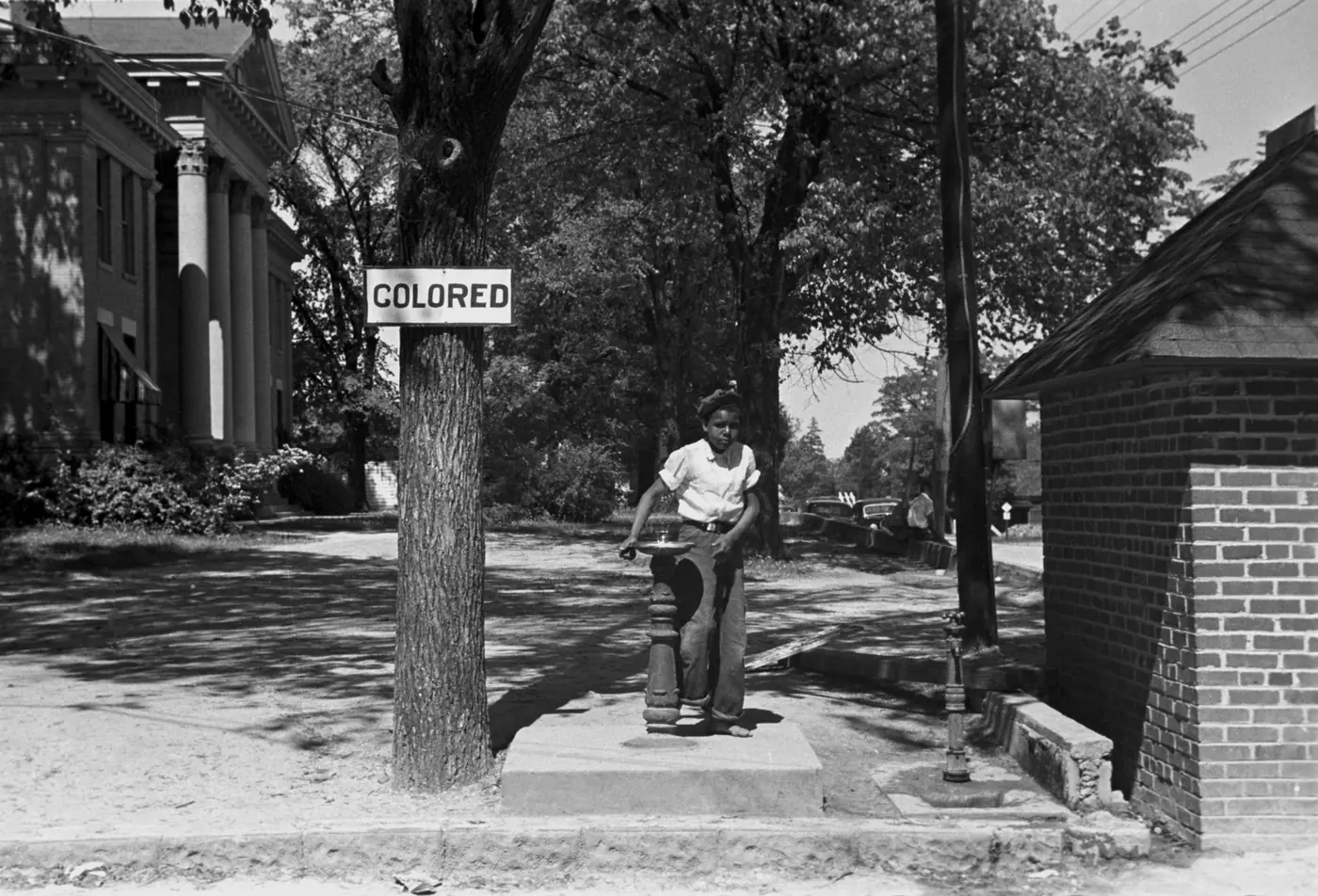
Jim Crow was the system of state laws, local rules, and enforced customs that separated Black and white Americans across the American South from 1877 to 1965. Under Jim Crow, schools, hospitals, trains, waiting rooms, water fountains, and cemeteries were divided by race, and signs reading "White" and "Colored" marked the separation. Beyond the written laws, an unwritten code required Black southerners to yield the sidewalk to white people, use rear entrances to buildings, and show deference to any white person they encountered. Breaking these rules risked violence. Jim Crow also stripped Black citizens of the right to vote through poll taxes, literacy tests, and intimidation. At its peak, the system governed every part of daily life in the South, from where a person could sit on a bus to where they could be buried.
How Jim Crow was built
The Emancipation Proclamation of 1863 and the Thirteenth Amendment of 1865 ended slavery. The Fourteenth Amendment gave Black Americans citizenship, and the Fifteenth, ratified in 1870, gave Black men the right to vote. During Reconstruction, the period after the Civil War when the federal government enforced these rights in the South, Black men voted in large numbers, held seats in state legislatures, and served in Congress.
When Reconstruction ended in 1877, federal troops left the South. White-dominated state governments began passing laws to separate the races and to push Black voters off the rolls. Southern states charged fees to register, required reading tests scored by white officials who could fail anyone they chose, and restricted primary elections to white voters. Some states added grandfather clauses, exempting anyone whose grandfather had voted before 1867, a date that excluded nearly all Black families. The results were swift. In Louisiana, 130,344 Black voters were registered in 1896. By 1904, after the state rewrote its constitution with new voting restrictions, the number was 1,342.
Violence reinforced the laws. White mobs lynched Black people as a form of terror, and Black workers who tried to vote or organize risked losing their jobs, their homes, or their lives.
In 1892, a 29-year-old shoemaker in New Orleans named Homer Plessy boarded a whites-only train car. Plessy was seven-eighths white and light-skinned, but under Louisiana law he was classified as Black. He was acting on behalf of the Comite des Citoyens, a group of New Orleans citizens who wanted to challenge the state's Separate Car Act in court. Plessy told the conductor he was Black and refused to move to the colored car. He was arrested, as planned.
The case, Plessy v. Ferguson, reached the Supreme Court in 1896. The court ruled 7-1 that "separate but equal" facilities satisfied the Constitution. Justice John Marshall Harlan, a Kentuckian and former slaveholder who had come to oppose segregation, was the only dissenter. He wrote that "our Constitution is color-blind." In practice, separate was never equal. In the 1930s, South Carolina spent $53 per year on each white student and $5 on each Black student. Mississippi spent $31 and $6. The ruling stood as Jim Crow's legal foundation until 1954.
How Jim Crow was dismantled
In 1954, the Supreme Court ruled in Brown v. Board of Education that segregated public schools were unconstitutional, overturning the reasoning of Plessy v. Ferguson. The case was brought by the NAACP on behalf of Black families in Topeka, Kansas, and in three other states and Washington, D.C.
The ruling alone did not end segregation. Southern states resisted, and enforcement required years of protest. The Montgomery bus boycott of 1955 and 1956, the sit-ins at segregated lunch counters, and the marches in Birmingham and Selma, Alabama, made segregation impossible for the federal government to ignore. Many of these campaigns were led or organized by Martin Luther King Jr..
The Civil Rights Act of 1964, signed by President Lyndon Johnson, outlawed segregation in public places. The Voting Rights Act of 1965 banned the literacy tests and other tools that southern states had used to keep Black citizens from voting. Together, these two laws ended Jim Crow as a legal system. The inequalities Jim Crow created, in wealth, education, and political power, outlasted the system itself.
Where did the name Jim Crow come from?
The name came from a minstrel show character. In 1828, a white performer named Thomas Dartmouth Rice created a blackface act called "Jump Jim Crow," in which he played a caricature of a Black man. Rice claimed he had copied the routine from a Black stable hand he had seen. The act became one of the most popular stage routines in the country, and "Jim Crow" became a common slur for Black people.
By the 1840s, abolitionists in Massachusetts were using "Jim Crow" to describe separate railroad cars for Black and white passengers. By the 1880s, the term was being applied to the segregation laws spreading across the South, and it remained in use until those laws were struck down in the 1960s.