
Khmer Rouge
The Cambodian communist movement that ruled from 1975 to 1979, emptied the cities, and killed close to two million people.
The Khmer Rouge was a Cambodian communist movement that ruled the country from April 1975 to January 1979. In less than four years, the regime killed roughly two million people, nearly one in four Cambodians. Most victims were not shot. They were starved, worked to death in rice fields, or killed with farm tools. The movement spent years as a small rural guerrilla force before the wider war in Southeast Asia turned it into an army. Its leaders were not peasants. They were mostly Paris-educated intellectuals, led by a man born Saloth Sar, who later called himself Pol Pot. Their goal was to build a purely agrarian communist society from scratch, and the people who had lived in Cambodia's old society were treated as obstacles.
How the Khmer Rouge came to power
For most of the 1960s, the Khmer Rouge had almost no popular support. Two things changed that.
The first was American bombing. Starting in 1969, the United States secretly bombed eastern Cambodia to destroy North Vietnamese supply lines running through the country. Over the next four years, American planes dropped an estimated 500,000 tons of bombs on Cambodia. Entire villages were destroyed, and the survivors were easy recruits for the communists.
The second was a coup. In 1970, a military coup led by General Lon Nol removed Cambodia's head of state, Prince Norodom Sihanouk. From exile in Beijing, Sihanouk told his rural supporters to join the Khmer Rouge. That endorsement from the most recognized figure in Cambodian politics turned a fringe movement into an army. On April 17, 1975, the Khmer Rouge marched into Phnom Penh.
What the Khmer Rouge did after taking power
Within 72 hours of entering the capital, the Khmer Rouge emptied it. Roughly two million people were driven into the countryside on foot, including hospital patients pushed out on their beds. The Khmer Rouge abolished money and blew up the central bank. It shut down markets, schools, courts, newspapers, and religious institutions. This break with the past became known as Year Zero.
The Khmer Rouge sorted the population into two groups. "Base people" were peasants from areas the Khmer Rouge had held during the war. "New people" were everyone else, mostly city dwellers, and they were presumed disloyal. Owning a pair of glasses, knowing French, or having uncalloused hands was treated as evidence against a person.
The Khmer Rouge's plan was to fund the new state by tripling rice production through forced labor. The quotas were impossible, but the Khmer Rouge took the rice from the workers regardless, and the workers starved. When production failed, the party leaders, who went by the name Angkar (Khmer for "Organization"), decided the shortfalls were deliberate and began purging their own members.
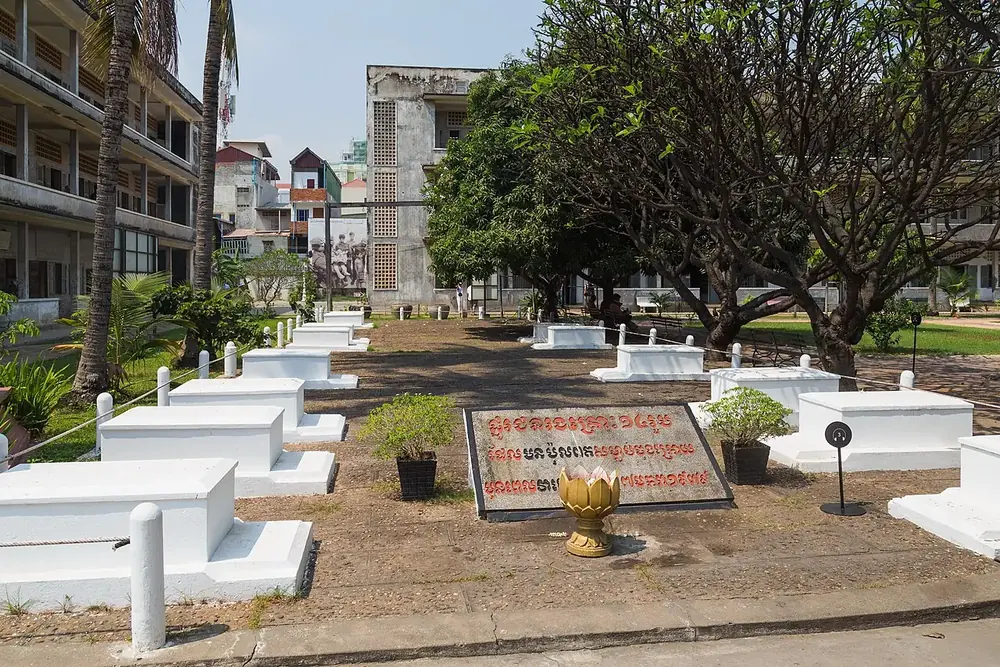
Many of the internal purges ran through S-21, a former high school in Phnom Penh that the Khmer Rouge turned into a torture center. Between 14,000 and 17,000 people passed through S-21. Guards forced them under torture to name supposed conspirators, then trucked them to the mass execution site at Choeung Ek. Only about two dozen people held at S-21 were still alive when the regime fell.
How many people did the Khmer Rouge kill?
Estimates range from 1.5 to 2 million, with some as high as 3 million. Most scholars use a figure close to two million, roughly a quarter of Cambodia's population at the time. The exact number cannot be determined because the Khmer Rouge destroyed the institutions that could have kept records. Deaths came from execution, starvation, forced labor, and untreated disease. Mass graves at Choeung Ek and more than 300 other sites across Cambodia are still being documented.
How did the Khmer Rouge end?
Vietnam ended it. After taking power, the Khmer Rouge launched cross-border raids into Vietnamese territory and killed Vietnamese civilians in border villages. In April 1978, Khmer Rouge soldiers massacred over 3,000 people in the Vietnamese town of Ba Chuc. Vietnam invaded Cambodia on December 25, 1978. Vietnamese forces entered Phnom Penh on January 7, 1979.
Because Vietnam was a Soviet ally, China threw its support behind the deposed Khmer Rouge. The United States and its Southeast Asian partners went along. The Khmer Rouge continued to represent Cambodia at the United Nations until the early 1990s, and its fighters were resupplied through camps on the Thai border. The Vietnamese-installed government in Phnom Penh, which had ended the genocide, was treated internationally as an occupying force.
The Khmer Rouge tribunal and Cambodia today
Pol Pot never stood trial for what his government did. He died under house arrest on April 15, 1998, officially of heart failure. A UN-backed tribunal, the Extraordinary Chambers in the Courts of Cambodia, eventually opened in Phnom Penh. Over 16 years it spent roughly $337 million and convicted three people: the commander of S-21 and two senior leaders, Nuon Chea and Khieu Samphan. Two other defendants died before their cases concluded.
Cambodia's median age today is about 27. The country's economy depends on garment manufacturing and tourism, and some of that tourism goes to the genocide memorials at Tuol Sleng and Choeung Ek. The political class descends in part from Khmer Rouge defectors. Hun Sen, who defected from the Khmer Rouge to the Vietnamese side, served as prime minister for 38 years before handing power to his son, Hun Manet, in 2023. Cambodia's professional class, its schools, and its institutions were destroyed between 1975 and 1979. The country spent decades rebuilding what the Khmer Rouge had wiped out, and the international isolation that followed Vietnam's invasion slowed that recovery further.