
Ho Chi Minh
Ho Chi Minh was the Vietnamese revolutionary who fought France and the United States for independence and founded North Vietnam's communist state.
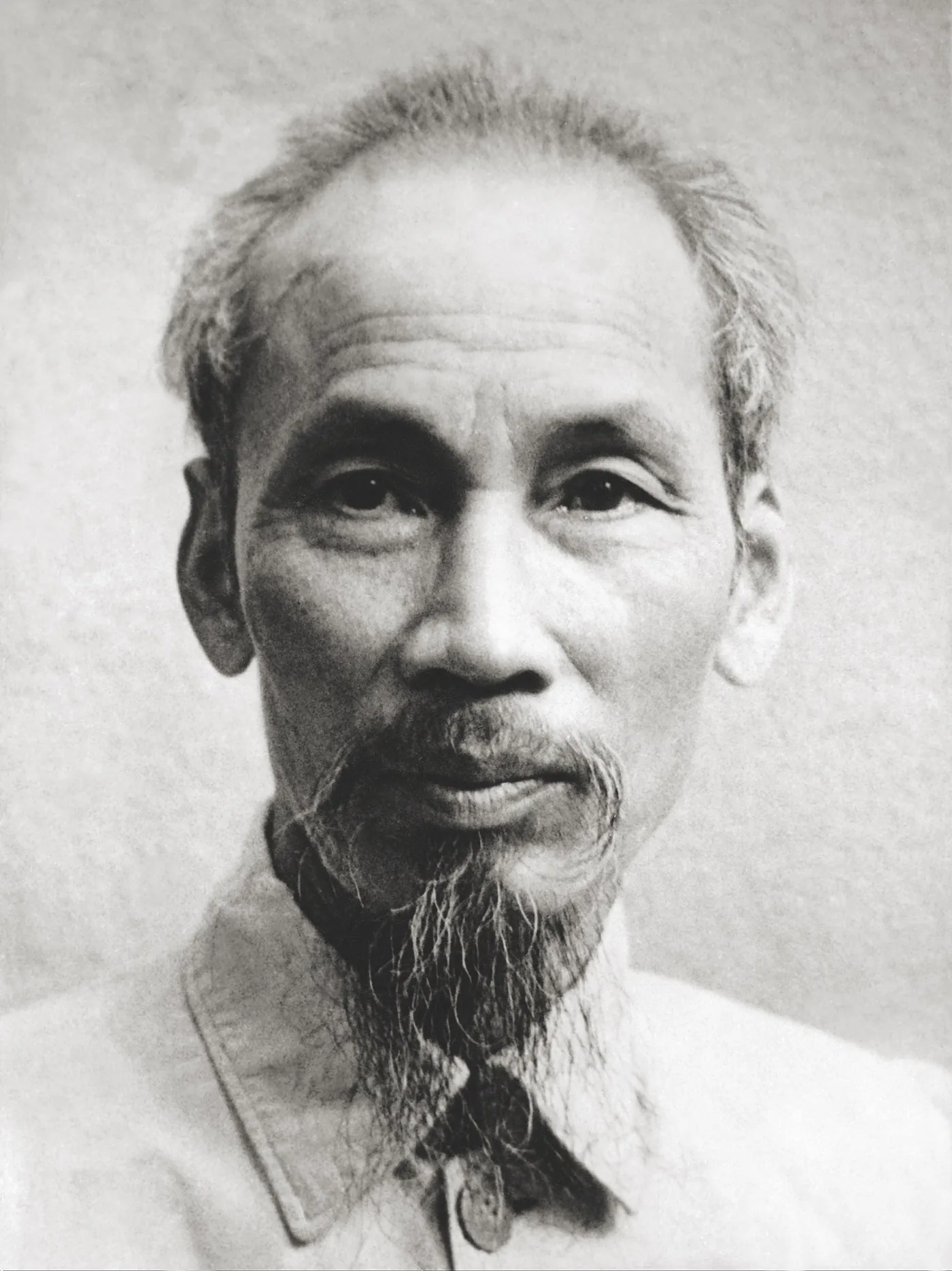
Ho Chi Minh was a Vietnamese revolutionary who spent decades fighting for his country's independence and led it through two wars, first against France and then against the United States. His birth name was Nguyen Sinh Cung, and he was born in 1890 in Nghe An province in central Vietnam, then a colony of France. His father was a local official who was dismissed from his government post. As a young man Ho left Vietnam and spent years abroad, working as a ship's crewman and a kitchen worker in London and Paris. He did not take the name Ho Chi Minh, which means roughly "he who enlightens," until his fifties. He declared Vietnam's independence in 1945 by opening his speech with a line from the American Declaration of Independence, wrote to President Harry Truman asking for support, and never received a reply. He died in 1969, six years before the war ended.
How Ho Chi Minh became a revolutionary
In 1919, the victors of World War I gathered at Versailles and President Woodrow Wilson was promoting self-determination for nations. A twenty-nine-year-old Vietnamese man presented a petition to the conference for the Vietnamese people. It did not ask for independence. It asked for civil liberties under French rule: the right to a fair trial, a free press, the ability to form political associations, and the end of government by decree. He used the name Nguyen Ai Quoc on the document, meaning "the Patriot." The petition went unanswered.
He concluded that European empires would not give up their colonies willingly. In December 1920, he helped found the French Communist Party at its congress in Tours. His stated reason was straightforward: communists were the only political movement in Europe that proposed to dismantle colonial rule. Over the next two decades he worked as a Comintern operative across Moscow, Canton, Hong Kong, and Siam. He organized an Indochinese communist party in 1930 and, in 1941, the Viet Minh, the independence front that would fight both Japan and France.
How Ho Chi Minh declared independence and lost American support
Japan surrendered in August 1945, and the French colonial administration had not yet come back. In September, Ho Chi Minh addressed a crowd in Hanoi and proclaimed independence for Vietnam. The speech opened with words borrowed from the American Declaration of Independence. Officers from the American OSS intelligence service were in the crowd. Ho's Viet Minh fighters had worked with the OSS against the Japanese, and Ho later wrote several letters to President Truman asking for support or recognition. Truman never replied. Washington wanted France's cooperation in rebuilding Europe more than it wanted Vietnamese goodwill, and began financing France's war to retake Vietnam.
That war lasted from 1946 to 1954. It ended at the Battle of Dien Bien Phu. The Viet Minh hauled heavy guns over mountain trails that the French had judged impossible to cross, then destroyed the garrison below. The battle lasted nearly two months and ended almost a century of French rule in Indochina. The Geneva settlement that followed split Vietnam along the 17th parallel and promised national elections in 1956. Those elections never took place, largely because Washington and the South Vietnamese government expected Ho Chi Minh to win them.
When American combat troops began arriving in the 1960s, Ho was aging and increasingly a ceremonial figure. Le Duan and the Communist Party leadership directed the fighting in the south. Ho served as the public symbol: a frugal, childless figure known as "Uncle Ho," typically shown in sandals and a simple tunic. That carefully maintained image left out a harsher record. From 1953 to 1956, he oversaw a land reform campaign that killed thousands of Vietnamese classified as landlords or wealthy farmers. The Communist Party later admitted the campaign had been a disaster.
Ho Chi Minh died on September 2, 1969, the twenty-fourth anniversary of the independence declaration. In his will he asked to be cremated. The government ignored his wishes, embalmed his body, and placed it in a mausoleum in Hanoi, where it remains today.
Why is Saigon called Ho Chi Minh City?
After North Vietnamese forces captured Saigon on April 30, 1975, ending the Vietnam War, the reunified government renamed the city Ho Chi Minh City on July 2, 1976. The name honored Ho Chi Minh as the founder of the independent Vietnamese state. Many residents and visitors still call the city Saigon in everyday conversation, and the city's international airport still uses the code SGN.
Ho Chi Minh's significance today
Vietnam remains a one-party communist state, but its foreign policy looks more like the work of a nationalist than of a communist ideologue. The country normalized relations with the United States in 1995 and elevated the relationship to a comprehensive strategic partnership in 2023. In July 2026, the aircraft carrier USS George Washington made a five-day port call in Da Nang, the fourth American carrier visit since normalization. Vietnam fought a brief war against China in 1979, and today it balances between Washington and Beijing.
The central question of Ho Chi Minh's career, whether he was first a nationalist or first a communist, shaped American foreign policy for a generation. His record points toward a nationalist who took communist allies because they were the ones willing to help. American Cold War planners read him the other way, as a piece in a chain of communist expansion running from Moscow to Beijing, and built the domino theory and the Vietnam War around that reading.