
Guerrilla Warfare
Guerrilla warfare is a form of fighting in which small, mobile forces use ambush and dispersal to wear down a larger conventional army.
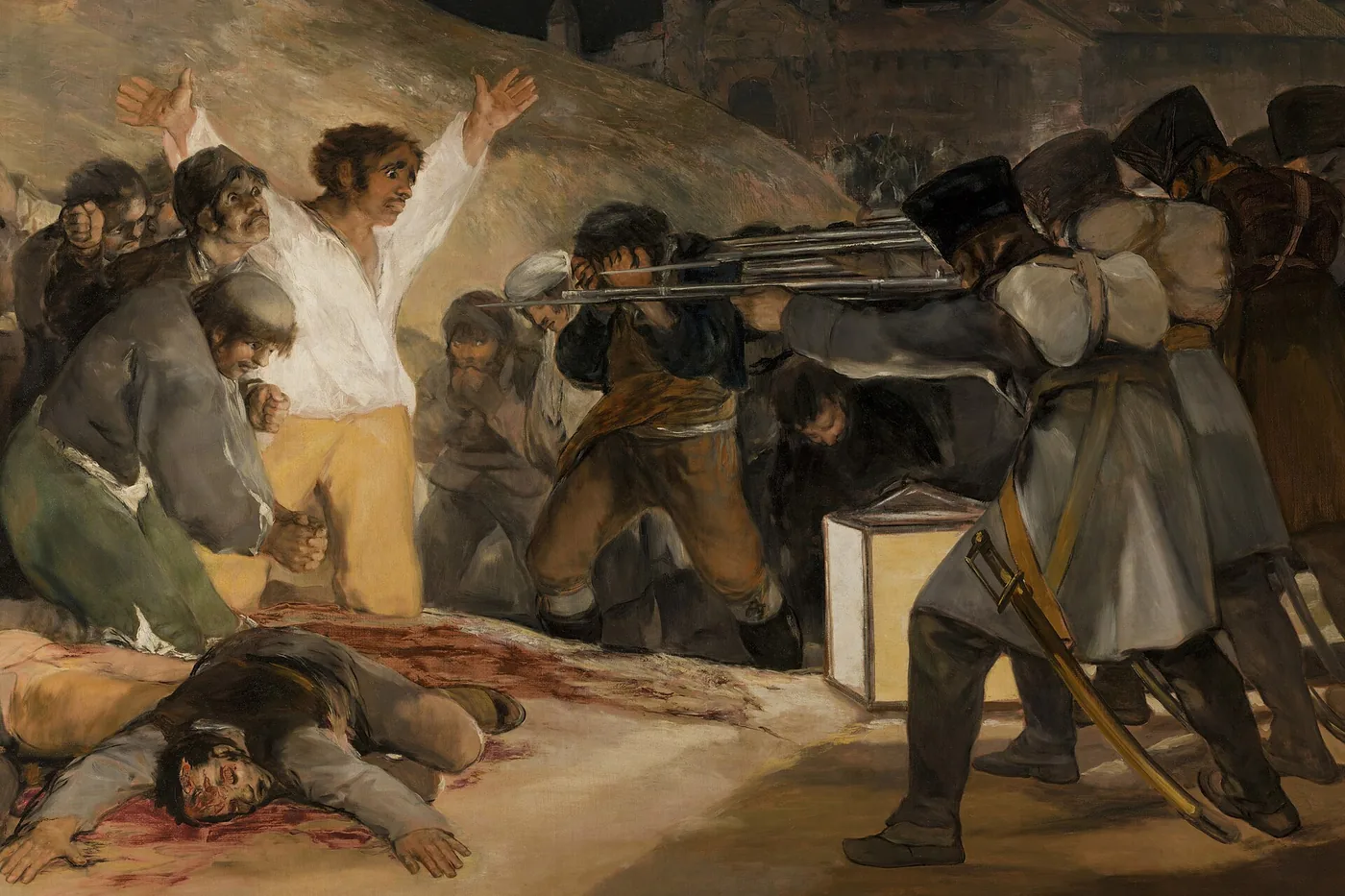
Guerrilla warfare is a way of fighting in which a smaller, weaker force avoids open battle and instead uses ambushes, raids, and sabotage to wear down a stronger one. The word comes from Spanish. "Guerrilla" is a diminutive meaning "little war," and English speakers picked up the word during the Peninsular War, when Spanish irregulars tied down Napoleon's army from 1808 to 1814. The basic idea is simple. A regular army fights to destroy the other side and hold ground. A guerrilla force holds no ground worth taking and fields no army that can be cornered. It disperses when threatened and regroups when the danger passes. The longer the war goes on, the more it favors the guerrilla.
How Spanish fighters gave guerrilla war its name
In 1808, Napoleon sent a French army into Spain. Napoleon won every battle he fought there, but winning battles did not give him control of the country. Spanish irregular fighters ambushed couriers, cut supply lines, killed stragglers, and disappeared into a population that refused to hand them over. The French controlled only the ground their soldiers physically stood on. At its peak, France kept more than 200,000 troops in Spain, even while preparing to invade Russia in 1812. Napoleon later called the conflict his "Spanish ulcer" and said that it destroyed him. The war that gave guerrilla fighting its name also showed its central lesson: a conventional army can win battle after battle and still lose the war.
Mao Zedong's theory of guerrilla warfare
The most influential writing on guerrilla warfare came from Mao Zedong, who published two works during China's war with Japan: "On Guerrilla Warfare" (1937) and "On Protracted War" (1938). Mao's central argument was political, not military. He compared guerrilla fighters to fish that can only survive in the sea of a supportive population, meaning that fighters depend on civilians willing to feed them, hide them, and cover for them. To keep that support, Mao's forces paid for the supplies they took from villagers. Their Nationalist opponents did not enforce the same discipline.
Mao laid out three stages of guerrilla war: strategic defense, stalemate, and conventional counteroffensive. The guerrilla phase was meant to be temporary. Once the insurgents had worn the enemy down and built enough strength, they would shift to conventional warfare to take the cities and finish the war. Without that final shift, an insurgency stays an insurgency.
Why is guerrilla warfare so effective?
Henry Kissinger put the problem plainly in a 1969 Foreign Affairs article about the Vietnam War. A guerrilla force does not need to win. It only needs to avoid losing. The regular army, by contrast, must win outright, or it has lost. A guerrilla force does not need to defeat its enemy on the battlefield. It only needs to survive long enough for the other side to decide the war is not worth fighting.
The costs work in the guerrilla's favor. An ambush costs a handful of fighters and a small amount of ammunition. Guarding against ambushes everywhere means posting soldiers in every town and running patrols on every road, which ties down enormous numbers of troops. Counterinsurgency campaigns are often said to require ten to twenty soldiers for every insurgent in the field.
The record since 1945 bears this out. France lost in Indochina and in Algeria. The Soviet Union lost in Afghanistan, and then the United States lost its own war there. The United States lost in Vietnam. In most of these cases, the stronger military power was undefeated on the battlefield but withdrew anyway. The guerrilla's real target was never the opposing army but the willingness of voters and taxpayers back home to keep paying for a distant war. Nuclear weapons and precision-guided munitions have not changed this pattern, because neither is useful against an enemy that can afford to wait indefinitely.
How guerrilla warfare has been defeated
Guerrilla wars are not unwinnable for the stronger side, but the victories follow a pattern. The British fought a communist insurgency in Malaya from 1948 to 1960 and defeated it. Under the Briggs Plan, the British moved roughly half a million rural Chinese residents into guarded settlements called "new villages," separating the insurgents from the civilians who had been feeding and sheltering them. The resettlement worked because the British paired it with a real promise of self-rule for Malaya. Once independence was on the table, the political case for the insurgency fell apart.
The United States backed something similar in South Vietnam starting in 1962, the strategic hamlet program. It moved Vietnamese villagers into fortified hamlets but offered no comparable political settlement. The hamlets were often poorly built and poorly defended. Villagers resented being forced from their homes, and the program collapsed after the South Vietnamese president, Ngo Dinh Diem, was overthrown in 1963.
Geography matters as much as politics. Insurgents who can slip across a border into a neighboring country to rest and resupply are very difficult to defeat. Those who are boxed in, with no foreign sanctuary, are usually beaten in the end. Malaya's insurgents had no accessible sanctuary. The Viet Cong and North Vietnamese Army used Laos and Cambodia. The Afghan mujahideen used Pakistan. In every case, the presence or absence of a cross-border sanctuary helped decide the outcome.