
Klaus Fuchs
German-born physicist who gave the Soviet Union the design of the plutonium bomb while working on the Manhattan Project.
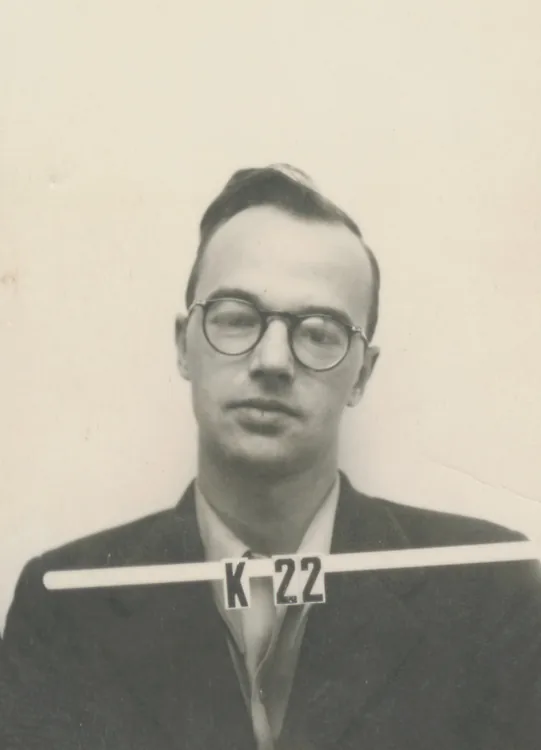
Klaus Fuchs was a German-born physicist who worked on the Manhattan Project during World War II and secretly passed the design of the plutonium bomb to the Soviet Union. He was a committed communist, and he spied out of conviction, not for money. Fuchs gave the Soviets enough technical detail to build their first bomb years earlier than they could have managed alone. The Soviet Union tested that weapon in August 1949, and its design closely matched Fat Man, the American plutonium bomb. Fuchs confessed in January 1950, was sentenced to fourteen years in prison, and served nine. He is one of the most consequential spies of the twentieth century.
How Klaus Fuchs became a spy
Fuchs was born on December 29, 1911, in Rüsselsheim, a small city near Frankfurt. His father, Emil Fuchs, was a Lutheran pastor and a committed socialist. The family paid for its politics. Fuchs' mother killed herself in 1931. His sister Elisabeth later killed herself.
Fuchs studied physics at the University of Leipzig and joined the German Communist Party in 1932. When the Nazis took power the following year, he fled to England. He earned a doctorate in physics from the University of Bristol in 1937 and worked under Max Born at the University of Edinburgh.
When the war began, Britain interned Fuchs as an enemy alien and sent him to a camp in Canada. He was released after the British government decided his scientific ability was too valuable to leave in a camp. He joined Rudolf Peierls' team in Birmingham, working on Britain's atomic bomb project, and became a naturalized British citizen in 1942. Fuchs began passing secrets to the Soviet Union almost as soon as he had access to them, through a courier in Britain.
In 1943, Fuchs went to the United States as part of Britain's team assigned to the Manhattan Project. By the following August he had arrived at Los Alamos, where he joined Hans Bethe's Theoretical Physics Division. He worked on the implosion mathematics for the plutonium bomb, one of the hardest problems in the project, and was one of the few people who understood the complete weapon design.
What Klaus Fuchs gave the Soviet Union
In the United States, Fuchs passed secrets through Harry Gold, a Philadelphia chemist who worked as a Soviet courier. The two met in New York and later in Santa Fe, near Los Alamos. At one meeting on the Castillo Street Bridge in Santa Fe, Fuchs handed Gold the plans for the Fat Man bomb.
Over several years, Fuchs delivered detailed technical secrets: how the implosion worked, the construction of the plutonium core, the neutron initiator that started the chain reaction, and the predicted explosive yield. He told the Soviets where and when the Trinity test would take place, and he watched the test himself in July 1945. Later, he passed along early American work on the hydrogen bomb.
Soviet physicists used Fuchs' material to check and accelerate their own work. The Soviet Union detonated its first nuclear weapon in August 1949. American intelligence had not expected the Soviets to test a bomb until 1953. Historians estimate that Fuchs' espionage shortened the Soviet program by one to two years.
How was Klaus Fuchs caught?
American codebreakers working on the Venona project, which decrypted thousands of wartime Soviet intelligence cables, identified a spy inside the British delegation at Los Alamos. The clues pointed to Fuchs.
The Venona intercepts were too secret to use as evidence. MI5 sent Jim Skardon, one of its most experienced interrogators, to question Fuchs directly. Skardon met with Fuchs several times over the winter of 1949 and 1950, using the fact that Fuchs' father had recently moved to East Germany as a way to open the conversation. On January 24, 1950, Fuchs confessed. He later said he had come to doubt Soviet policy.
Fuchs' trial at the Old Bailey on March 1, 1950, lasted less than two hours. He was charged with passing secrets to a wartime ally, not with treason, because the Soviet Union had been an ally when the spying began. The maximum sentence for that charge was fourteen years, and that is what he received.
Fuchs' confession set off a chain of arrests. It led to Harry Gold, the courier, who in turn identified David Greenglass, another spy at Los Alamos. Greenglass testified against his sister and brother-in-law, Julius and Ethel Rosenberg. The Rosenbergs were executed in 1953. The case also helped fuel the American spy panic that became McCarthyism.
What happened to Klaus Fuchs after prison?
Fuchs served nine years and was released in June 1959. Britain had stripped him of his citizenship. On the day of his release, he flew to East Germany.
The communist government welcomed Fuchs. He was appointed deputy director of the Central Institute for Nuclear Research and became a member of the East German Academy of Sciences. He married Grete Keilson, a Communist Party official he had known before the war, and lived quietly as a respected scientist.
Fuchs died on January 28, 1988, in East Berlin, at the age of 76. In East Germany, he never expressed regret for what he had done. The information he passed helped end the American nuclear monopoly and shaped the nuclear arms race that defined the rest of the Cold War.