
Little Boy and Fat Man
Little Boy and Fat Man were the atomic bombs dropped on Hiroshima and Nagasaki in August 1945.
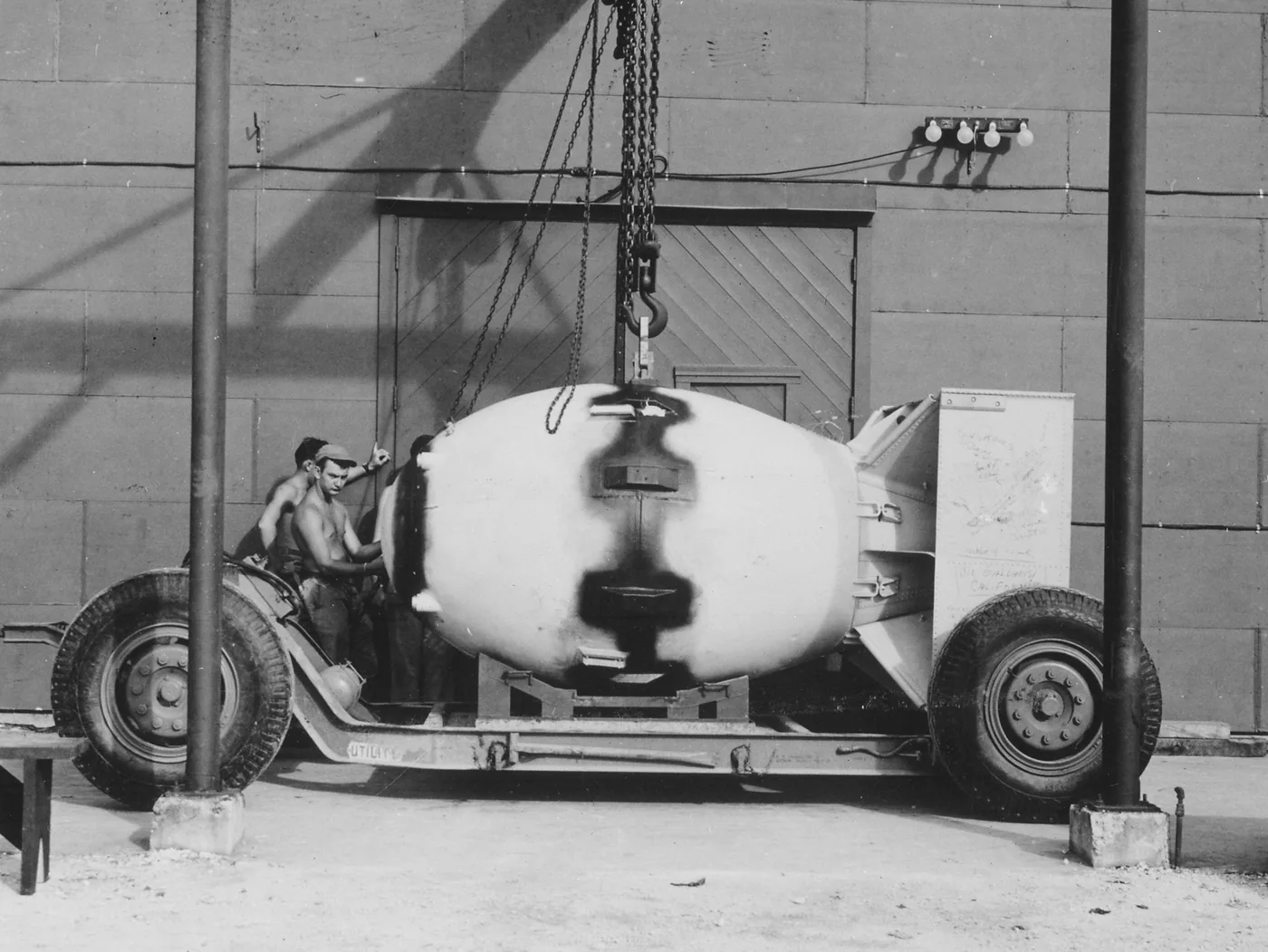
Little Boy and Fat Man were the two atomic bombs dropped on Japan in August 1945, the only nuclear weapons ever used in war. Little Boy, a uranium bomb, destroyed Hiroshima on August 6. Fat Man, a plutonium bomb, destroyed Nagasaki three days later. Together they killed an estimated 110,000 to 210,000 people, most of them civilians, from the blasts themselves and from burns and radiation sickness in the months that followed. The two bombs used completely different designs. Little Boy worked like an artillery piece. Fat Man used a precision implosion mechanism so complex that its builders tested it in the New Mexico desert three weeks before the Nagasaki mission just to prove it would work. Since 1945, the implosion approach has been the basis for nearly all nuclear weapons.
How the two bombs were built at Los Alamos
Scientists at Los Alamos, the secret wartime laboratory in New Mexico directed by J. Robert Oppenheimer, developed both designs as part of the Manhattan Project. The project pursued two paths because each depended on a different material, and no one knew which would be ready first.
Little Boy used uranium-235. The bomb worked by firing a hollow cylinder of enriched uranium along a barrel toward a target piece of the same metal, driven by a cordite charge. When the two pieces met, the combined uranium reached critical mass and a chain reaction released its energy in an instant. The design was simple enough that the scientists used it in combat without ever testing it. The hard part was the uranium itself: enriching enough uranium-235 took enormous industrial plants and used most of the Manhattan Project's budget. Little Boy contained about 64 kilograms of enriched uranium, and less than one kilogram of that actually fissioned.
The plutonium path was harder. Plutonium could be produced in a nuclear reactor, which Enrico Fermi had first demonstrated in Chicago in December 1942. But reactor-produced plutonium contains the isotope plutonium-240, which emits stray neutrons on its own. In a gun-type bomb, those stray neutrons would trigger the chain reaction prematurely, before the pieces came together completely, producing a partial explosion rather than a full one. The Manhattan Project had originally planned a gun-type plutonium bomb, code-named Thin Man. When scientists discovered the plutonium-240 problem in 1944, Thin Man was abandoned.
The replacement was implosion. Fat Man surrounded a sphere of plutonium with precisely shaped blocks of high explosive, called lenses, that were detonated at the same instant. The explosion squeezed the plutonium core to over double its usual density, holding it together long enough for the chain reaction to finish. The engineering was demanding: the explosive lenses had to fire within a microsecond of each other, or the core would not compress evenly. To prove the design worked, the scientists detonated a test device at Trinity, in the desert south of Los Alamos, on July 16, 1945. The explosion equaled about 25,000 tons of TNT.
The missions over Hiroshima and Nagasaki
President Harry Truman authorized the use of atomic weapons against Japan in late July 1945. On the morning of August 6, a B-29 bomber named Enola Gay took off from Tinian, a small island in the western Pacific. The pilot, Colonel Paul Tibbets, had named the plane after his mother. At 8:15 a.m. local time, the crew released Little Boy over the center of Hiroshima. Little Boy fell for about 44 seconds and detonated roughly 600 meters above the ground. The blast and the firestorm that followed destroyed about five square miles of the city. An estimated 70,000 people died that day. By the end of 1945, the total had reached about 140,000, as more people died from burns and radiation sickness.
Three days later, on August 9, Major Charles Sweeney flew a B-29 called Bockscar from Tinian carrying Fat Man. The primary target was the city of Kokura, but clouds and smoke from a firebombing raid the day before made it impossible to see the aiming point. Sweeney turned southwest for the secondary target, Nagasaki. Fat Man detonated at 11:02 a.m. Nagasaki's hills and valleys shielded parts of the city from the blast, but between 60,000 and 80,000 people still died by the end of 1945. Japan announced its surrender on August 15.
How big were Little Boy and Fat Man?
The names matched their shapes. Little Boy was long and narrow: 10 feet long, 28 inches across, and about 9,700 pounds. Fat Man was round: about 10 feet 8 inches long, 60 inches across, and about 10,300 pounds. Fat Man's wide shape came from the sphere of explosive lenses packed around its plutonium core.
Fat Man used far less fissile material than Little Boy. Fat Man's core held about 6.2 kilograms of plutonium, compared to Little Boy's 64 kilograms of uranium. But Fat Man produced the larger explosion: about 21 kilotons compared to about 15 kilotons. Implosion compresses the core so efficiently that more of the material actually fissions.
That efficiency is the reason Fat Man's design became the standard. Nearly every nuclear weapon built since 1945, from small tactical warheads to the cores of hydrogen bombs, has used some form of implosion. The gun-type design was simpler but wasteful, needing large amounts of enriched uranium and converting very little of it into energy. About 125,000 nuclear warheads have been built in the decades since, and almost all of them are based on implosion.