
Little Ice Age
The Little Ice Age was a period of unusual cold across the Northern Hemisphere from about 1300 to 1850.
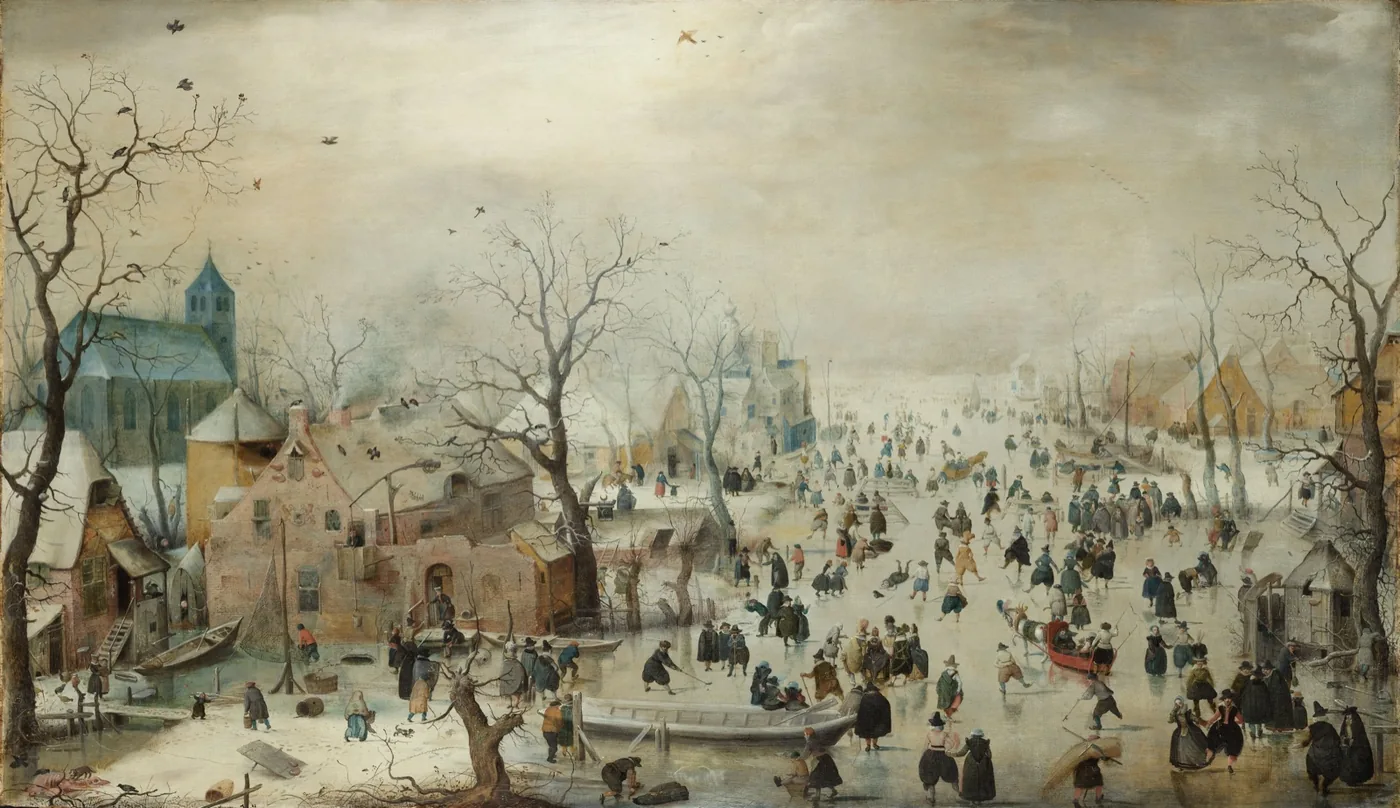
The Little Ice Age was a period of unusual cold across the Northern Hemisphere that lasted from roughly 1300 to 1850. Average temperatures for the hemisphere dropped by about 0.6°C, but parts of Europe cooled by 1 to 2°C during the worst decades. Growing seasons shortened, rivers that normally flowed year-round froze solid, and glaciers advanced into farmland.
The River Thames in London froze thick enough for "frost fairs" on the ice, with ox roasts, market stalls, and printing presses. Londoners held at least seven between 1607 and 1814. In the Alps, glaciers buried villages. In Greenland, Norse settlements founded by Erik the Red around 985 died out by the mid-1400s as expanding sea ice cut them off from Europe. The coldest stretch, the 1600s, overlapped with more wars and uprisings than any other period before the twentieth century.
What caused the Little Ice Age?
No single cause explains five centuries of cold. Several forces pushed temperatures down at different times, and the worst cold came when they overlapped.
Solar output declined. During the Maunder Minimum, from about 1645 to 1715, sunspots nearly vanished. Astronomers recorded fewer than 50 in the 28 years between 1672 and 1699. Less solar activity meant slightly less energy reaching Earth.
Volcanic eruptions made the cooling worse. When a large volcano erupts, it sends sulfate particles into the stratosphere, where they reflect sunlight and cool the surface for a year or more. A cluster of tropical eruptions in the late 1200s may have helped start the cold period. Iceland's Laki erupted in 1783 and released a toxic haze that damaged crops across Europe. In Iceland itself, about 20 percent of the population died. Indonesia's Mount Tambora erupted in April 1815 in one of the largest eruptions in recorded history. The following year became known as the "year without a summer" after snow fell in New England in June and harvests failed across Europe and Asia.
Shifts in Atlantic Ocean circulation may have deepened the cooling by changing how heat moved between the tropics and the poles. And one theory ties the cold to an unexpected human cause: the deaths of roughly 55 million indigenous people in the Americas after European contact. As their farmland returned to forest, the regrowing trees absorbed enough carbon dioxide from the atmosphere to contribute to the cooling already under way.
How the Little Ice Age reshaped the seventeenth century
The 1600s were the coldest stretch of the Little Ice Age, and they were also among the most violent decades in recorded history. Geoffrey Parker, a British historian, made this case in Global Crisis, published in 2013.
Parker traced a sequence. Failed harvests drove up the price of grain. Hungry populations, already taxed to pay for wars and royal debts, turned against their rulers. The result was a wave of uprisings, wars, and fallen governments that spread across continents within a single generation.
The Thirty Years War, which ended in 1648, cost central Europe as many as a third of its people. Some German states lost half their people to fighting, famine, and plague. England's Civil War overthrew and executed King Charles I in 1649. The Fronde, a series of revolts against the French crown, lasted from 1648 to 1653. Revolts broke out across the Spanish empire. In China, a series of droughts and famines fueled the rebellions that brought down the Ming dynasty. The last Ming emperor, the Chongzhen Emperor, hanged himself on a hill behind the Forbidden City as rebels entered Beijing in April 1644, ending nearly three centuries of rule. Parker identified similar crises in the Ottoman Empire, the Mughal Empire, and Japan.
Parker did not argue that cold weather directly caused these wars. His point was narrower: the cold added one more pressure to societies that were already close to collapse. A country with full granaries and competent administration could survive several failed harvests in a row. A country already stretched thin could not.
The Little Ice Age and climate conflict today
Modern defense planners use the term "threat multiplier" to describe the same pattern Parker found in the 1600s. Climate change does not start wars on its own. But drought, crop failure, and the migration they cause can push unstable regions into conflict. Defense departments now plan for scenarios in which climate-driven food shortages drive unrest in places like the Sahel and parts of the Middle East.
The Little Ice Age shows what happens when even a modest temperature shift meets societies with no margin. The cold did not hit everywhere at once, and the hemisphere-wide average dropped by less than a degree. But where it met governments that were already overstretched, the results were famine, revolt, and the fall of states that had ruled for centuries.