
Thirty Years' War
The Thirty Years' War (1618-1648) was a conflict in the Holy Roman Empire that started over religion, drew in most of Europe, and killed millions.
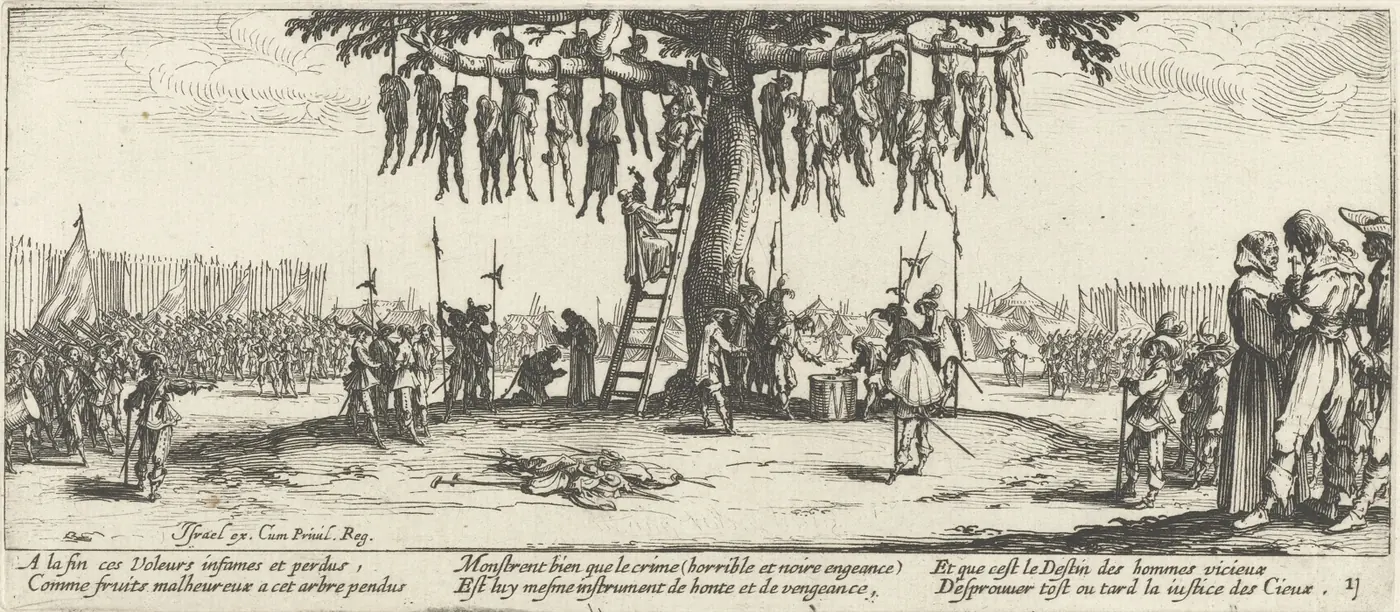
The Thirty Years' War (1618–1648) was a series of connected conflicts fought mainly in the German lands of the Holy Roman Empire. It began as a fight between Catholics and Protestants over religious freedoms. The Reformation had split western Christianity a century earlier, and the German lands had been divided along religious lines ever since. The conflict grew into a struggle for territory and power involving most of Europe's major states, including Sweden, France, Spain, Denmark, and the Dutch Republic. The fighting devastated central Europe, killing millions. Most of the dead were civilians who died from famine and disease rather than combat. The Peace of Westphalia brought the fighting to an end in 1648, leaving the Empire weakened, Spain in decline, and France as the continent's strongest power.
How the Thirty Years' War grew from a revolt to a European war
The war began with one of history's most dramatic protests. In Prague on May 23, 1618, a group of Protestant nobles seized two Catholic governors and a royal secretary. The nobles were angry that the Habsburgs had broken promises of religious freedom. They hurled all three men from a castle window about seventy feet above the ground. All three men survived. Catholics said angels caught them. Protestants claimed that they landed on a dung heap.
The incident set off a revolt across Bohemia. The rebels deposed the Habsburg King Ferdinand II and replaced him with Frederick V, a Calvinist prince from the Palatinate. Frederick's reign lasted one year. Ferdinand's forces crushed the Bohemian army at White Mountain, outside Prague, in November 1620, and Frederick fled into exile, earning the nickname "the Winter King."
What could have ended as a local rebellion kept drawing in outside powers. Christian IV of Denmark intervened in 1625 to defend Protestant interests. He was driven back by imperial armies commanded by Albrecht von Wallenstein, a Bohemian nobleman who was devoted to astrology and had the astronomer Johannes Kepler cast his horoscope. Wallenstein recruited personal forces numbering in the tens of thousands. He paid for them by squeezing money from every territory his soldiers occupied.
In 1630, King Gustavus Adolphus of Sweden landed in northern Germany with a professional army. He was tall, powerfully built, and led his troops from the front. In May 1631, imperial forces stormed the Protestant city of Magdeburg. Fire and massacre killed roughly 20,000 people, most of the population. The destruction shocked Protestant Germany and pushed several states to ally with Sweden. Gustavus Adolphus won a major victory at Breitenfeld in September 1631, which turned the course of the war. At the Battle of Lützen in November 1632, he rode into the fight wearing only a leather coat because an old wound made armor painful. He died in the middle of a mounted charge, lost in thick fog. His army won the battle, but Sweden had lost its king.
Emperor Ferdinand II had Wallenstein assassinated in the town of Eger in February 1634, after Wallenstein grew too powerful and was suspected of negotiating with the enemy on his own.
The longest and bloodiest phase began when Catholic France, under Cardinal Richelieu, declared war in 1635 against Spain and in 1636 against the emperor, both fellow Catholics. Richelieu's reasoning was strategic, not religious: the Habsburg dynasty ruled both Spain and the Empire and surrounded France on nearly every side. Weakening the Habsburgs mattered more to France than any shared faith.
The Thirty Years' War death toll
An estimated 4.5 to 8 million people died during the war from battle, famine, and disease. The German lands bore the worst of it. The population fell from roughly 20 million to around 12 million between 1618 and 1648. Some regions, like Pomerania and Württemberg, lost close to half their people.
Most of the dead were civilians, not soldiers. Armies stripped the countryside of food as they moved, and epidemics of typhus, plague, and dysentery followed in their path. Rural areas lost about 40 percent of their population on average, while cities lost about a third. The devastation set back Germany's political and economic development by generations.
Who won the Thirty Years' War?
No single side won a clear victory. The Peace of Westphalia, signed in 1648, ended most of the fighting. The settlement gave France and Sweden territory and influence. It recognized the independence of the Dutch Republic and Switzerland. Inside the Empire, each of the roughly 300 German princes gained the right to conduct foreign policy, which left the emperor with little real power.
France came out strongest. Cardinal Richelieu died in 1642, but his strategy worked: the Habsburgs were weakened on every side, and France dominated European politics for the next half century under Louis XIV. Spain, which had entered the war as Europe's greatest power, never recovered. Spain and France continued fighting until the Treaty of the Pyrenees in 1659, and Spain's long decline as a great power is dated from this period.
The Peace of Westphalia is also remembered for a broader principle. By treating each state as sovereign within its own borders, the treaties are often said to have established a foundation for the international system that still shapes how countries relate to each other.