
Mandate of Heaven
The Mandate of Heaven is an ancient Chinese idea that a ruler governs only as long as he rules justly.
The Mandate of Heaven (in Chinese, Tianming) is the idea that the right to rule China comes from Heaven, and that Heaven grants it only to a ruler who governs well. If a ruler becomes corrupt or incompetent, Heaven withdraws its favor and gives the mandate to whoever can restore order. The ruler held the title Son of Heaven, but that did not make him divine. His throne belonged to Heaven, not to him, and Heaven could take it back at any time.
The idea first appeared around 1046 BC, when the Zhou dynasty overthrew the Shang dynasty. It shaped how China thought about power for nearly three thousand years, and the basic bargain it described, govern well or forfeit the throne, is still visible in how Beijing governs today.
How the Zhou invented the Mandate of Heaven
The idea came out of a conquest. In roughly 1046 BC, the Zhou, a smaller and less established people from China's western frontier, defeated the Shang at Muye and took their throne. The Shang had ruled for centuries. The Zhou needed to explain why replacing them was right and not simply a seizure of power.
Their answer was a new political idea. The Zhou said that the last Shang king, Di Xin, had grown cruel and corrupt, holding drunken feasts while his people suffered. Because of those failures, Heaven had taken its favor away from the Shang and given it to the Zhou instead. The argument did two things. It justified what the Zhou had done, and it put every future Zhou king on notice that Heaven could do the same to him.
The idea was probably propaganda at first. But it became something more durable: a theory of government in which legitimacy depended on results, not just bloodline or military strength. A ruler earned his throne by governing well, and he could lose it by governing poorly.
The concept spread through the writings of thinkers like Confucius and Mencius, who developed it further. Mencius argued that a king who mistreated his people was no true king at all, and that overthrowing him was not rebellion but justice. That idea gave the Mandate of Heaven a moral weight that lasted long after the Zhou themselves lost power.
How the Mandate of Heaven shaped Chinese history
Chinese thinkers turned the Mandate of Heaven into a repeating pattern called the dynastic cycle. It went like this: a strong founder takes power and governs well. His early successors enjoy the prosperity he built. Over time, later rulers grow comfortable. Tax burdens increase, officials become corrupt, and the government loses its grip. Natural disasters, floods, droughts, famines, earthquakes, were read as signs that Heaven had turned against the ruling house. If a rebellion broke out and succeeded, the rebel's victory was itself the proof that Heaven had picked a new ruler, and the cycle started over.
This pattern gave emperors a strong reason to govern well. Flood control, famine relief, and keeping the peace were not just practical tasks. They were ways of showing that the emperor still held Heaven's favor. A drought or a flood could become a political crisis, because it looked like Heaven withdrawing its support.
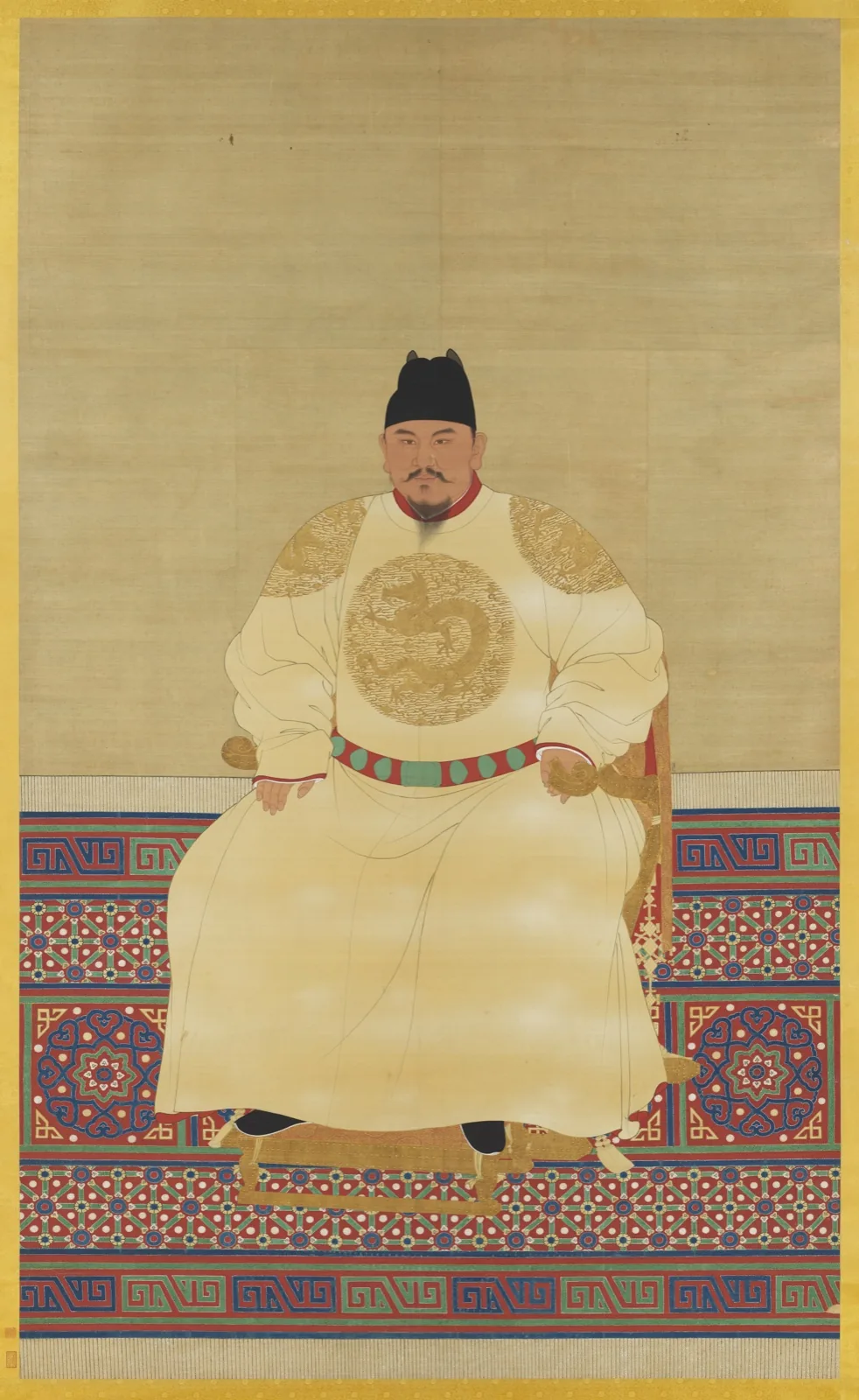
At the same time, the Mandate of Heaven gave every rebel a ready-made justification. If a revolt succeeded, the success itself was evidence that Heaven had chosen the rebel over the emperor. A usurper was not just a usurper. He was the person Heaven used to punish a failing dynasty. This pattern repeated across the Zhou, Han, Tang, Song, Ming, and Qing dynasties. The Ming dynasty is a clear example. Its founder, Zhu Yuanzhang, was a peasant and a former monk who led a rebellion against the Mongol-led Yuan dynasty in the 1360s. His victory was interpreted as proof that Heaven had chosen him. The portrait at the top of this page shows him in imperial robes, a peasant rebel turned Son of Heaven. China's long history of unification, decline, and violent renewal followed this pattern for roughly three thousand years.
When the Qing, China's last dynasty, collapsed in 1912, the monarchy ended and the formal doctrine went with it.
Does the Mandate of Heaven still matter?
The Chinese Communist Party does not hold competitive elections and does not invoke any divine authority. Yet the party's claim to power rests on a bargain that resembles the old Mandate: keep the country stable, keep the economy growing, and keep people's lives improving, and in return the people accept the party's rule. The party treats results, not procedures, as the basis of its authority.
Chinese leaders remain highly sensitive to natural disasters and mass unrest. Major floods, earthquakes, or large-scale protests are treated as urgent political problems, not just practical ones. The reasoning is the same as it was under the emperors: if the government cannot protect the people, its right to govern comes into question. The word "Heaven" is gone, but the core bargain has not changed. A ruler who fails to deliver loses his claim, and that idea goes back three thousand years.