
Marco Polo
Marco Polo was a Venetian merchant who spent seventeen years in Mongol China and wrote the book that shaped Europe's picture of Asia.
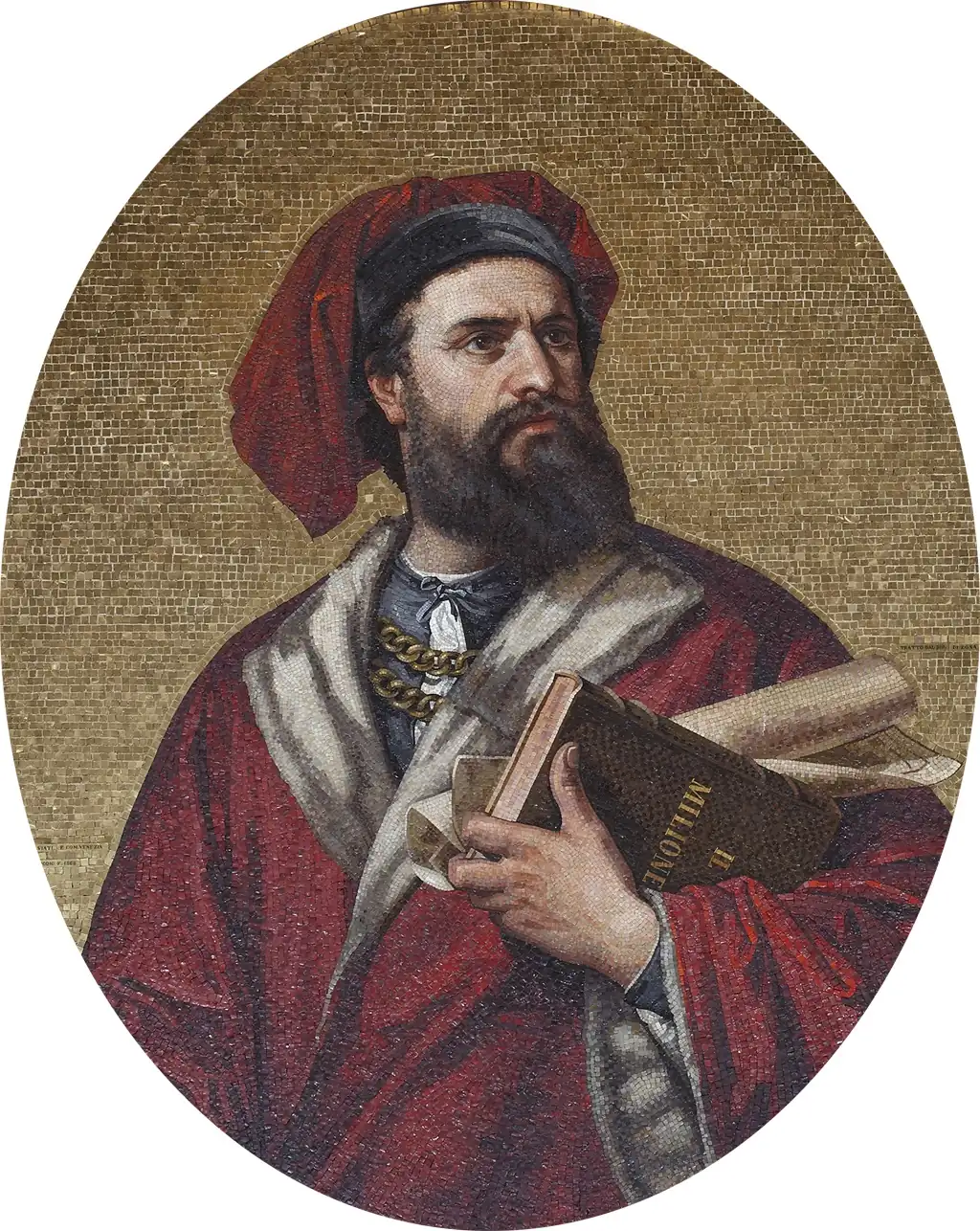
Marco Polo was a Venetian merchant who traveled to China in the 1270s and spent about seventeen years serving Kublai Khan, the Mongol emperor. He was born around 1254 in Venice and died there in January 1324. After returning home, he dictated a book about Asia that remained the most detailed European account of the East for roughly three centuries. The book described things most Europeans had never encountered: government-issued paper currency, a postal relay system covering thousands of miles, and cities far larger than anything in Europe. It was also widely mocked. In Venice, people called it "Il Milione," a name often explained as "the million lies." On his deathbed, when friends urged him to retract his stories, Polo reportedly refused, saying he had left out more than he put in.
How Marco Polo reached Kublai Khan's court
In 1271, the seventeen-year-old Marco Polo departed Venice alongside his father Niccolo and his uncle Maffeo. The Polo family traded goods across the eastern Mediterranean, and the two older brothers had already visited Kublai Khan's court once before. They returned to Venice in 1269 carrying a letter from the Khan requesting Christian scholars and holy oil from Jerusalem.
The journey was possible because the Mongol conquests had placed a single ruling family across most of Eurasia, a period known as the Pax Mongolica. With the right documents, a Venetian merchant could travel overland from Constantinople to the Mongol capital. The Polos followed the Silk Road through Persia, crossed the Pamir Mountains and the Gobi Desert, and arrived at Kublai Khan's court around 1275. The overland crossing took about three and a half years.
Kublai Khan was a grandson of Genghis Khan and the ruler of China, which his family had conquered. According to Polo, he served the Khan for seventeen years, carrying out imperial assignments across Yunnan, Burma, and cities in southern China. His account portrays Hangzhou as a place of staggering scale, with stone-paved roads, bathhouses open to the public, and countless marketplaces. By the standards of the thirteenth century, Hangzhou was genuinely one of the largest cities in the world.
Marco Polo's return and his book
Polo returned by ship in the early 1290s, escorting a Mongol princess named Kokachin who was being sent to marry a ruler in the Persian branch of the Mongol empire. He arrived back in Venice in 1295, twenty-four years after he had left.
Three years later, a war at sea between Venice and Genoa ended with Polo as a prisoner. He shared a cell in Genoa with Rustichello of Pisa, a writer who made his living producing Arthurian romances. Polo dictated his account of Asia, and Rustichello wrote it down. The book, known as the "Description of the World," combines detailed notes on trade routes, currencies, and provincial government alongside passages that sound like the adventure stories Rustichello normally wrote.
Polo records things few European writers had reported before. He describes coal being burned as fuel. He describes government-issued paper currency that drew its value from the emperor's decree, at a time when Europe used only metal coins. He describes the imperial postal relay system, in which riders on fresh horses carried messages across the empire in days, and the state salt monopoly that funded the Mongol government. The book was copied by hand through Europe in many different manuscript versions, and for roughly three centuries it served as the standard European reference on East Asia.
After his release, Polo returned to Venice, married Donata Badoer, and had three daughters. He lived as a merchant until his death in January 1324.
Did Marco Polo really go to China?
Scholars have argued about this for centuries. Polo's book says nothing about tea, chopsticks, foot-binding, or Chinese writing. No Chinese or Mongol record from the period names anyone matching Polo in the positions he claims to have held. In 1995, the librarian Frances Wood published a book arguing that Polo traveled only as far as Persia and the Black Sea, and that he assembled his account of China from Persian and Arab traders' reports.
Most scholars of the Yuan dynasty, the Mongol-ruled period of Chinese history, disagree with Wood. Polo's descriptions of the Yuan currency system, the government salt trade, and regional tax collection match the dynasty's actual practices in ways that a secondhand account would be unlikely to reproduce.
The silences have an explanation. Polo lived and worked within a Persian-speaking Mongol ruling class that governed China from above without mixing into its daily life. Mongol officials conducted government business in Persian and Mongolian and had limited contact with everyday Chinese customs. A foreign administrator in that system could plausibly spend years without encountering tea ceremonies or the practice of foot-binding. Polo also says nothing about the Great Wall of China, but the wall that tourists see today dates from the Ming dynasty, about two centuries after Polo's time.
How Marco Polo's book shaped European exploration
Polo's book gave European readers a clear message: Asia held enormous wealth, the journey there was possible, and there were large profits waiting for anyone who could reach it. That message took on new importance two centuries later, when European sailors began searching for sea routes to Asia.
Columbus kept a printed edition of Polo's book and filled its margins with notes. When Columbus reached the Caribbean in 1492, he believed he had arrived near the places Polo described, and he sent a search party looking for the Great Khan's cities. He was wrong about where he was, but Polo's book was part of what sent him there.
Polo's account remained the most complete European description of East Asia until after Portuguese traders reached China by sea in the early 1500s.