
Great Wall of China
The Great Wall of China is roughly two thousand years of walls built along China's northern frontier, totaling over 21,000 kilometers.
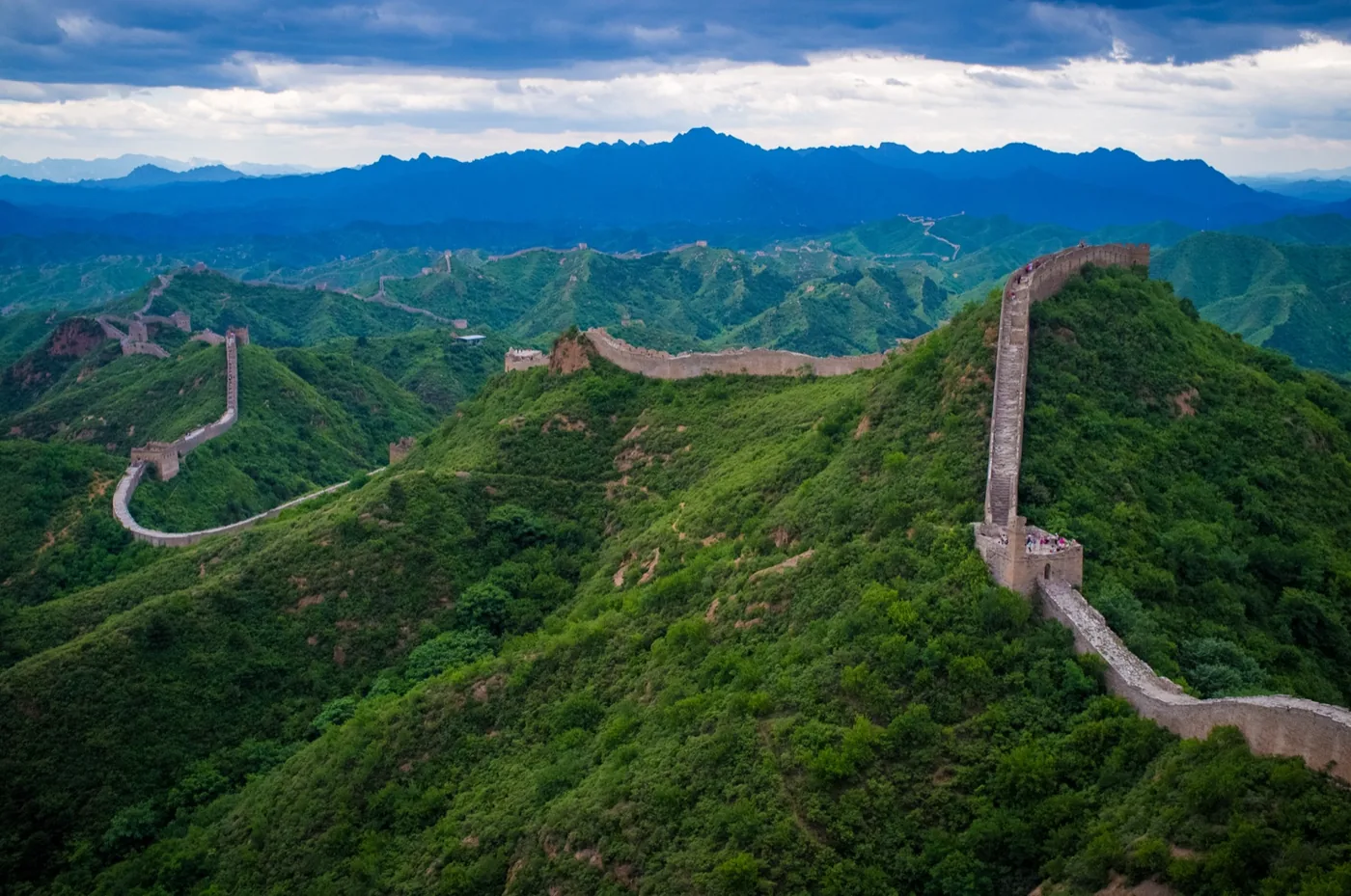
The Great Wall of China is not a single structure. It is about two thousand years of construction and reconstruction by a dozen different dynasties along China's northern border. A 2012 archaeological survey measured all surviving sections and branches at 21,196 kilometers, more than half the circumference of the Earth. No army ever defended the full length at one time, and large stretches of what the survey counted have since crumbled into the surrounding hills. The wall that tourists photograph today, gray brick running along ridgelines north of Beijing, dates to the 14th through 17th centuries. It is the Ming dynasty's contribution, and the newest layer of a building tradition that goes back more than two millennia.
How Qin Shi Huang built the first Great Wall
Qin Shi Huang is credited with the first continuous Great Wall, around 220 BC. Earlier Chinese kingdoms had put up separate border ramparts, and Qin Shi Huang linked them into one line after unifying China. The wall was a defense against the Xiongnu, a mounted confederation from the northern steppe that raided Chinese farming settlements. The Xiongnu fought from horseback and could pull back into the grasslands faster than any Chinese infantry could follow.
Workers built the early walls from rammed earth, pounding layers of loess soil between wooden frames. The Chinese called this technique hangtu and had used it for thousands of years. The labor was deadly. Historians estimate that as many as 400,000 workers died during the Qin construction, and people began calling the wall "the longest cemetery on Earth." Archaeologists have never found human remains inside the wall itself.
A wall that soldiers can scale will not stop a determined invasion force. The purpose was to slow raiders, force mounted attackers through specific chokepoints, and buy defenders time to respond. The wall's defensive network also included garrisons, gates that taxed and controlled trade, and beacon towers spaced along the ridgeline that could pass warnings from tower to tower faster than a rider could carry the news.
The wall the Ming dynasty built
The wall most visitors see today is from the Ming dynasty, which drove the Mongol-led Yuan dynasty out of China in 1368. Fearing the Mongols' return, the Ming government spent the next two centuries fortifying the northern frontier in one of the biggest building efforts any government has ever undertaken.
Ming builders often replaced rammed earth with fired brick, cut granite, and a mortar that sometimes included sticky rice, which made it stronger and more water-resistant. The result was a brick-and-stone wall running along mountain ridgelines, lined with watchtowers and arrow slits for defenders. Signal codes for the beacon towers were specific: one fire plus one cannon blast signaled up to about 100 raiders, two fires and blasts signaled about 500, and three signaled more than 1,000. Using this relay, news of a breach could travel hundreds of miles within hours.
In 1644, Wu Sangui, one of the Ming dynasty's own generals, opened Shanhaiguan Pass and let the Manchu army through. The Manchus replaced the Ming with their Qing dynasty, which ruled territory on both sides of the wall and had no reason to keep it up. The wall never closed China off from the outside world. Nomadic peoples broke through it, used its gates for trade, and on two occasions conquered all of China despite it. An Orbis article on why China kept getting conquered from the north explains why the steppe threat kept coming back.
Where does the Great Wall start and end?
The answer depends on which wall. The Ming wall, the one most people mean, runs from Hushan near the Yalu River in Liaoning province in the east to Jiayuguan Pass in Gansu province in the west, a distance of about 8,850 kilometers. Jiayuguan sits at the narrowest point of the Hexi Corridor, the strip of land between the Tibetan Plateau and the Gobi Desert that connected China to the Silk Road. Shanhaiguan Pass in Hebei province, where the wall meets the Bohai Sea, is the most famous point along the eastern end and was long thought to be the starting point. In 1989, archaeologists identified wall ruins at Hushan, about 400 kilometers further east near the North Korean border, as part of the Ming wall.
Earlier dynasties built walls along different lines. Some Han dynasty walls extended further west into the Gobi Desert. The 21,196 kilometers measured in the 2012 survey includes every stretch of wall from every dynasty, spread across fifteen provinces and regions.
Can you see the Great Wall from space?
No. The wall is about six meters wide in most places, far too narrow for the human eye to pick out from orbit. Astronauts from the Apollo missions through the ISS have said the same. The myth is older than spaceflight. It traces back to 1754, when an English antiquarian named William Stukeley was writing about Hadrian's Wall in England. Comparing the two walls, he wrote that the Great Wall "may be discerned at the Moon." He had never visited China or left the ground. A 1932 Ripley's Believe It or Not cartoon claimed the wall was the only man-made structure visible from the Moon, and the idea stuck. It cannot be seen from orbit, but it can be seen from the hills north of Beijing, where millions of visitors walk the Ming-era sections each year.