
Marshall Plan
The Marshall Plan was the American aid program that sent about $13 billion to rebuild 16 Western European countries between 1948 and 1952.
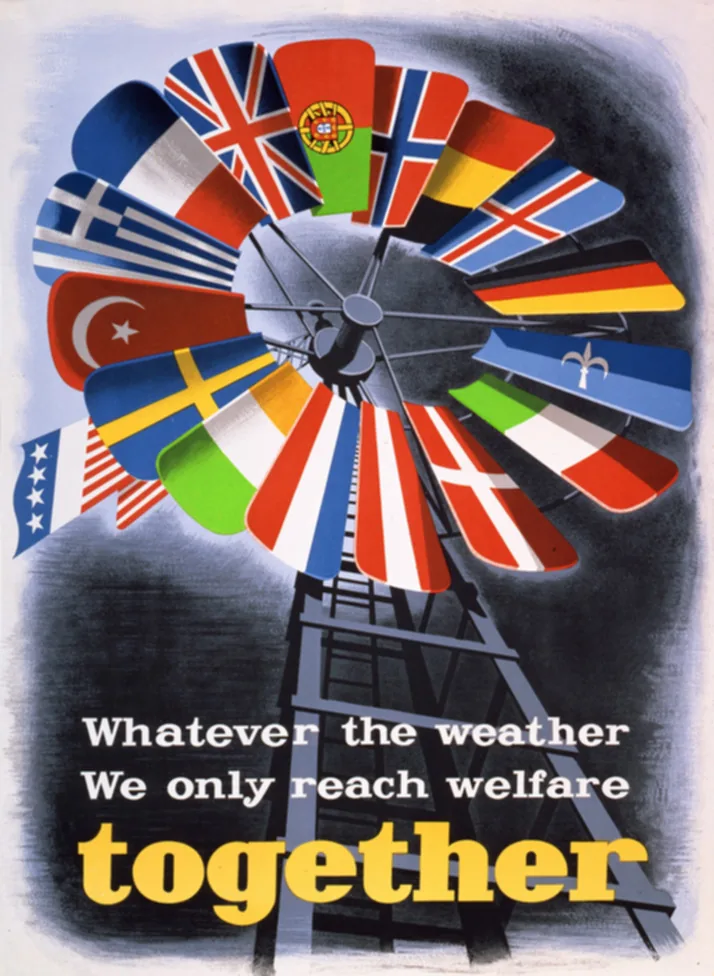
The Marshall Plan was an American aid program that gave about $13 billion to 16 Western European countries between 1948 and 1952, over $150 billion in 2024 dollars. Most of the money was given outright rather than lent, and much of it arrived as American goods: food, fuel, raw materials, and industrial equipment. It was officially called the European Recovery Program, but it took the name of George Marshall, the US Secretary of State who proposed it in a commencement speech at Harvard University on June 5, 1947. The plan rebuilt Western Europe's economies, created a bloc of capitalist democracies aligned with the United States against the Soviet Union, and required the recipient countries to cooperate with each other in ways that eventually helped produce the European Union. In 1953, Marshall won the Nobel Peace Prize for it, the first career military officer to receive the award.
How the Marshall Plan began
Two years after World War II ended, Europe was in worse shape than most Americans realized. Cities across the continent were rubble. Factories were gutted. In the winter of 1946 to 1947, temperatures across Europe dropped to historic lows, waterways froze, and harvests failed from Britain to the Balkans. Britain's wartime debts had left the country nearly bankrupt. In France and Italy, Communist parties with about three million members between them were winning over voters with each month of hunger and shortages. Washington saw both a humanitarian crisis and a strategic problem: Communist parties gained ground fastest in countries where people were going hungry.
George Marshall grew up in Uniontown, Pennsylvania, and enrolled at the Virginia Military Institute after overhearing his older brother tell someone that George would embarrass the family there. He graduated as the top-ranking cadet, spent four decades in the Army, and served as Chief of Staff during World War II, overseeing the buildup of more than eight million soldiers. President Truman appointed him Secretary of State in January 1947.
On June 5, Marshall stood up at a Harvard commencement ceremony and delivered a speech of about 1,200 words. It took less than twelve minutes. It received loud applause, and American newspapers played it down. But in it, Marshall offered American help to rebuild Europe, on one condition: the European countries had to meet together and agree among themselves on how to divide the money.
That condition shaped what followed. The recipient countries formed the Organisation for European Economic Co-operation to divide the funds and coordinate national recovery plans. The OEEC required countries that had recently fought each other to coordinate their economic recovery, and it became the OECD in 1961. The cooperation it required among Western European governments was an early step toward what later became the European Union. Most of the money came as grants of American goods rather than cash. American wheat fed European cities. American fuel and industrial equipment helped restart factories. The arrangement also served American interests. A Europe that could afford to buy again became a market for American grain, fuel, and equipment.
Why did the Soviet Union reject the Marshall Plan?
Marshall offered the aid to every country in Europe, including the Soviet Union and its allies. Stalin sent his foreign minister, Vyacheslav Molotov, to the Paris talks in late June 1947 with a delegation of 89, including economic experts, a sign that Moscow took the offer seriously. But the plan required participating countries to share economic data and coordinate spending through joint institutions. Stalin wanted neither the transparency nor the American influence that came with the money. On July 2, 1947, Molotov walked out.
Moscow then ordered every Soviet-aligned state to refuse. Czechoslovakia had already accepted the invitation. Stalin summoned the Czechoslovak delegation to the Kremlin and told them the Soviet Union would regard their participation as "an act specifically aimed against the USSR." They withdrew. Stalin blocked Poland, which had also shown interest.
The rejection turned the division of Europe into an economic fact. Over the next few years, Western Europe rebuilt and entered a long boom. Eastern Europe, cut off from American capital and locked into Soviet-directed trade, fell further behind. By the end of the 1950s, the gap between the two halves of the continent was visible in everything from factory output to grocery shelves.
Did the Marshall Plan work?
By 1952, every country that received Marshall Plan aid had passed its prewar level of economic output. Western European industrial production was about 35 percent above prewar levels. The continent then entered a period of growth that lasted roughly two decades.
Historians debate whether American money was the main driver of the recovery or just one factor among many. The $13 billion was large, but it amounted to only a few percent of the recipients' combined economic output. Europe already had skilled workers, engineers, and the institutions of a wealthy continent. Much of the recovery came from Europeans rebuilding their own countries. The boom might have happened without American money.
What the aid clearly did was keep things stable during the most dangerous years. It fed people while they rebuilt. It supplied raw materials that Europe could not have paid for on its own. And by requiring cooperation among the recipients, it created institutions that outlasted the program.
The phrase "Marshall Plan" has since become a label for any proposed large rescue program. Politicians have proposed similar large-scale programs for Africa, Ukraine, and the climate, borrowing the name each time. The comparisons usually miss what made the original work. Most of the recipient countries had been wealthy and industrialized before the war, with the skilled workers and institutions to rebuild once they had the raw materials. Those conditions are what most proposed programs of the same scale lack.