
Mau Mau Uprising
The Mau Mau uprising was a Kikuyu-led rebellion against British rule in Kenya from 1952 to 1960, met with mass detention and torture.
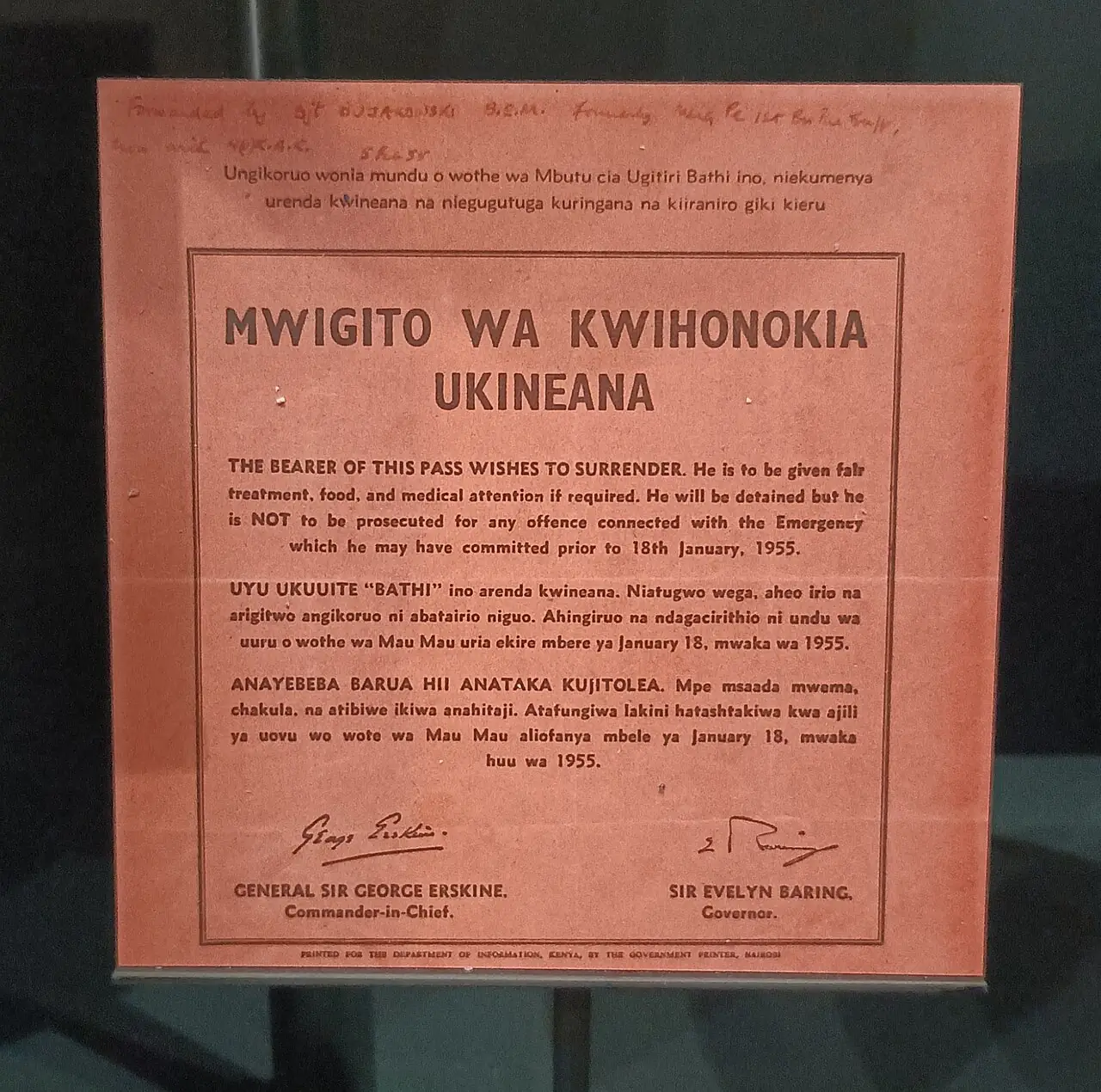
The Mau Mau uprising was a rebellion against British colonial rule in Kenya, fought from 1952 to 1960. It was led primarily by the Kikuyu, Kenya's largest ethnic group, who had lost their most fertile land to white settlers. The colonial government imposed emergency rule in October 1952 and spent eight years fighting not just a few thousand guerrillas in the forests, but the broader Kikuyu civilian population through mass detention, forced resettlement, and organized torture. Official British figures recorded over 11,000 insurgents killed, though historians believe the real total was considerably higher. Thirty-two white settlers died in the entire conflict, fewer than were killed in road accidents in Nairobi during those same years.
How the Mau Mau uprising started
British settlers in Kenya had claimed the most fertile land in the central highlands, an area known as the White Highlands, during the Scramble for Africa and the decades that followed. By 1950, a few thousand European farmers controlled this land while more than a million Kikuyu were squeezed into crowded reserves or worked as laborers on land that had been theirs. A growing number moved to Nairobi, where they found casual work but had no political rights.
Unlike colonies in West Africa, where Britain was already moving toward African majority rule, Kenya had a powerful white settler class with political influence in London. Majority rule would have ended the settler economy, and the settlers meant to prevent it.
The movement that became known as Mau Mau grew out of this pressure. It was decentralized, had no formal leadership structure, and drew on Kikuyu oathing traditions that pledged participants through oath ceremonies to the cause of land and freedom. Its fighters were equipped largely with improvised firearms and machetes. On October 7, 1952, loyalist Chief Waruhiu wa Kungu was shot and killed near Nairobi. Two weeks later, the colonial government imposed emergency rule and arrested Jomo Kenyatta, Kenya's most prominent political leader. Kenyatta was convicted of managing Mau Mau after a trial in which the key prosecution witness later admitted to perjury. He spent nearly nine years in prison and internal exile.
How Britain fought the Mau Mau
The military campaign against Mau Mau fighters took place in the forests of the Aberdare Range and Mount Kenya, where a few thousand guerrillas held out for years. Dedan Kimathi, the most important Mau Mau commander in the forests, was captured in October 1956 after being shot in the leg. He was convicted of possessing a firearm and hanged in February 1957.
But the forest war was the smaller part of the conflict. The larger part was a campaign against Kikuyu civilians. The colonial government constructed a system of detention camps it called "the Pipeline." Suspects were pushed through the system, screened, and classified by their supposed loyalty to Mau Mau. More than 70,000 people were held without trial. Abuse in the camps was systematic. Guards carried out beatings, sexual assault, and forced labor, all recorded in official British files.
Around a million Kikuyu were forced into more than 800 fenced compounds surrounded by barbed wire and guard towers, under a program called villagization. It amounted to the forced confinement of an entire rural community. In March 1959, at a camp called Hola, guards beat eleven detainees to death for refusing to work. The colonial administration tried to blame the deaths on contaminated drinking water. That explanation fell apart once post-mortems showed the men had died from beatings. The public outcry over Hola did more to bring the emergency to an end than any military operation. Britain lifted emergency rule in January 1960.
The press at the time told a different story. British and international newspapers portrayed the Mau Mau as savage terrorists attacking white farmers. The casualty figures show something else. Mau Mau fighters killed roughly 2,000 people, and the great majority were Kikuyu loyalists, not Europeans. The conflict was, in practice, a war between Kikuyu factions conducted within a British counterinsurgency operation against the entire Kikuyu population.
Did Britain acknowledge what happened in Kenya?
Jomo Kenyatta became Kenya's first prime minister at independence in 1963, the same man Britain had jailed for leading Mau Mau. But Kenyatta's government depended in part on the loyalist Kikuyu families that had opposed the uprising, and he did not make Mau Mau the founding story of the new state. Veterans received little recognition for decades.
Britain said nothing about the conduct of the war. The government's position was that any liability for events during the emergency belonged to independent Kenya.
In the 2000s, elderly Kenyan survivors of the detention camps sued the British government. During the proceedings, the court learned that the British government had taken thousands of documents out of Kenya at independence and stored them in secret at a facility in Hanslope Park, Buckinghamshire. The facility turned out to hold a far bigger collection of classified records from more than thirty former colonies. The recovered documents confirmed what survivors had said for decades: the abuse in the camps was organized from the top, not the work of individual guards acting alone.
In June 2013, Foreign Secretary William Hague agreed to pay £19.9 million to 5,228 claimants. He expressed regret for the abuse they had suffered. It was the first time Britain compensated victims of abuses carried out during the dismantling of its empire.
Britain's war against civilians in Kenya, and the fifty years it spent concealing the evidence, shaped both the politics of the new country and the history written about the uprising. The same pattern, a colonial departure that determined the successor state's course for generations, played out across the Sahel after France left. In Kenya, the record changed only after a small group of elderly survivors took Britain to court, and the archive could no longer be kept from view.