
Attack on Pearl Harbor
The Japanese attack on Pearl Harbor on December 7, 1941, killed 2,403 Americans and brought the United States into World War II.
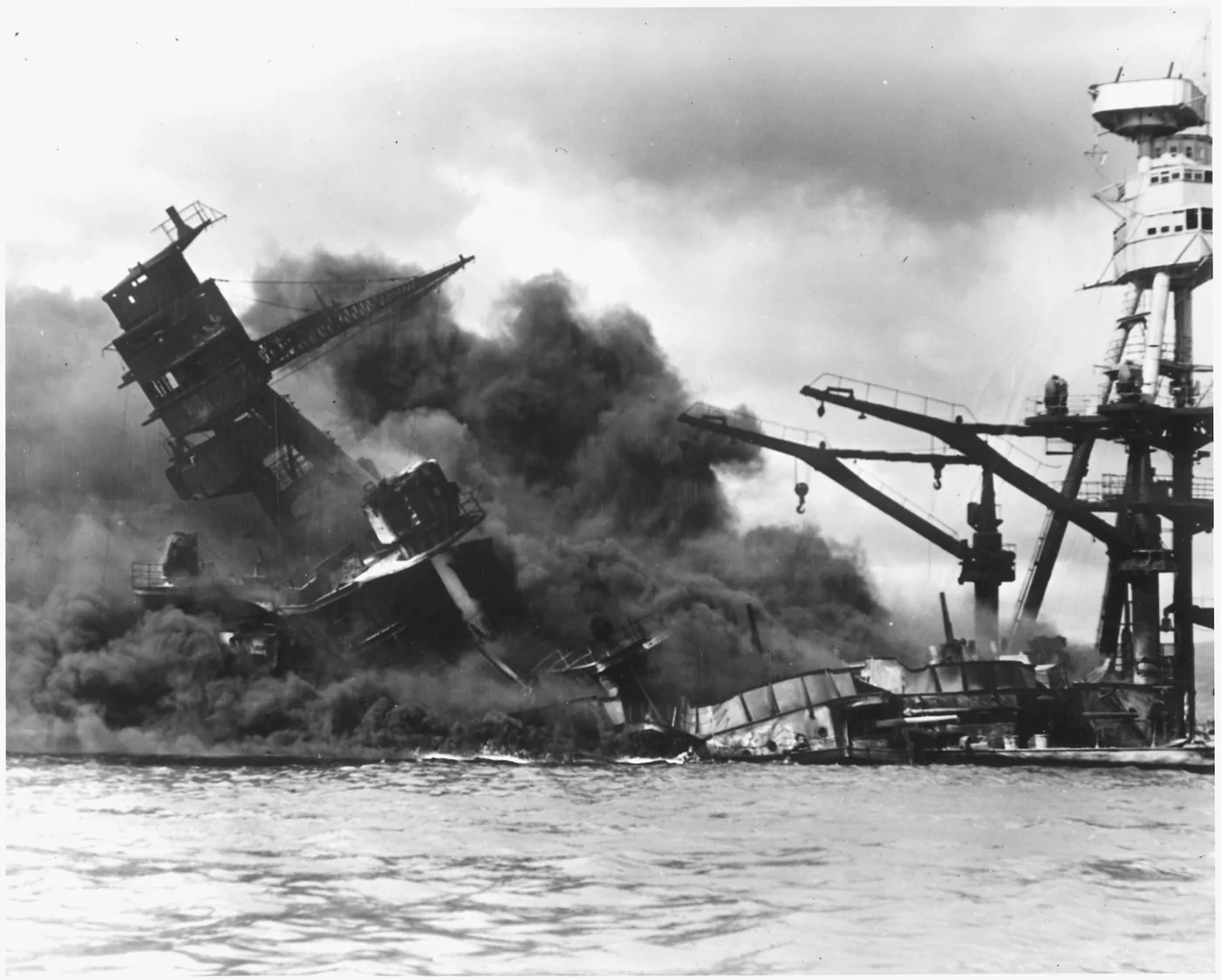
On Sunday morning, December 7, 1941, shortly before eight o'clock, roughly 350 Japanese aircraft struck the American Pacific Fleet where it lay at anchor in Pearl Harbor. Within two hours they hit all eight battleships in the harbor, sank four of them, and destroyed or damaged more than 300 aircraft. The attack killed 2,403 Americans. Nearly half of those deaths, 1,177, happened on a single ship, the battleship USS Arizona, when a bomb detonated its forward ammunition magazine. The next day, President Franklin Roosevelt asked Congress to declare war on Japan, calling December 7 "a date which will live in infamy." Congress approved with only one vote against. Three days later Germany declared war too, and the United States was fighting on both sides of the world.
How Japan planned the attack on Pearl Harbor
By 1941 Japan had been fighting in China for four years with no end in sight. The United States had responded to Japan's expansion into French Indochina with an oil and steel embargo that cut off the raw materials Japan's military depended on. Facing a slow strangulation, Japan's leaders decided to seize the oil fields of the Dutch East Indies and the resources of British Malaya. The US Pacific Fleet, based at Pearl Harbor, could interfere with those plans. It had to be taken out first.
The man who designed the attack was Admiral Isoroku Yamamoto, commander of Japan's Combined Fleet. Yamamoto knew the United States better than almost anyone in the Japanese military. He had studied at Harvard from 1919 to 1921, where he became an avid poker player and once hitchhiked to Texas to tour the oil fields. As a young officer he had lost two fingers on his left hand at the Battle of Tsushima in 1905, during the Russo-Japanese War. Geisha in Tokyo later nicknamed him "80 sen" because a full manicure cost 100 sen and he needed only eight fingers. Yamamoto understood American industrial power, and he was convinced Japan could not survive a long war against it. His plan called for one large surprise attack that would cripple the Pacific Fleet, after which Japan would hold a defensive perimeter across the ocean until a weary America agreed to negotiate.
The attack on December 7, 1941
Six Japanese aircraft carriers, the largest carrier force ever assembled at that point, sailed across the North Pacific to a launch point north of Oahu. They sent two waves of fighters, dive bombers, torpedo bombers, and high-altitude bombers. The first wave struck at 7:48 a.m. local time. American aircraft sat parked wingtip to wingtip on the airfields, easy targets. Torpedoes and bombs tore into the warships anchored along Battleship Row. The USS Arizona exploded and sank in minutes. The USS Oklahoma capsized. The attack came without a declaration of war, while Japanese diplomats in Washington were still in negotiations. That fact, more than the destruction itself, enraged the American public.
Two things the attackers missed shaped the rest of the war. America's three Pacific carriers, the Enterprise, the Lexington, and the Saratoga, were all away from Pearl Harbor that morning. And the Japanese did not strike the base's fuel storage tanks, which held about 4.5 million barrels of oil, or its repair yards. Admiral Chuichi Nagumo, commanding the carrier force, decided against sending a third wave and withdrew. If the fuel and repair facilities had been destroyed, the Pacific Fleet would likely have had to fall back to the American west coast, setting the recovery back by months.
How Pearl Harbor changed the course of the war
On December 8, Congress voted to declare war on Japan, 82 to 0 in the Senate and 388 to 1 in the House. The single no vote came from Jeannette Rankin of Montana, a pacifist who had also voted against entering World War I. On December 11, Adolf Hitler declared war on the United States, a decision he was not required to make under his alliance with Japan. America was now fighting in both the Pacific and in Europe.
Before the attack, the country had been bitterly divided over whether to join the war. Isolationist sentiment was strong, and most Americans opposed sending troops to fight in Europe. The attack ended that debate overnight. American factories shifted to war production at a pace no other country could match.
The raid gave Japan about six months to push across Southeast Asia. Then, in June 1942, American carriers met the Japanese fleet at the Battle of Midway and sank four of the six carriers that had launched the Pearl Harbor attack. The tide of the war in the Pacific turned. Within four years of the attack, Japan had surrendered.
The USS Arizona still lies on the bottom of Pearl Harbor where it sank. A memorial dedicated in 1962 straddles the sunken hull, marking the graves of more than 900 crew members who remain inside the wreck. Oil still seeps from the ship's fuel tanks, about two to nine quarts a day, more than eighty years after the attack. When the September 11 attacks struck in 2001, Pearl Harbor was the comparison Americans reached for, the only previous attack on American territory that felt similar in scale.