
Robber Barons
The robber barons were American industrialists who built monopolies in oil, steel, and railroads during the Gilded Age.
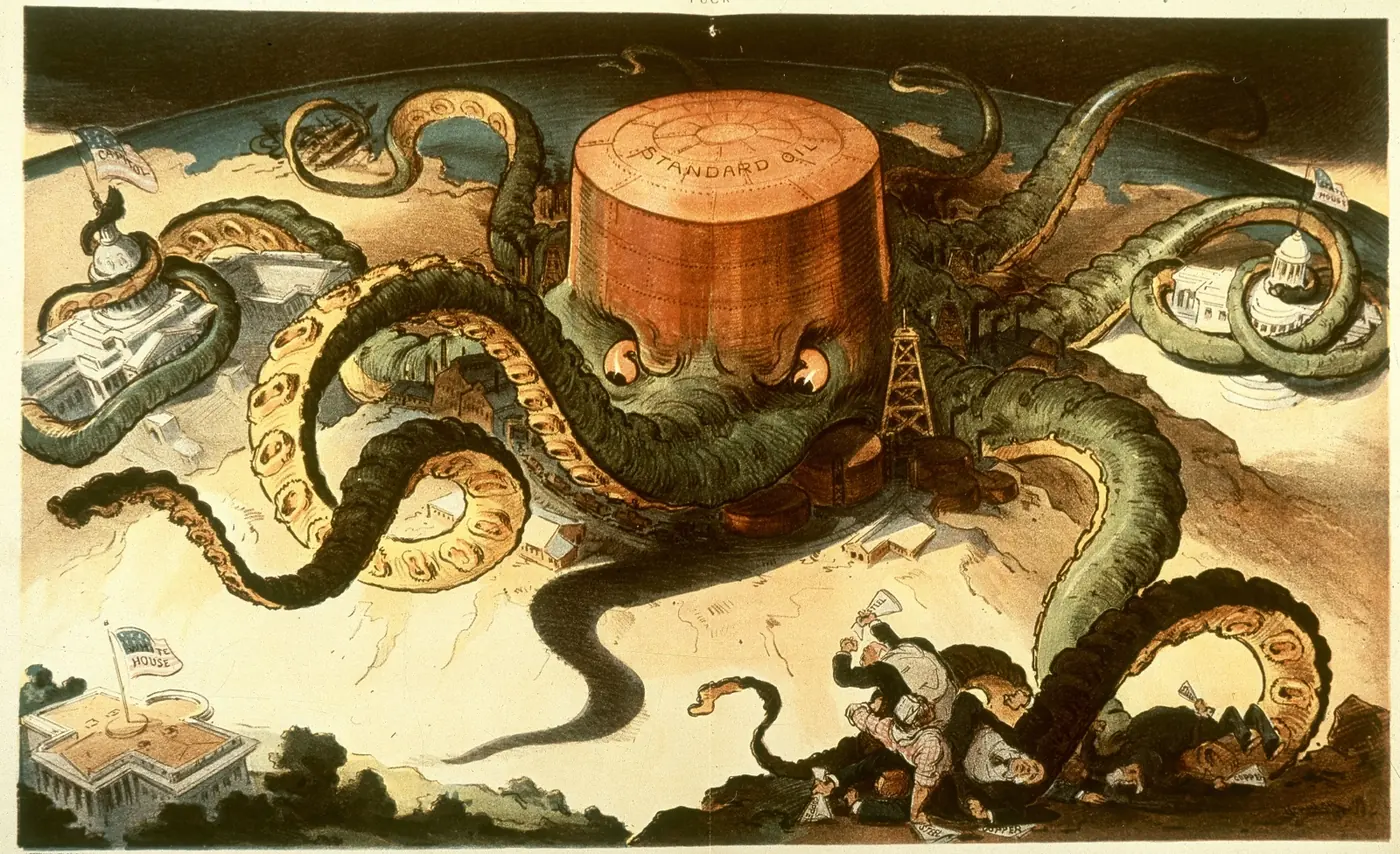
"Robber barons" is the name Americans gave to the industrialists and financiers who amassed vast fortunes and dominant control over whole industries in the decades after the Civil War, a period known as the Gilded Age. The most famous were John D. Rockefeller in oil, Andrew Carnegie in steel, Cornelius Vanderbilt in railroads, and J.P. Morgan in banking. Together they made the United States the world's leading industrial power. They also crushed competitors, suppressed unions, and bought legislators. The comparison with medieval German lords who collected unauthorized tolls along the Rhine was first applied to Vanderbilt by the New York Times in 1859, and the name spread to the whole class of industrial tycoons within a generation.
How the robber barons built their monopolies
They relied on two legal structures: trusts and holding companies. Both allowed a handful of men to fix prices and control production across an entire industry.
John D. Rockefeller was a devout Baptist who gave to charity from his very first paycheck as a teenage bookkeeper in Cleveland. He entered the oil business in 1863 and spent the next two decades buying, undercutting, or squeezing out competitors. He negotiated secret rebates from railroads so that Standard Oil shipped its product more cheaply than anyone else could. Companies that refused to sell to him found their customers and their freight advantages disappearing. By the 1880s Standard Oil had taken over about 90 percent of the oil refining business in the United States.
Andrew Carnegie arrived in the United States from Scotland at 12. His first job was as a bobbin boy in a Pittsburgh cotton mill, earning $1.20 a week. He worked his way into the railroad business, learned to invest, and built the largest steel operation in the country. In 1901 he sold Carnegie Steel to J.P. Morgan for $480 million. Morgan folded it into U.S. Steel, the first corporation capitalized at over a billion dollars.
Cornelius Vanderbilt quit school at 11 and started running a ferry boat in New York Harbor at 16. He built a shipping empire, then moved into railroads and consolidated competing lines across the Northeast. When he died in 1877, his fortune of about $100 million made Vanderbilt one of the wealthiest people in history.
J.P. Morgan was a banker whose power ran through all of these industries. He arranged mergers, placed his partners on corporate boards, and set terms that entire sectors had to follow. In 1895, when a run on gold reserves brought the U.S. Treasury close to default, Morgan organized a private syndicate that sold the government $65 million in gold in exchange for bonds. In 1907 he stepped in again, organizing emergency loans that kept the New York Stock Exchange and New York City itself from failing. The fact that one private citizen could rescue the nation's finances twice helped lead Congress to create the Federal Reserve in 1913.
How the public turned against the robber barons
Congress passed the Sherman Antitrust Act in 1890, the first federal law aimed at monopolies, but for a decade the government rarely enforced it. Public outrage and investigative journalism changed that.
The violence at Andrew Carnegie's Homestead steel plant in 1892 shocked the country. Carnegie was in Scotland when his manager, Henry Clay Frick, cut workers' wages and locked them out. Frick hired 300 Pinkerton guards and sent them up the Monongahela River on barges. Striking workers met them with gunfire. At least 10 people were killed. Carnegie's reputation as a benevolent employer never recovered.
Ida Tarbell, a journalist whose father's oil business in Pennsylvania had been squeezed out by Standard Oil's tactics, spent years documenting how Rockefeller built his monopoly. Her investigation ran as a series in McClure's Magazine starting in 1902 and was published as a book, The History of the Standard Oil Company, in 1904. It turned Rockefeller into the most hated businessman in the country.
President Theodore Roosevelt made trust-busting a central part of his presidency, filing dozens of antitrust suits. In 1911 the Supreme Court ordered Standard Oil broken up into 34 independent successor firms. In the years that followed, the Progressive movement rewrote American law to establish the principle that private power could grow large enough to need public restraint.
Why were they called robber barons?
The name comes from the Raubritter, medieval German lords who built castles along the Rhine and charged tolls on every ship that passed. Only the Holy Roman Emperor could authorize such tolls, but during periods of weak central authority, dozens of lords collected them anyway, extracting money from trade without providing anything in return.
Americans borrowed the term to make a specific accusation: that men like Rockefeller and Vanderbilt got rich not by producing something new, but by positioning themselves where commerce had to pass and taking a cut. Rockefeller controlled refining so completely that oil producers had no one else to sell to. Vanderbilt controlled railroad routes so that shippers had no real alternative. The comparison said these men, like the medieval lords, extracted wealth from people who had no choice but to pass through their territory.
Robber barons or captains of industry
The debate over what to call them started in their own lifetimes and has never been settled.
The case against them is straightforward. They fixed prices, destroyed competitors, treated workers as disposable, and bought the politicians who were supposed to regulate them. Frick's Pinkerton guards at Homestead were an extreme version of a common practice across Gilded Age industry.
The case for them is also real. Rockefeller's efficiency drove the price of kerosene from 26 cents a gallon in 1870 to about 8 cents by the mid-1880s, giving ordinary families affordable light for the first time. Carnegie's steel built the bridges, railroads, and buildings of modern America. Carnegie later gave away most of his fortune, funding 2,509 libraries around the world and arguing in his 1889 essay "The Gospel of Wealth" that the rich had a duty to redistribute their money during their lifetimes. Rockefeller founded the University of Chicago and funded a public health campaign that helped eliminate hookworm across the American South.
Every era when wealth concentrates in a few hands, from the oil trusts of the early 1900s to the technology giants of the 2020s, brings the comparison back. The argument over whether great private power builds a country or takes from it is the same one Americans started having in the 1870s, and it has not ended.