Theodore Roosevelt
Theodore Roosevelt was the 26th and youngest president of the United States, known for trust-busting, conservation, and expanding American power.
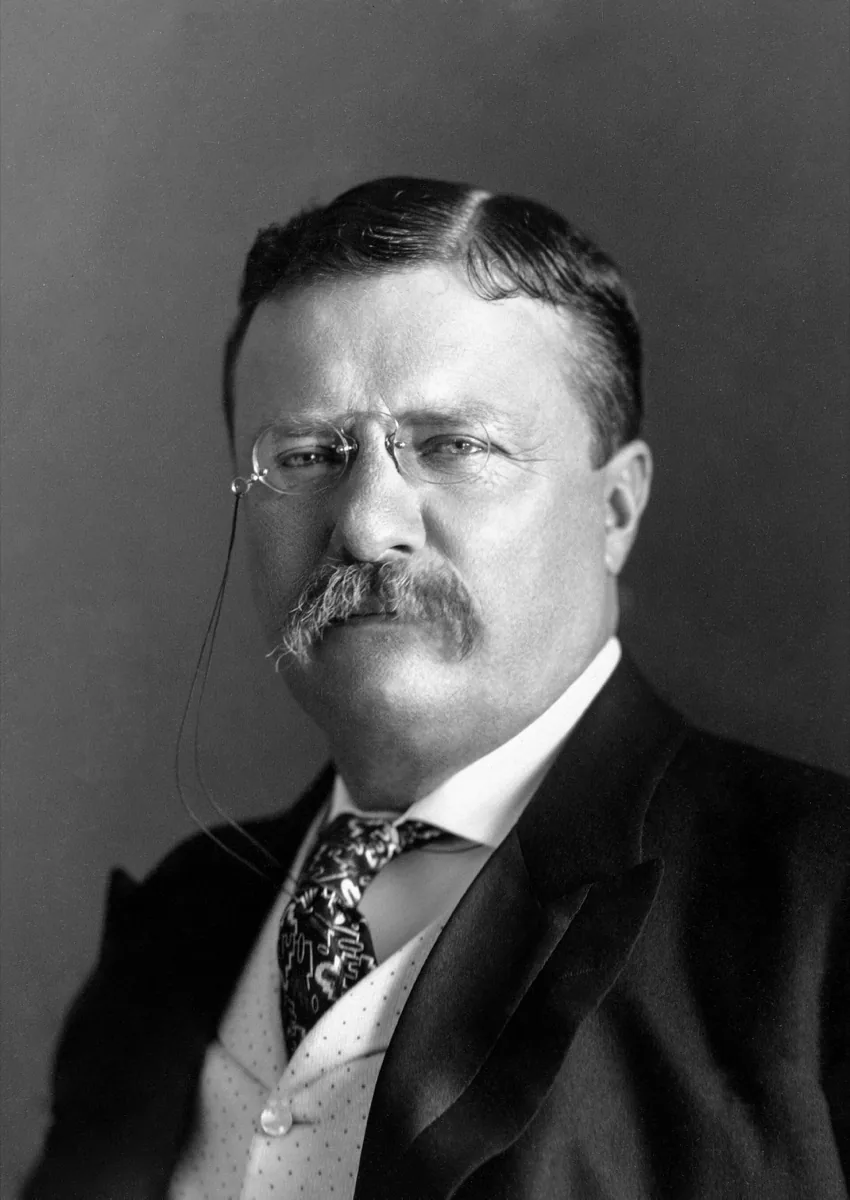
Theodore Roosevelt became the 26th president of the United States on September 14, 1901, after an anarchist shot President William McKinley at an exposition in Buffalo. McKinley died eight days later, and Roosevelt took the oath of office at forty-two, the youngest person to serve as president in American history. Roosevelt used the office to break up corporate monopolies, settle labor disputes, protect millions of acres of public land, and push through the first major federal food and drug safety laws. Abroad, he expanded the Navy into one of the world's largest fleets, took control of the Panama Canal zone, and declared the right of the United States to intervene anywhere in Latin America. He described his approach to foreign policy with a proverb he liked: speak softly and carry a big stick.
How Roosevelt reached the White House
Roosevelt was born in 1858 into a wealthy New York family. As a child he was sickly and severely asthmatic. He overcame his health problems through relentless physical effort, turning himself into a boxer, a cattle rancher, and a big-game hunter. He wrote about forty books in his lifetime.
He entered politics young. He led the New York City police board, held the post of Assistant Secretary of the Navy, and used that office to push for war with Spain. When the Spanish-American War came in 1898, Roosevelt resigned and went to fight in it. He organized the Rough Riders, a volunteer cavalry regiment, and led them in a charge up the heights outside Santiago, Cuba. The charge made him famous, and New York elected him governor.
Republican party bosses found Roosevelt too difficult to control and pushed him to the vice-presidential nomination to keep him out of the way. He had held the job for about six months when McKinley was shot. Roosevelt took the oath of office at forty-two.
Roosevelt's Square Deal
Roosevelt called his domestic program the Square Deal. He believed the federal government should stand between big business and ordinary Americans when the balance tipped too far.
He started with the trusts. In 1902 he sued to break up Northern Securities, a railroad combination controlled by some of the country's wealthiest financiers. The Supreme Court ruled in Roosevelt's favor, proving that antitrust law applied even to the wealthiest men in the country. That same year, when coal miners struck and the mine owners refused to negotiate, Roosevelt threatened to have the Army take over the mines. The owners agreed to arbitration.
Roosevelt pushed federal food and drug inspection laws through Congress, the first major laws of their kind. His largest legacy at home was conservation. He placed roughly 230 million acres of land into federal protection as national forests, wildlife refuges, and monuments, more than any president before or since.
How Roosevelt expanded American power abroad
Roosevelt's foreign policy rested on naval strength. He expanded the United States Navy until it ranked among the largest in the world. In 1907 he ordered the Great White Fleet, sixteen battleships, on a fourteen-month voyage around the world.
He wanted to build what became the Panama Canal. When Colombia would not agree to terms he found acceptable, Roosevelt supported a revolt in Panama, then a province of Colombia, in 1903. He granted the new country diplomatic recognition within days. Two weeks after that, the United States signed a canal treaty with it. He later said that he had simply taken the Isthmus.
In 1904 Roosevelt added what became known as the Roosevelt Corollary to the Monroe Doctrine. It declared that if a Latin American country engaged in what the United States considered chronic misconduct, the United States had the right to intervene as an international police power. Over the following thirty years, American presidents used the corollary to justify customs takeovers and military occupations across the Caribbean.
In 1905 Roosevelt brokered a peace treaty between Russia and Japan at Portsmouth, New Hampshire, ending the Russo-Japanese War. He calculated that no single power should control northeast Asia. He won the Nobel Peace Prize in 1906 for the effort, the first American to receive it.
Why is Theodore Roosevelt on Mount Rushmore?
Sculptor Gutzon Borglum chose Roosevelt for Mount Rushmore to represent the growth and development of the United States in the early twentieth century. Roosevelt joins Washington, Jefferson, and Lincoln as one of four presidents carved into the granite in South Dakota's Black Hills, completed in 1941.
The case for including Roosevelt was his record as president. He broke up monopolies, protected more public land than any president before or since, built the Navy and started the Panama Canal, and asserted the right of the United States to police its own hemisphere.
Roosevelt left the presidency in 1909 and tried to take it back in 1912, running on a third-party ticket challenging his chosen successor. On October 14, in Milwaukee, a man shot him on his way to give a campaign speech. The bullet passed through his steel eyeglasses case and a folded fifty-page manuscript in his coat pocket, which slowed it enough to save his life. Roosevelt delivered the speech anyway, speaking for about eighty minutes with the bullet still in his chest. He lost the election, and the split in the Republican vote handed the presidency to Woodrow Wilson. Roosevelt died on January 6, 1919, at sixty. Roosevelt was the first president to treat the country as a world power with global interests, and every president since has governed the same way.