
Standard Oil
Standard Oil was John D. Rockefeller's oil company, which refined 90 percent of America's oil before the Supreme Court broke it up in 1911.
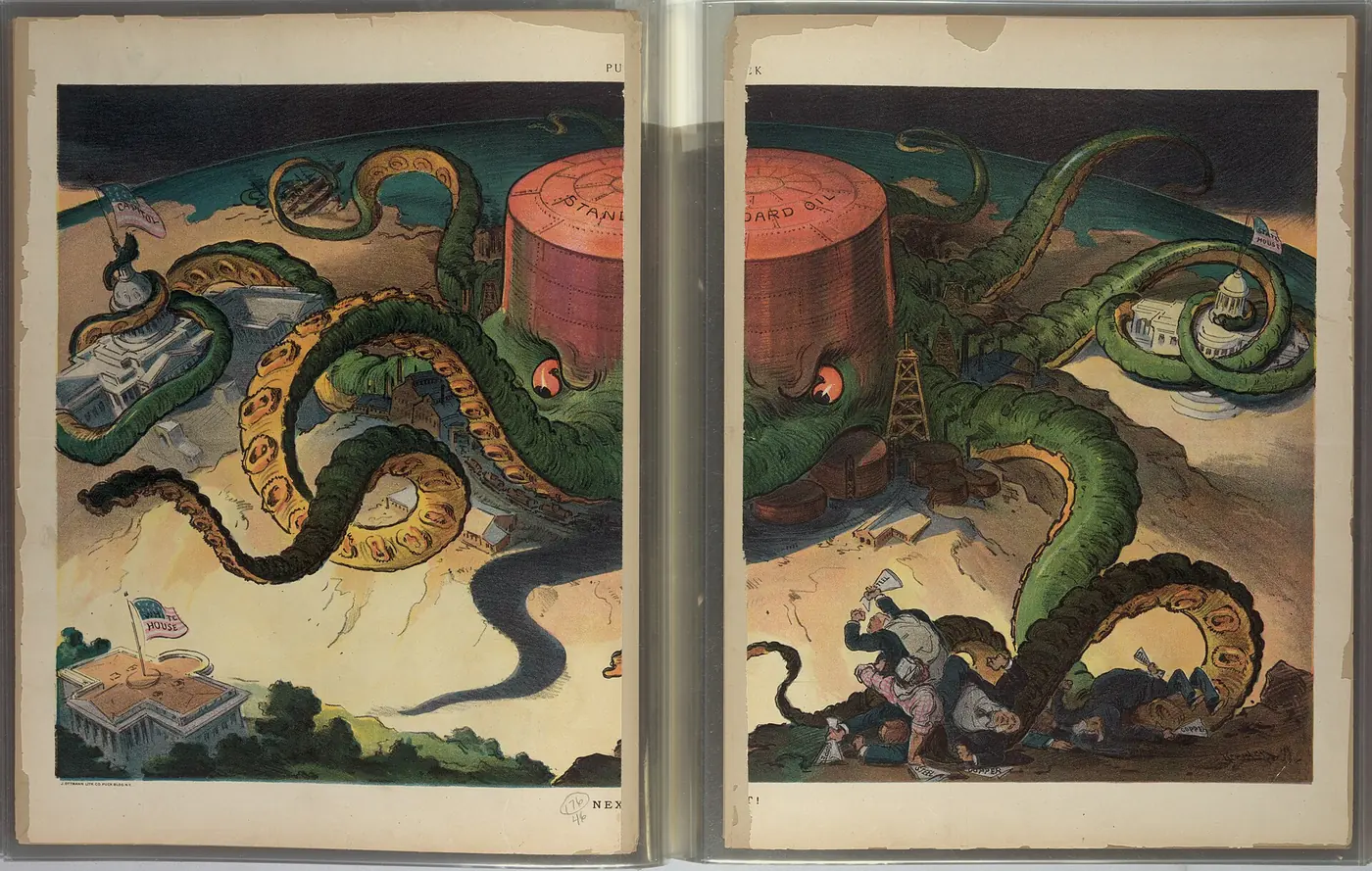
Standard Oil was the oil company that John D. Rockefeller founded in Cleveland, Ohio, in 1870. Within about a decade, Standard Oil refined close to 90 percent of all the crude oil processed in the United States, making it one of the first and largest monopolies in American history. Rockefeller used secret railroad deals to undercut competitors and then bought them out, but Standard Oil also ran its operations with genuine efficiency and drove consumer prices down. On May 15, 1911, the United States Supreme Court declared that Standard Oil violated the Sherman Antitrust Act and ordered it broken apart into 34 independent firms. Several of those firms, including ExxonMobil and Chevron, are among the largest oil producers in the world today.
How Rockefeller built Standard Oil
Rockefeller was born in 1839 in upstate New York. His father was a traveling salesman who was often away for months. His mother was a devout Baptist, and Rockefeller stayed one his entire life. He never drank or smoked, kept a ledger of every penny he spent from his teens onward, and celebrated the anniversary of his first job every year until he died. He started work at 16 as a bookkeeper, earning 50 cents a day.
In 1863, Rockefeller and a partner invested in an oil refinery in Cleveland. The early oil business was wild and unpredictable. A well could flood the market with crude one month and run dry the next. Refiners slashed prices against each other until most went broke. Rockefeller decided that the way to survive was to bring the industry under one company's control.
Standard Oil's most powerful tool was the railroad rebate. Standard Oil shipped oil in such steady, high volume that it had the leverage to negotiate secret discounts that no smaller shipper could get. Standard Oil also collected drawback payments: for every barrel a competitor shipped at the regular rate, the railroad sent Standard Oil a portion of that fee. Any competitor stuck paying full shipping costs was, in effect, subsidizing Standard Oil. Rockefeller gave his competitors two options: accept Standard Oil's buyout offer, or try to survive against a company with permanently lower costs. Most took the buyout.
The South Improvement Company scheme of 1872, a secret deal between Standard Oil, several other refiners, and three railroads, was exposed before it took effect. The exposure made Rockefeller one of the most hated businessmen in the country, but it did not slow Standard Oil down.
Standard Oil also ran its operations efficiently. Standard Oil manufactured its own barrels, laid its own pipelines, and operated its own fleet of tank cars. Standard Oil employed chemists who found profitable uses for materials that other refiners discarded. Standard Oil drove the price of kerosene from 26 cents a gallon in 1870 to 8 cents by 1885. Before cheap kerosene, most families outside cities went to bed at dark because candles and whale oil cost too much for everyday use. Standard Oil overcharged in markets where it had no competition, but it still delivered a cheaper product overall than the disorganized industry it replaced.
How Standard Oil was broken up
By the early 1880s Rockefeller ran dozens of companies in different states, but the law in most states prevented one corporation from holding shares in another. In 1882, Standard Oil's lawyers invented a workaround. Shareholders of each subsidiary turned their shares over to a board of nine trustees, who then cast all the votes as a single block. This arrangement was called a trust, and it gave Rockefeller unified command over the entire operation without formally combining any of the companies.
Other industries adopted the same structure for sugar refining and whiskey. The American legal term "antitrust" dates to this period, because the trust was the thing the new laws were written to stop.
Ohio's courts dissolved Standard Oil's trust in 1892. In 1899, Standard Oil reorganized as a holding company under New Jersey's more permissive corporate law. The monopoly carried on under a different legal form.
The person who turned public opinion against Standard Oil was a journalist named Ida Tarbell. Tarbell grew up in Pennsylvania's oil region. Her father, Franklin Tarbell, was an independent oil producer, and Standard Oil's tactics nearly ruined him. Between 1902 and 1904, Ida Tarbell published a 19-part investigation in McClure's Magazine, detailing the secret railroad discounts, the drawback payments, and the corporate spying that Standard Oil had directed at its competitors. The series became one of the defining works of American investigative journalism.
In 1911, the Supreme Court ruled in Standard Oil Co. of New Jersey v. United States that Standard Oil had violated the Sherman Antitrust Act. The court ordered Standard Oil broken apart into 34 independent firms. The ruling also introduced what became known as the "rule of reason," meaning the Sherman Act only prohibited restraints of trade that a court considered unreasonable. That principle weakened antitrust enforcement for decades.
What companies did Standard Oil become?
Standard Oil of New Jersey became Exxon. Standard Oil of New York became Mobil. Standard Oil of California became Chevron. Standard Oil of Indiana became Amoco. Several of these successors joined the Seven Sisters, the group of Western oil companies that controlled the global oil industry until the 1970s.
Every shareholder in the old Standard Oil received stock in all 34 new companies. The individual pieces turned out to be worth considerably more as separate firms than they had been as one. Rockefeller's personal fortune went from about $300 million to $900 million in the two years after the breakup. Theodore Roosevelt remarked that investors were now praying for the government to dissolve more companies.
The successors have been recombining ever since. Exxon and Mobil merged in 1999 to form ExxonMobil. BP bought Amoco in 1998. Chevron merged with Texaco in 2001. In 2026, ExxonMobil and Chevron alone are worth a combined total of roughly $1 trillion. Standard Oil was broken up more than a century ago, but its successor companies are still among the largest and most valuable oil producers in the world.