Second Boer War
The Second Boer War (1899–1902) was fought between Britain and two Afrikaner republics over gold and control of southern Africa.
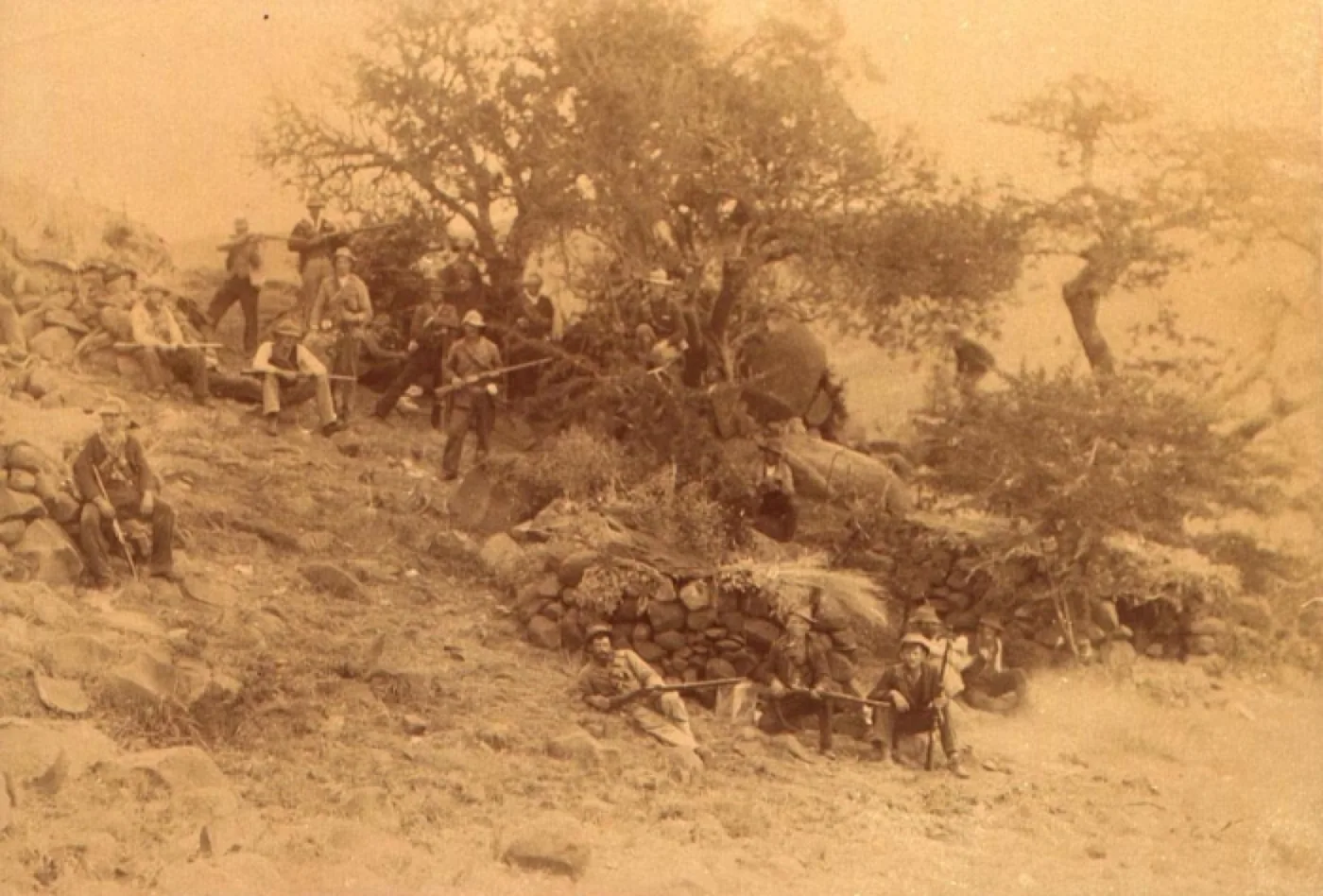
The Second Boer War (1899–1902) was a war between the British Empire and two small republics of Dutch-descended settlers, called Boers, in southern Africa: the South African Republic (the Transvaal) and the Orange Free State. Britain was the most powerful state in the world and expected a quick victory. Instead the war took nearly three years and about 450,000 troops. It also produced concentration camps where roughly 28,000 Boer civilians and over 20,000 black Africans died, most of them children. The war started because of gold. The world's richest goldfield had been discovered in the Transvaal in 1886, and British mining magnates and imperial officials wanted the territory under their control. Britain won, but the cost in lives and reputation shook the empire.
How gold started the Second Boer War
In 1886, prospectors found the main reef of gold on the Witwatersrand, a ridge near what is now Johannesburg. It was the largest gold deposit ever discovered. Fortune-seekers poured into the Transvaal, a landlocked republic run by Boer farmers. The newcomers, called uitlanders (Afrikaans for "foreigners"), were mostly British. Within a decade they outnumbered the Boers in the mining region.
The Transvaal's president, Paul Kruger, taxed the uitlanders heavily and refused them the vote. Kruger had grown up on the frontier. His family joined the Great Trek north from the Cape Colony in 1836, when he was ten years old. He had spent his adult life fighting, farming, and governing on the veld, and he saw the uitlanders as a threat to Boer independence.
Mining magnates like Cecil Rhodes, who was also the prime minister of the Cape Colony, wanted to bring the Boer republics under British control. In 1895, Rhodes backed an armed raid into the Transvaal led by Leander Starr Jameson, hoping to trigger an uitlander uprising. The raid failed completely, but it convinced Kruger that Britain intended to take the Transvaal by force. He bought modern German Mauser rifles and artillery, and allied formally with the Orange Free State.
By 1899, negotiations over uitlander voting rights had stalled. Britain moved troops to the border. On October 9, 1899, Kruger issued an ultimatum demanding that Britain withdraw its forces within 48 hours. When the deadline passed, the Boer republics declared war.
How Britain struggled to defeat the Boers
The Boers struck first and fast. Within weeks they besieged Ladysmith, Kimberley, and Mafeking, three British garrison towns. In December 1899, during a stretch the British called Black Week, Boer forces beat the British in three battles in a single week: Stormberg, Magersfontein, and Colenso. At Colenso the British suffered over 1,100 casualties while inflicting only 38 on the Boers. It was the worst run of British defeats since the Napoleonic Wars. The Boers were farmers and hunters who had grown up shooting on the veld, and armed with modern Mauser rifles, they picked off advancing British soldiers from entrenched positions.
Britain responded with reinforcements on a massive scale. Under new commanders Lord Roberts and Lord Kitchener, British forces relieved the besieged towns by May 1900 and captured the Boer capitals, Pretoria and Bloemfontein, by June. Kruger fled to Europe and eventually settled in Clarens, Switzerland, where he died in 1904 without seeing South Africa again.
But the war did not end. Instead of surrendering, the Boers broke into small, fast-moving mounted units called commandos. They blew up railways, raided supply lines, and ambushed British columns, then disappeared into the countryside. The guerrilla war dragged on for nearly two more years.
What were the concentration camps in the Boer War?
To defeat the guerrillas, Lord Kitchener ordered a scorched-earth campaign. British troops burned about 30,000 Boer farms and killed livestock to deny the commandos food and shelter. The British rounded up Boer families and their black African workers and placed them in camps the army called concentration camps.
These camps were badly planned and poorly supplied. Overcrowding and lack of sanitation led to epidemics of measles and typhoid. About 28,000 Boer civilians died in the camps. Roughly 80 percent of them were children. More than 20,000 black Africans died in separate, even worse-supplied camps.
Emily Hobhouse, an English activist, traveled to South Africa in December 1900 and visited camps in the Orange Free State. She found thousands of women and children living in desperate conditions and published a report that caused a national scandal in Britain. Henry Campbell-Bannerman, the leader of the opposition Liberal Party, called the camps "methods of barbarism" in a speech in June 1901. The government sent the Fawcett Commission to investigate, and conditions eventually improved. The term "concentration camp" entered common use through the Boer War and later took on far darker meaning in the twentieth century.
What the Second Boer War changed
The war ended with the Treaty of Vereeniging on May 31, 1902. The Boer republics accepted British sovereignty. In return, Britain promised eventual self-government and provided £3 million to rebuild the destroyed farms.
About 22,000 British soldiers died during the war, more than 14,000 of them from disease rather than combat. The Boer death toll, military and civilian combined, was higher. The war showed the world that a small, determined force could keep the largest empire on earth fighting for years, and it shook British confidence in the empire's military power.
In 1910, the former Boer republics joined the Cape Colony and Natal to form the Union of South Africa, a self-governing dominion within the British Empire. The new country was built by and for its white population. The black majority, which made up most of South Africa's people, gained nothing from the war or the settlement that followed. The racial order the Union established would harden over the following decades into apartheid.