
Sputnik
Sputnik 1 was the first artificial satellite, launched by the Soviet Union on October 4, 1957, opening the Space Age.
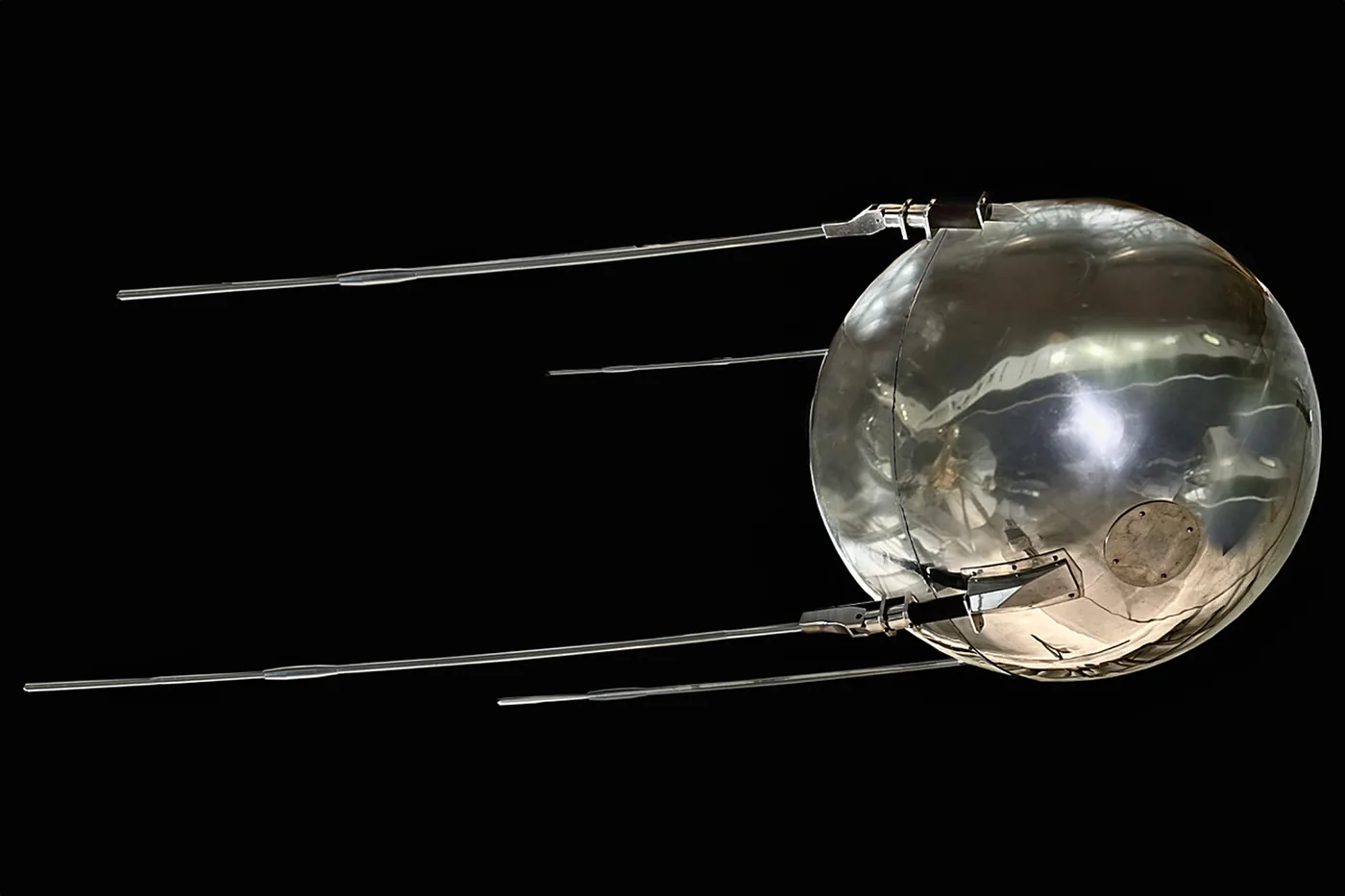
On October 4, 1957, the Soviet Union launched Sputnik 1, the first artificial satellite. It was a polished aluminum sphere 58 centimeters across, small enough to hold in your arms, weighing 83.6 kilograms. There was no camera or weapon aboard. All it did was orbit the Earth once every 96 minutes and broadcast a steady beep on radio frequencies that anyone with a shortwave receiver could pick up. Its batteries lasted three weeks, and in January 1958 it burned up in the atmosphere.
But the rocket that carried Sputnik was an adapted R-7 Semyorka, the first intercontinental ballistic missile ever built. A rocket powerful enough to put a satellite into orbit was also powerful enough to drop a nuclear warhead on an American city. That fact set off a panic in the United States that reshaped the country.
How Sergei Korolev built Sputnik
The man behind Sputnik was Sergei Korolev, a rocket engineer whose name the Soviet government kept secret from the outside world. Officials referred to him only as "the Chief Designer." His identity was not made public until after his death in 1966.
Korolev had nearly not survived to build anything. In 1938, during Stalin's purges, he was arrested on charges of sabotage and sentenced to a labor camp. He spent almost six years in the Soviet gulag, including time at Kolyma in eastern Siberia, one of the harshest camps in the system. Interrogators beat him badly enough to break both his jaws. He nearly starved to death. After his release he went back to building rockets, and by the mid-1950s he was leading the Soviet missile program.
Both the United States and the Soviet Union had announced plans to launch satellites during the International Geophysical Year of 1957-1958. The Americans chose a civilian rocket called the Vanguard. Korolev used his R-7, a military missile originally designed to carry nuclear warheads across continents.
His team built the satellite in a few months. It was an aluminum alloy shell two millimeters thick, with four whip antennas up to 2.9 meters long and two radio transmitters powered by silver-zinc batteries. The name "Sputnik" translates roughly as "traveling companion." Korolev's team launched it from a facility in the Kazakh steppe that would become known as Baikonur. The satellite entered an elliptical orbit ranging from about 227 to 945 kilometers above the Earth's surface.
How Americans reacted to Sputnik
Americans went outside night after night to watch the satellite pass overhead. Newspapers called the reaction the "Sputnik crisis." President Dwight Eisenhower tried to play down the launch, but the public was not reassured. If the Soviet Union could put a satellite over American cities, it could send a nuclear warhead there too.
One month later, the Soviets launched Sputnik 2, carrying a dog named Laika, the first animal to orbit the Earth. Sputnik 2 was six times heavier than Sputnik 1, which showed that Soviet rockets were more powerful than the first launch had suggested.
The first American attempt to match them made things worse. On December 6, 1957, a Vanguard rocket carrying a small satellite rose about four feet off the launch pad, lost thrust, and exploded on live television. The press called it "Flopnik" and "Kaputnik." The army's rocket team, led by the German-born engineer Wernher von Braun, got its chance next. On January 31, 1958, a Jupiter-C rocket launched Explorer 1, the first American satellite, from Cape Canaveral.
Why was Sputnik important?
Sputnik itself lasted only three months. But the panic it caused led the United States to overhaul its approach to science, technology, and education in ways that lasted decades.
In February 1958, President Eisenhower created the Advanced Research Projects Agency, later known as DARPA, to fund advanced military research. That July, he signed the National Aeronautics and Space Act, creating NASA, which began operations on October 1, 1958. In August, Congress passed the National Defense Education Act, which funded science, mathematics, and foreign-language education across the country. It was the first comprehensive federal education law driven by national security.
The space race between the two superpowers accelerated from there. In 1961, the Soviet Union sent Yuri Gagarin into orbit, the first human in space. That same year, President John F. Kennedy told Congress that the United States should land a man on the Moon before the end of the decade.
A small, short-lived satellite pushed the United States to create its premier space agency, reshape its education system, and enter a space race that defined the rest of the Cold War.