
Yuri Gagarin
Yuri Gagarin was a Soviet cosmonaut who became the first human in space on April 12, 1961, orbiting Earth once aboard Vostok 1.
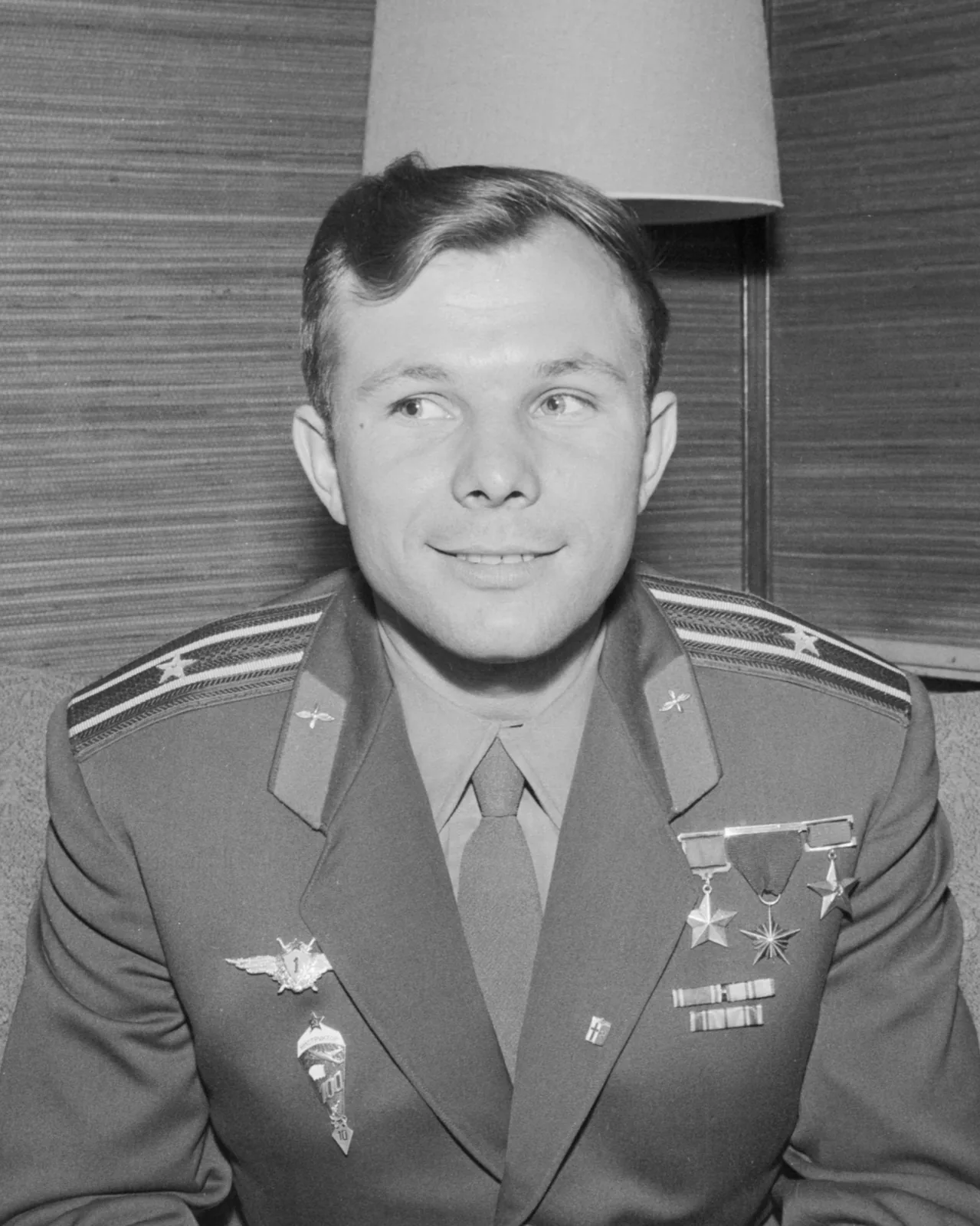
Yuri Gagarin was a Soviet air force pilot who on April 12, 1961, became the first human being to travel into space. He was 27 years old. His spacecraft, Vostok 1, launched from the Baikonur Cosmodrome in present-day Kazakhstan. It circled the Earth once, climbing to roughly 327 kilometers, and landed 108 minutes after launch. The flight came four years after the Soviet Union launched Sputnik, the first artificial satellite, and just days before the United States' Bay of Pigs disaster in Cuba. His father was a carpenter in a small village west of Moscow. He became the most famous person in the world almost overnight. He was killed in a training jet crash seven years later, at 34.
How the Soviet Union chose its first cosmonaut
Gagarin was born on March 9, 1934, in the village of Klushino, in western Russia. His father, Alexei, was a carpenter. His mother, Anna, was a milkmaid on a collective farm. He was the third of four children. During World War II, German troops occupied the village, and two of Gagarin's older siblings were taken to Germany as forced laborers.
After the war Gagarin trained as a fighter pilot in the Soviet air force. In 1960 the Soviet space program selected its first group of twenty cosmonauts. Gagarin stood out for two reasons. At 157 centimeters, about five foot two, he fit inside the cramped Vostok capsule, which was just over two meters wide. He also had an easy, friendly smile that Soviet leaders thought would represent the program well. Soviet premier Nikita Khrushchev wanted the first cosmonaut to be a symbol of Soviet achievement, and Gagarin, the working-class son of a carpenter, fit the role.
Gagarin's 108 minutes in space
No one knew whether a human mind could function in weightlessness. Soviet engineers designed Vostok 1 to fly automatically from the ground and locked the manual controls. A code to unlock them, 1-2-5, was sealed in an envelope inside the cabin, to be opened only in an emergency. Several people quietly told Gagarin the code before launch anyway.
At liftoff Gagarin said "Poyekhali," meaning "let's go." The phrase became famous across the Soviet Union and is still repeated in Russia today. The capsule climbed to about 327 kilometers above the Earth and completed one full orbit. Gagarin was largely a passenger for the entire flight.
During descent Gagarin ejected from the capsule at about seven kilometers altitude and came down by parachute on his own. He landed in a field near the village of Smelovka, close to the Volga River. A farmer named Anna Takhtarova and her young granddaughter were the first people to reach him. They saw a man in an orange suit descending under a parachute. When Takhtarova asked if he had come from outer space, Gagarin told her he had.
The Soviet government kept the separate landing secret for years. International aeronautical rules at the time required the pilot to land inside the spacecraft for the flight to count as an official record.
How did Yuri Gagarin die?
After the flight, Khrushchev sent Gagarin on tours around the world to showcase Soviet achievement. He visited dozens of countries and met heads of state. But the same fame that made him useful also grounded him. The Soviet government would not risk losing its most famous citizen on another spaceflight and steered Gagarin toward ceremonial duties. Gagarin resisted and fought to return to active duty.
On March 27, 1968, he was killed when a MiG-15 training jet he was piloting with instructor Vladimir Seryogin crashed near the town of Kirzhach, east of Moscow. He was 34 years old, less than seven years after his spaceflight.
The cause of the crash has been debated for decades. The official Soviet investigation in 1968 was inconclusive. Documents declassified in 2003 pointed to several possible factors. The jet had been fitted with external fuel tanks that made it unstable in poor weather. Air traffic controllers may have given the pilots wrong information about how high the clouds were, leaving them too little time to recover from a spin. One declassified report found that an unauthorized Su-15 supersonic jet may have passed within 10 to 15 meters of Gagarin's aircraft in the clouds, possibly sending it into a tailspin. No single explanation has been confirmed.
Gagarin's spaceflight lasted less than two hours. It proved that a human being could survive in orbit and return safely. Six weeks later, President John F. Kennedy told the United States Congress that America should send a man to the Moon before the end of the decade, a commitment that led directly to the Apollo Moon landings.