
ICBM (Intercontinental Ballistic Missile)
An intercontinental ballistic missile (ICBM) is a rocket that can deliver nuclear warheads to any point on Earth in about thirty minutes.
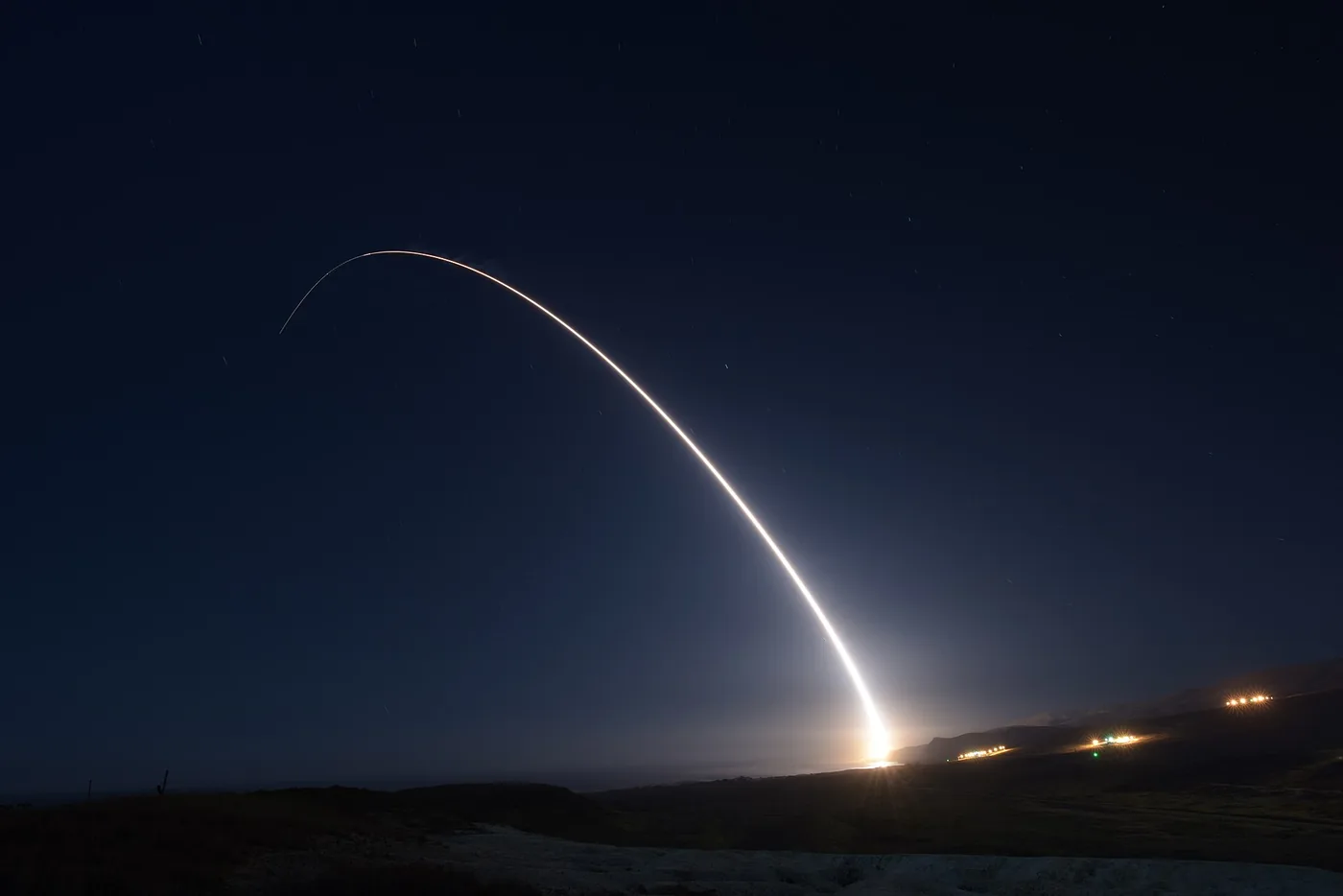
An intercontinental ballistic missile, or ICBM, is a rocket designed to carry nuclear warheads across distances greater than 5,500 kilometers. It burns its fuel in the first three to five minutes of flight, then travels unpowered through space for about twenty-five minutes. Its warheads reenter the atmosphere at speeds above Mach 20, or roughly 24,000 kilometers per hour. The flight from Moscow to Washington lasts about thirty minutes. Once launched, an ICBM cannot be recalled. Bombers can be recalled, and armies take months to arrive. An ICBM removes both the warning time and the option of defense, which is why it became the central weapon of the nuclear age.
How the Soviet Union built the first ICBM
The Soviet R-7 Semyorka was the first successful ICBM. It flew on August 21, 1957. Its chief designer was Sergei Korolev, an engineer who had spent six years as a political prisoner under Stalin, including time in a gold mine at Kolyma, one of the deadliest labor camps in the Soviet Union. After his release, the Soviet government put him in charge of its rocket program. Six weeks after the R-7's first successful flight, Korolev used the same booster to launch Sputnik into orbit. That satellite is how the rest of the world became convinced the Soviet Union had a missile that could reach the United States.
The American Atlas ICBM entered service in 1959. Both the R-7 and the Atlas were liquid-fueled, which meant their crews had to load volatile propellants into the rocket shortly before launch. An early liquid-fueled missile could be used for a planned first strike, but not for retaliation, because an enemy's warheads could arrive before the missile was ready to fire.
How solid fuel and MIRVs changed ICBMs
Solid fuel solved that problem. The Minuteman missile, first deployed by the United States in 1962, used solid propellant that could sit inside a reinforced silo for years with little maintenance. It could be fired in less than a minute. Once a country could launch its missiles before an incoming attack landed, it could credibly promise to retaliate after being hit. The architecture of nuclear deterrence, known as mutually assured destruction, rests on that retaliatory capability rather than on trust between governments.
Starting in the 1970s, both the United States and the Soviet Union fitted their ICBMs with multiple independently targetable reentry vehicles, or MIRVs. A single MIRV-equipped missile carries several warheads, each aimed at a separate target. MIRVs multiplied the number of warheads in each country's arsenal without multiplying the number of rockets, and they made arms control agreements harder to verify, because counting missiles no longer told you how many warheads existed. At the same time, missile accuracy improved until warheads could reliably hit within a few hundred meters of their target. That precision made it theoretically possible to destroy an opponent's missile silos in a first strike. This concern is why submarine-launched ballistic missiles matter: a missile submarine (SSBN) hides beneath the ocean, where it cannot be located or destroyed before it fires.
Which countries have ICBMs?
The United States has 400 Minuteman III missiles deployed in silos across five states: Montana, Wyoming, North Dakota, Colorado, and Nebraska. Each missile carries a single warhead. The Sentinel program is meant to replace them, though its costs have risen sharply. Russia fields the Yars mobile ICBM and is preparing to deploy the heavier silo-based Sarmat. China kept a deliberately small ICBM force for decades, but in 2021 researchers identified three large new silo fields under construction in its western deserts, and China is now expanding its ICBM arsenal faster than any other country. North Korea has flight-tested ICBMs, which is why its nuclear program is treated as a threat on a different scale from those of other small states. France and Britain maintain submarine-launched ballistic missiles with intercontinental range but no land-based ICBMs. India has tested the Agni-V, whose range of more than 5,000 kilometers puts it at the intercontinental threshold.
Can an ICBM be intercepted?
The United States operates a Ground-based Midcourse Defense system with 44 interceptors in Alaska and California, designed to stop a small number of incoming warheads from a country like North Korea. Against a major nuclear power with hundreds of ICBMs and multiple warheads on each one, no existing missile defense can stop the attack. Russia and China are also developing maneuvering reentry vehicles and hypersonic glide vehicles designed to defeat interceptors.
Because ICBMs cannot be reliably stopped, the thirty-minute flight time forces every nuclear power to compress its decisions into that window. Early-warning satellites, ground-based radars, airborne command posts, and prepared retaliation plans all exist so that a country can decide whether to fire back before the incoming warheads arrive. The Soviet Union built Dead Hand, a semi-automatic system designed to launch a retaliatory strike even if the country's leadership had been destroyed.
Compressing decisions into minutes means mistakes have very little room to be discovered. On September 26, 1983, Stanislav Petrov, a Soviet lieutenant colonel on duty at a satellite monitoring station south of Moscow, watched his screen report that the United States had launched five ICBMs. Petrov judged it was a false alarm and did not pass the warning up the chain of command. He was right: a sensor error had triggered the alert. In 1979, a training tape simulating a Soviet attack was accidentally loaded into the live warning system at NORAD, the North American Aerospace Defense Command. Bomber crews were sent to their planes and missile crews were put on alert before anyone realized the attack was not real.
Land-based silos are obvious targets because they cannot move, and critics have argued for retiring them for over thirty years. They remain in service because they are the cheapest way to force an adversary to use hundreds of warheads instead of a handful on a first strike. As long as those silos exist, no first strike can be quick or simple, and that is one of the foundations that nuclear deterrence rests on.