
1996 Taiwan Strait Crisis
The 1996 Taiwan Strait Crisis was China's attempt to frighten Taiwan's voters with missile tests before the island's first direct presidential election.
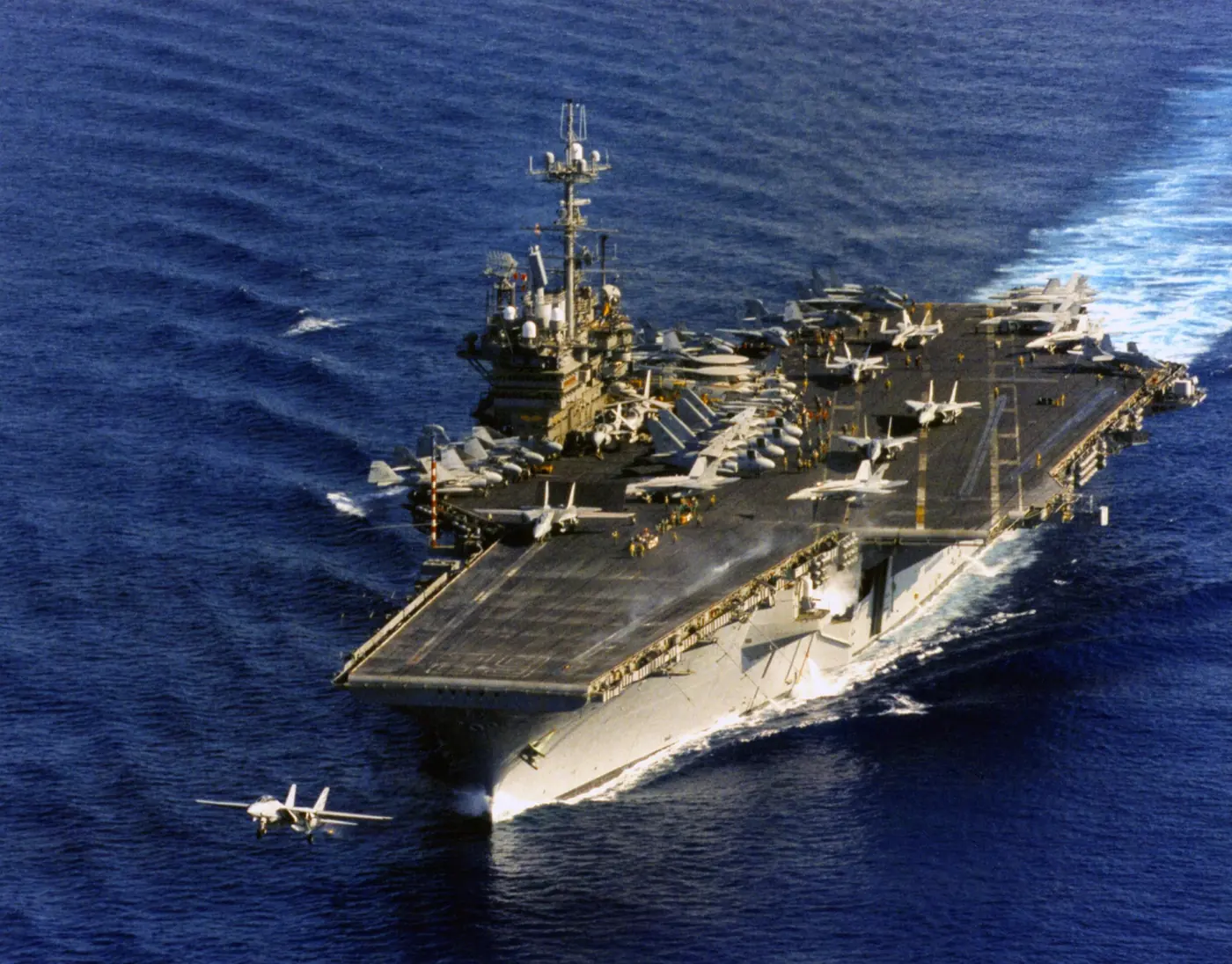
The 1996 Taiwan Strait Crisis, also called the Third Taiwan Strait Crisis, was a military confrontation between China and the United States over Taiwan that lasted from July 1995 to March 1996. China launched ballistic missiles into waters near Taiwan's two largest ports to intimidate voters before Taiwan's first direct presidential election. The United States deployed two aircraft carrier battle groups in response, the biggest American naval deployment in East Asia since the Vietnam War. China's attempt to sway the election failed. On March 23, 1996, Taiwan's president, Lee Teng-hui, took 54 percent of the vote, winning by a wider margin than most analysts had predicted.
How Lee Teng-hui's Cornell speech started the crisis
In June 1995, Lee Teng-hui traveled to Cornell University, where he had earned his doctorate in agricultural economics in 1968. He gave a speech titled "Always in My Heart" before about 3,000 alumni and received four standing ovations. Lee was Taiwan's first native-born president. Previous leaders had come from mainland China with the Nationalist government after 1949, and Lee had spent his presidency pushing Taiwan from one-party rule toward democracy. His speech celebrated that transformation. He thanked Congress and President Bill Clinton for allowing the visit and referred to his government as "the Republic of China on Taiwan." Several hundred reporters covered the event, and the speech was broadcast across Asia. It was the first time a sitting Taiwanese leader had visited the United States since Washington ended official diplomatic ties with Taiwan in 1979. Congress passed the Taiwan Relations Act that same year to govern the relationship without formal recognition.
Beijing saw the visit as a provocation. Under its one-China policy, China considered Taiwan a province, not a country. Lee's presence on American soil, and the attention it drew, implied a level of diplomatic recognition that contradicted that position. China's government also viewed Taiwan's move toward direct elections as a step toward formal independence.
China responded with a military pressure campaign that ran from July 1995 to March 1996. The People's Liberation Army launched short-range ballistic missiles into the sea, staged live-fire exercises near Taiwan's coast, and conducted large-scale military drills. The goal was to warn Taiwan's voters that choosing leaders who moved toward independence would have consequences.
China fires missiles near Taiwan's largest ports
The crisis peaked in early March 1996, days before the presidential election. The People's Liberation Army launched DF-15 ballistic missiles into target zones near Taiwan's two busiest ports, landing roughly 23 miles from Keelung in the north and 33 miles from Kaohsiung in the south. Over 70 percent of Taiwan's commercial shipping passed through those two ports. Beijing warned airlines and ships to avoid the target areas. The warnings closed off stretches of open water around the island and disrupted sea and air traffic across some of the busiest shipping lanes in Asia.
The Clinton administration treated the launches as a direct threat. Secretary of Defense William Perry ordered the USS Independence, an aircraft carrier forward-deployed at Yokosuka, Japan, to move into waters east of Taiwan. The Pentagon then sent the USS Nimitz carrier battle group from its post in the Persian Gulf toward Taiwan to reinforce the Independence. Two American carriers, their escort ships, and submarines converged on the region. Neither carrier group entered the Taiwan Strait itself, but their presence nearby was unmistakable.
Instead of frightening voters into punishing Lee Teng-hui, the missile tests pushed them the other way. On March 23, 1996, Taiwan held its first direct presidential election. Lee took 54 percent, far ahead of the three other candidates. His closest competitor, Peng Ming-min of the Democratic Progressive Party, received 21 percent. The launches briefly rattled Taiwan's stock market and drove some capital abroad, but the financial panic faded quickly.
How the 1996 crisis reshaped China's military
The crisis exposed a gap between China's military capability and America's that was impossible to ignore. The People's Liberation Army could launch missiles, but it had no way to challenge two American carrier groups operating off its coast. The 1991 Gulf War had already shown Beijing the power of American precision weapons. The 1996 crisis made the problem immediate: China could not project power even in waters it considered its own. China's leaders concluded that the country needed a military capable of keeping American ships out of the western Pacific.
In the decades since, China has pursued what analysts call an anti-access/area denial strategy. The most prominent result is the DF-21D, a medium-range ballistic missile designed to hit moving ships at sea, sometimes called the carrier killer. China also built a large submarine fleet, expanded its navy into the largest in the world by number of ships, and deployed coastal missile batteries along its southeastern coast.
The 1996 standoff set the pattern that still defines Taiwan Strait tensions: missiles from China, carriers from the United States. The military balance, though, has shifted. In 1996, two American carriers could operate near Taiwan with little risk. Today, any carrier approaching the strait would face a layered system of missiles, submarines, and sensors that China has built in the three decades since.