
Telegraph
The electric telegraph, developed in the 1830s, sent messages across continents and oceans in minutes for the first time.
The electric telegraph, developed in the 1830s and 1840s, sent messages along wires as electrical pulses. Before it existed, news traveled only as fast as a ship, a horse, or a running messenger. A dispatch from London to India took months. The telegraph made the same message arrive in minutes. By the 1860s, networks of wire connected most major cities in Europe and North America, and undersea cables linked continents. The telegraph changed how governments ruled, how wars were fought, and how markets set prices. For the first time, a leader could receive word of a crisis thousands of miles away within hours, not months.
How Samuel Morse built the American telegraph
Samuel Morse was a portrait painter. He had studied art at the Royal Academy in London, painted the Marquis de Lafayette, and helped found the National Academy of Design in New York. In 1825, while Morse was working in Washington, his wife Lucretia died suddenly in New Haven. The letter carrying the news took days to reach him. By the time he arrived home, she had already been buried.
In 1832, on a ship back from Europe, Morse heard a fellow passenger describe experiments with electromagnetism. He decided to build a device that could send messages through wire. He spent the next twelve years on the project, with help from the scientist Leonard Gale and the machinist Alfred Vail. The key invention was the code. Morse and Vail created a system of short and long signals, dots and dashes, with each combination representing a letter of the alphabet. The code was easy to learn and worked reliably over long distances.
On May 24, 1844, Morse sat in the Supreme Court chamber inside the Capitol in Washington and tapped out a message to Vail at a railroad station in Baltimore, about 38 miles away. The message, "What hath God wrought," was a line from the Book of Numbers, suggested by Annie Ellsworth, the young daughter of a friend. It arrived instantly. Within months, investors were stringing wires between cities. By the 1850s, telegraph networks reached across much of the United States and Europe.
How the telegraph crossed the Atlantic
In 1858, a company laid the first telegraph cable across the Atlantic, from Ireland to Newfoundland. Queen Victoria and President James Buchanan exchanged messages, and cities on both sides held celebrations. Three weeks later, the cable failed.
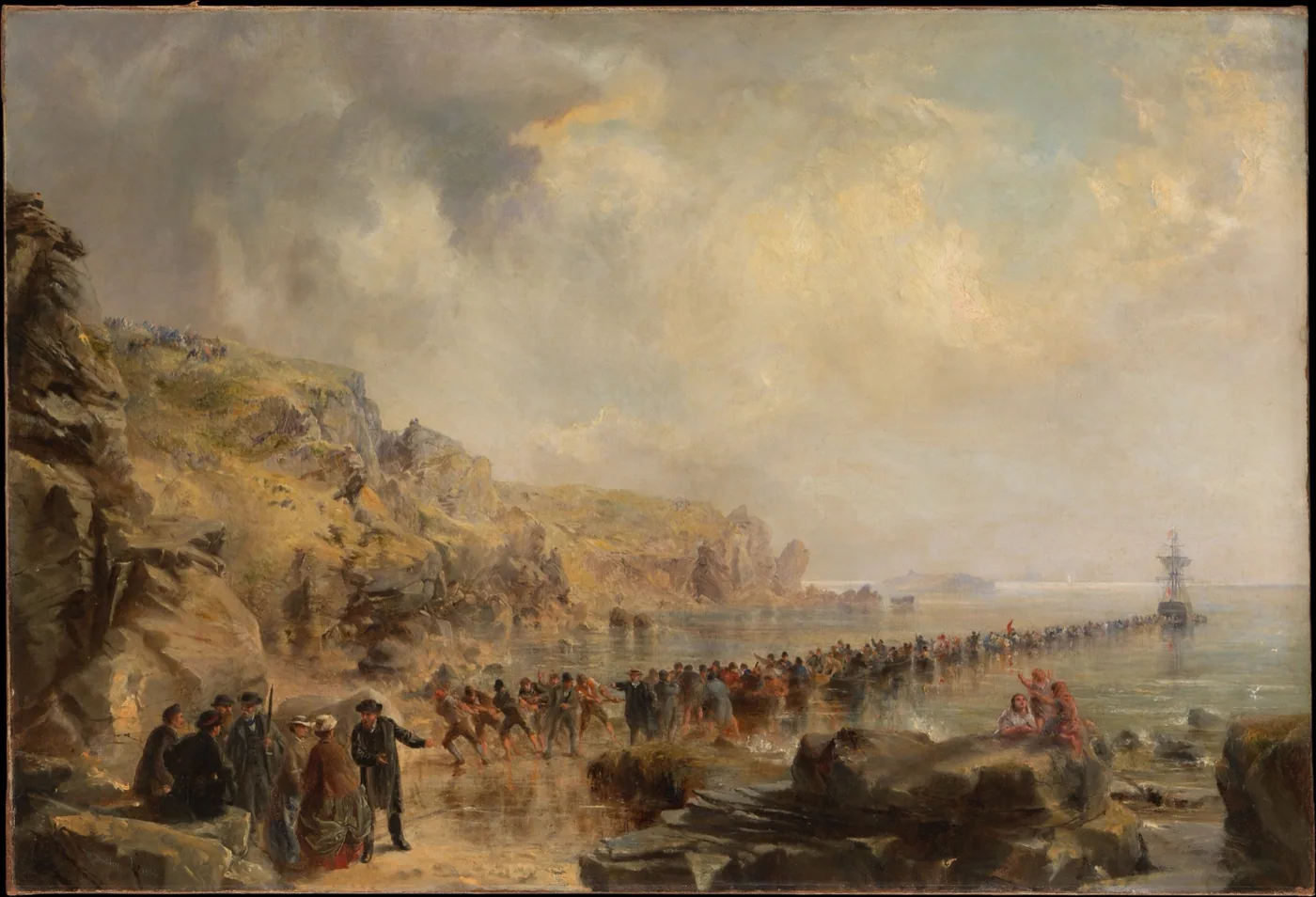
It took eight more years. In 1866, the Great Eastern, the largest ship in the world, sailed from Valentia, Ireland, with thousands of miles of armored cable in its hold. On July 27, it reached Heart's Content, Newfoundland, and the connection held. A crossing that once took ten days by ship now took minutes by wire. The Great Eastern then sailed back, found the broken cable from a failed 1865 attempt on the ocean floor, spliced it, and completed a second transatlantic line.
Britain recognized the strategic value of these cables before other countries did. Over the next three decades, British companies laid submarine cables to India, Australia, Africa, and East Asia. By the 1890s, British companies controlled about two-thirds of all submarine telegraph cables in the world. The small Cornish village of Porthcurno, where many of the cables came ashore, became one of the busiest communications stations in the world. In 1902, the last link was completed across the Pacific, and a British cable network ran through British territory for its whole length. It was called the "All Red Line," after the color used for the British Empire on maps.
How cutting the cables helped decide a world war
On August 5, 1914, hours after Britain declared war on Germany, the British cable ship Alert sailed into the English Channel and cut five German transatlantic telegraph cables. Berlin lost its ability to send telegrams directly to the outside world. Germany had to use wireless radio for long-distance messages instead, and wireless signals could be intercepted.
In January 1917, British codebreakers intercepted a telegram from Germany's foreign minister, Arthur Zimmermann, to Germany's ambassador in Mexico. The telegram offered Mexico an alliance against the United States and promised to help Mexico recover Texas, New Mexico, and Arizona. When Britain shared the decoded Zimmermann Telegram with Washington, it helped push the United States into World War I.
Who invented the telegraph?
Samuel Morse is the name most people connect with the telegraph, but he was not the first to build one. In 1837, two British inventors, William Fothergill Cooke and Charles Wheatstone, patented an electric telegraph and had it running commercially on Britain's Great Western Railway by 1839, five years before Morse's demonstration. Their device used needles that swung to point at letters on a board.
Morse's system won out because it was simpler. It needed only a single wire, and Morse code could be learned quickly by any operator. By the 1860s, his design was the standard across most of the world.
The telegraph made real-time news reporting and agencies like Reuters possible. Stock markets could react to events as they happened, and governments could manage distant territories from a single capital. The undersea fiber-optic cables that carry almost all of the world's intercontinental internet traffic today serve the same purpose the telegraph cables served when they first crossed the oceans in the 1860s.