
Undersea Cables
Undersea cables are the fiber-optic lines on the ocean floor that carry about 97% of the world's intercontinental internet traffic.
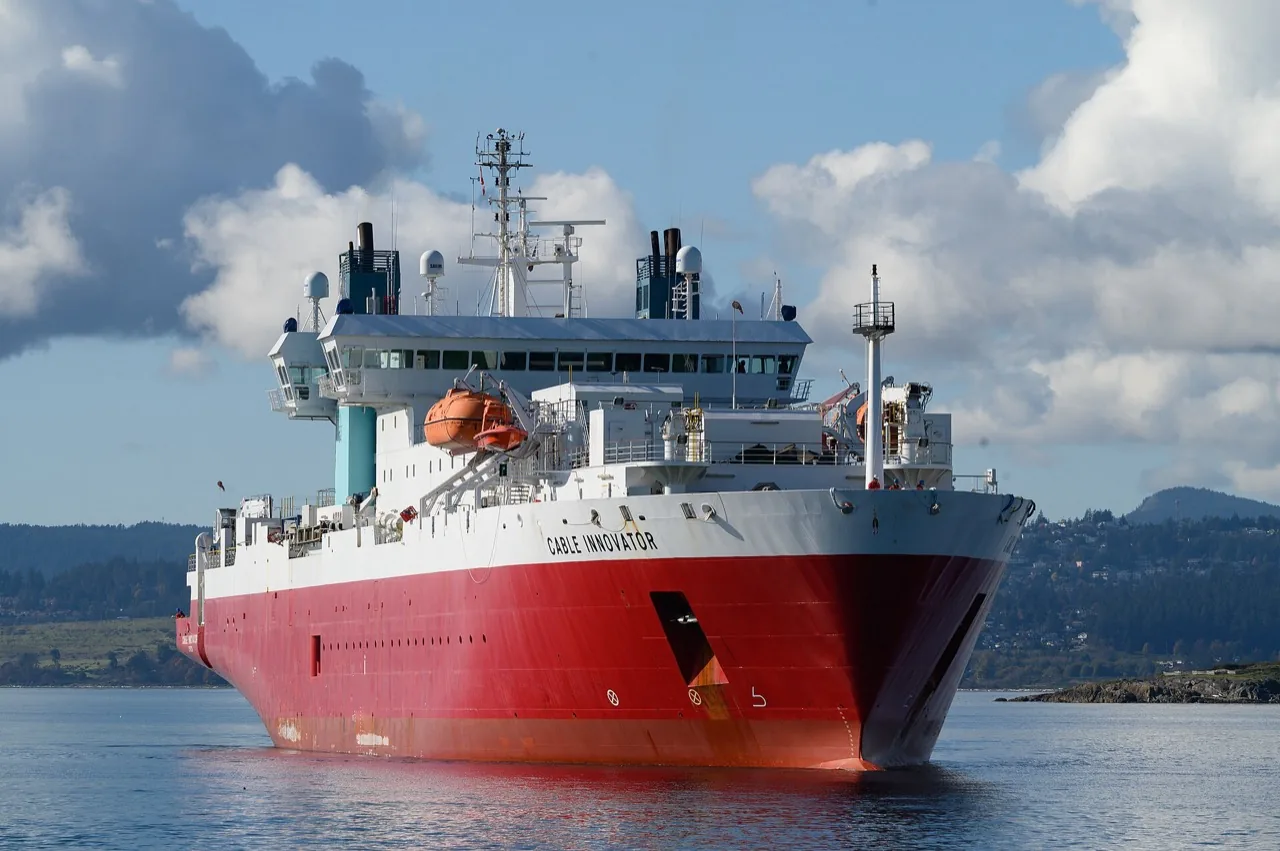
Undersea cables are fiber-optic lines that sit on the ocean floor and carry about 97% of the world's intercontinental internet data. Satellites handle only a small fraction. As of 2026, roughly 600 cable systems are in service, covering more than a million kilometers of seabed and connecting every continent except Antarctica. In deep water, the cables are only about as thick as a human thumb. Nearly every email, video call, financial transaction, and web search that crosses an ocean passes through one. The cables are hard to protect, easy to damage, and concentrated on a few routes where a single break can disrupt service for millions of people.
How undersea cables connected the world
The first person to connect Europe and North America by cable was Cyrus Field, a New York paper merchant who had retired wealthy at 33 and then spent twelve years and much of his fortune trying to wire the Atlantic. In August 1858, his team laid a telegraph cable from Ireland to Newfoundland. Queen Victoria sent a congratulatory message to President James Buchanan, and American cities held parades. The cable failed within weeks. Field kept going, and in 1866 the steamship Great Eastern laid a permanent line across the Atlantic.
Britain owned the majority of the world's submarine cables after that, and turned them into a strategic advantage. Within hours of declaring war on Germany on August 4, 1914, the British cable ship Alert cut all five of Germany's transatlantic cables in the English Channel. Germany was forced to send its overseas messages by radio or through cables that ran through British-controlled territory. British codebreakers could now read German diplomatic traffic. Two and a half years later, that access produced one of the war's turning points: British intelligence intercepted the Zimmermann Telegram, in which Germany offered Mexico an alliance against the United States. The telegram helped push America into the war.
Who owns undersea cables today?
From the 1950s on, undersea cables were built by groups of telephone carriers that shared the cost and the capacity. That changed in the 2010s. Google, Meta, Amazon, and Microsoft move such large volumes of their own traffic for cloud computing, video, search, and AI training that renting capacity on shared cables stopped making sense. As of 2026, Google holds stakes in 37 cable systems and Meta in 21, with Microsoft and Amazon in about ten more between them. Together, content companies like these four use about three-quarters of the world's international bandwidth and at least 80% of transatlantic capacity. Spending on new cables is expected to reach about $13 billion between 2025 and 2027, nearly double the previous three years, driven largely by demand from AI data centers.
Where do undersea cables come ashore?
Data does not flow evenly across the world's oceans. The great majority of traffic between Europe and Asia takes a single path, through the Red Sea corridor and into Egypt, where several cables land at stations only a few kilometers apart. That concentration makes the corridor a single point of failure. In February 2024, the cargo ship Rubymar, hit by Houthi missiles, drifted in the Red Sea and dragged its anchor across the seabed, cutting three telecommunications cables. Repairs took months because of the fighting in the area and a dispute over repair permits.
Why are undersea cables being cut?
Between 150 and 200 cable faults happen worldwide every year, and about 86% result from fishing nets, trawls, and ship anchors. But a pattern of damage in the Baltic Sea since 2023 has looked deliberate.
In October 2023, the Chinese-owned container ship NewNew Polar Bear dragged its anchor along the Baltic seabed, damaging the Balticconnector gas pipeline and two telecommunications cables linking Estonia to Finland and Sweden. China acknowledged responsibility but called it a storm-related accident. In November 2024, two more cables were severed less than 24 hours apart, a Finland-to-Germany line and a Lithuania-to-Sweden line. On Christmas Day 2024, the oil tanker Eagle S dragged its anchor for dozens of kilometers along the Baltic seabed. The Eagle S belongs to Russia's shadow fleet, the unofficial group of aging tankers that move sanctioned Russian oil. Its anchor severed the Estlink 2 power link and four telecommunications cables connecting Finland to Estonia and Germany. Finnish special forces boarded and seized the tanker, the first time Finland had taken a foreign vessel since World War II. In January 2025, another cable, between Latvia and Sweden, was damaged.
NATO responded by launching Baltic Sentry in January 2025, deploying warships, surveillance planes, and naval drones to watch the seabed routes. But protecting cables is difficult. Only about 60 specialized cable-repair ships exist worldwide, and many are nearing retirement age. Fixing a break means sending one of those ships to the fault, hauling the cable up, splicing it, and laying it back down, a process that can take weeks.
International law has banned damaging submarine cables since 1884, and the UN Convention on the Law of the Sea carries the same prohibition. Enforcement, though, is weak. On the open ocean, only the country whose flag a ship flies has the authority to prosecute, and flags of convenience are sold by registries with no interest in investigating. Even when a government wants to act, showing that a crew destroyed a cable on purpose is almost impossible. An anchor dragged along the seabed looks the same whether the act was deliberate or incompetent. That gap between the written rule and its enforcement is what makes cable sabotage useful. It is cheap, it does real economic damage, it is extremely difficult to trace to a government, and it stays below the line that would start a war.